

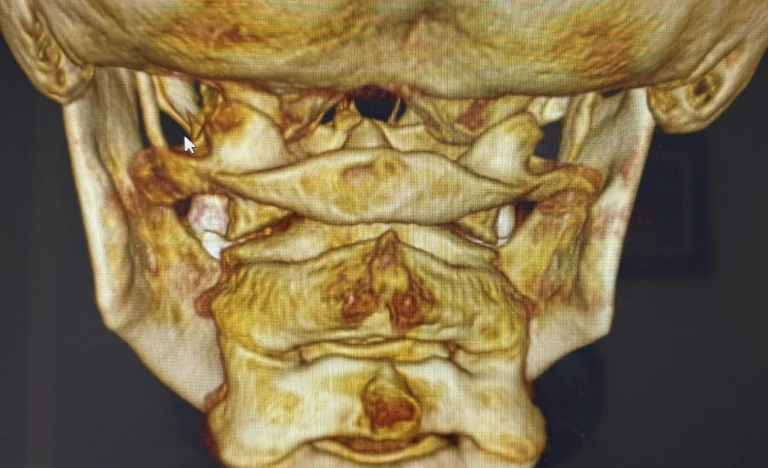
Chiari Malformation Relief and Treatment Sarasota and Lakewood Ranch
If you or a loved one has been diagnosed with Chiari malformation, you know how complex and frustrating the condition can be.
Schedule Your Appointment
Schedule appointmentMany patients in Sarasota and Lakewood Ranch undergo decompression surgery hoping for relief — yet still struggle with lingering symptoms like:
Head pressure
Occipital headaches
Dizziness
Brain fog
Neck pain
Balance problems
Arm tingling
Autonomic dysfunction
While surgery may address structural crowding at the foramen magnum, it does not always address biomechanical stress coming from the upper cervical spine.
That’s where upper cervical chiropractic may play a supportive role — especially in post-surgical cases.
Understanding Chiari Malformation and the Brainstem
Chiari malformation (Type I) involves downward displacement of cerebellar tissue — specifically portions of the cerebellum — through the foramen magnum (the opening at the base of the skull).
schedul e a FREE consultation
Here is a google review on our sarasota upper cervical google review page from a post surgical chiari malformation case that had amazing results:
NIcole Freeman google review
:For the past five years, I’ve been suffering from a range of difficult and overwhelming symptoms. From Severe neck pain, tinnitus, constant pressure in my head, headaches at the base of my skull, and muscle tension that radiated through my shoulders and upper body.
Eventually, I was diagnosed with Chiari malformation and decided to undergo decompression surgery, believing it was the only option that might help. But even after the surgery, I continued to experience many of the same symptoms. Looking back now, I wish I had more knowledge about what was truly going on with my body before going through with such a major procedure.
After years of researching on my own and trying to get to the root cause of my issues, I stumbled across a video of Dr. Drew Hall on TikTok. I flew out to Sarasota Florida to see him, and I can honestly say the results have been life changing. Immediately after the adjustment I felt instant relief.
I truly wish I had found this place sooner. If you’re out there struggling with unexplained symptoms and if you are considering surgery, take the time to explore options because the right kind of care might make all the difference.
Without you, Dr. Drew Hall, I would still be stuck in the same cycle of pain and confusion.
Thank you so deeply for giving me my life back."
Related article
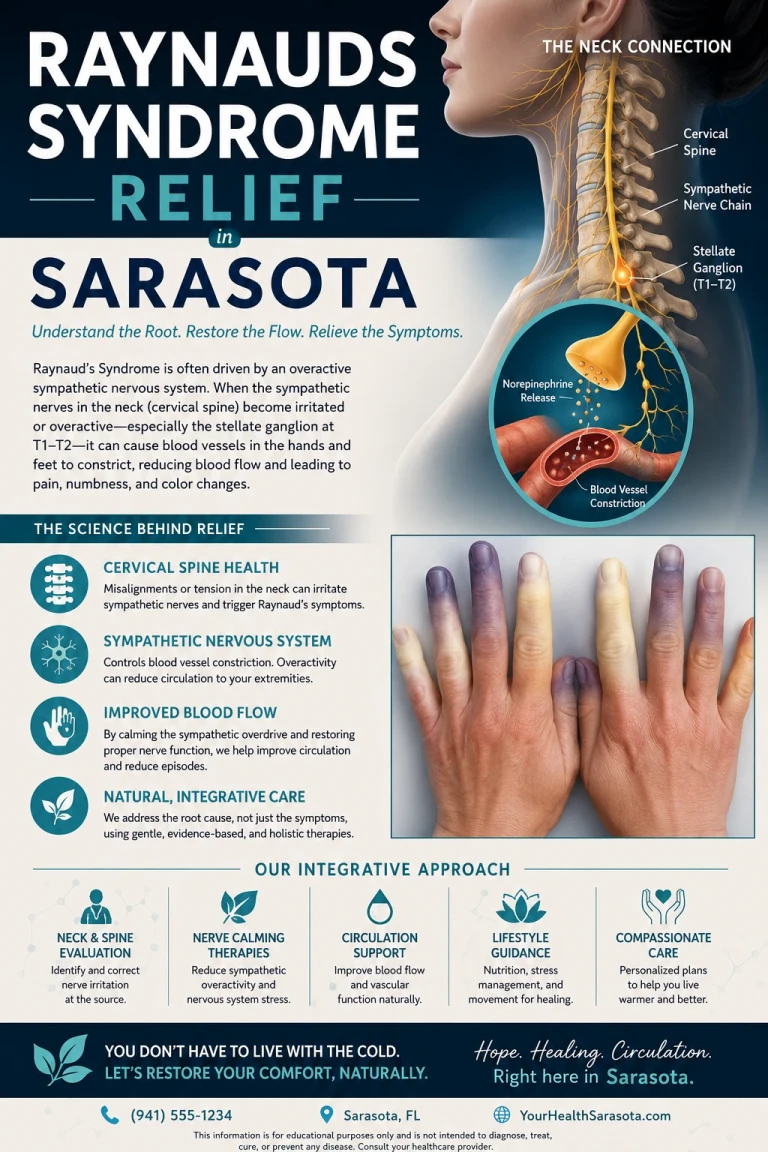
Why Do My Hands Always Get Cold and Then Hot? | Raynaud's Relief and Doctor in Sarasota
May 12, 2026
The cerebellum contains a white matter structure called the arbor vitae, which plays a role in coordination and communication within the cerebellum.
When cerebellar tissue extends downward, it can:
Compress the brainstem
Disrupt CSF (cerebrospinal fluid) flow
Create pressure-related headaches
Affect balance centers
Influence autonomic nervous system function
Even after decompression surgery, patients may continue to experience symptoms if mechanical stress persists in the upper neck.
The Upper Cervical Spine and Tensile Cord Stress
The upper cervical spine (C1 and C2) sits directly beneath the skull and supports the brainstem.
When misalignment occurs, it can contribute to:
Straightening or loss of normal cervical curvature
Increased dural tension
Mechanical stress along the spinal cord
Altered cerebrospinal fluid dynamics
In some biomechanical models, excessive cervical straightening may increase tensile stress on the spinal cord and surrounding tissues.
This tension may theoretically contribute to downward traction forces that influence cerebellar positioning near the foramen magnum.
While Chiari malformation itself is a structural neurological condition diagnosed via MRI, secondary mechanical stress from upper cervical misalignment may aggravate symptoms.
This is especially relevant in post-surgical patients whose structural decompression was successful, but who still experience:
Occipital pressure
Neck stiffness
Headaches with coughing or straining
Dizziness
Brain fog
👉 If you have had Chiari surgery and still struggle with symptoms, schedul e a FREE consultationto determine whether upper cervical stress is contributing.
How Upper Cervical Misalignment May Affect the Brainstem
The brainstem controls:
Balance and coordination
Heart rate and breathing
Swallowing
Pain modulation
Autonomic nervous system function
Mechanical irritation or abnormal tension in this region can influence symptom patterns.
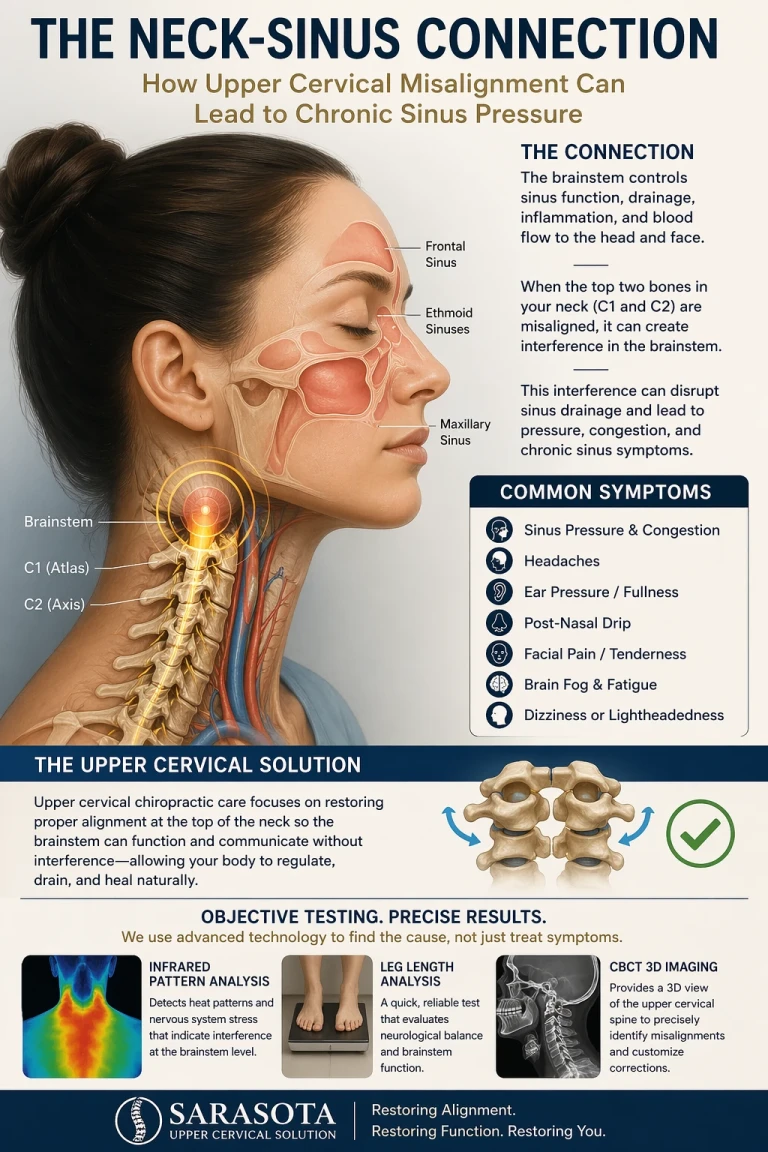
Upper cervical misalignment may:
Distort joint proprioceptive input
Increase asymmetrical muscle tone
Influence dural tension
Contribute to abnormal CSF flow dynamics
Correcting misalignment does not “treat Chiari” — but it may reduce secondary mechanical stress affecting the brainstem and surrounding structures.
Testing and Evaluation
A careful, conservative approach is critical — especially in post-surgical cases.
Evaluation may include:
Detailed health history
Neurological screening
Postural analysis
Leg length assessment
Thermographic scanning
Review of prior MRI studies
When appropriate, advanced imaging is used.
The Role of 3D CBCT Imaging
We utilize 3D Cone Beam CT (CBCT) imaging to evaluate:
Atlas alignment
Rotational displacement
Lateral and angular deviation
Structural relationship of C1 to the skull
This allows us to determine the exact direction and degree of misalignment.
Precision matters.
Especially in patients with complex neurological conditions.
No Yanking. No Twisting. No Pulling.
Patients with Chiari malformation often fear chiropractic care due to concerns about neck manipulation.
Upper cervical chiropractic is different.
There is:
No forceful twisting
No aggressive cracking
No yanking or traction pulling
No high-force rotational adjustments
Corrections are:
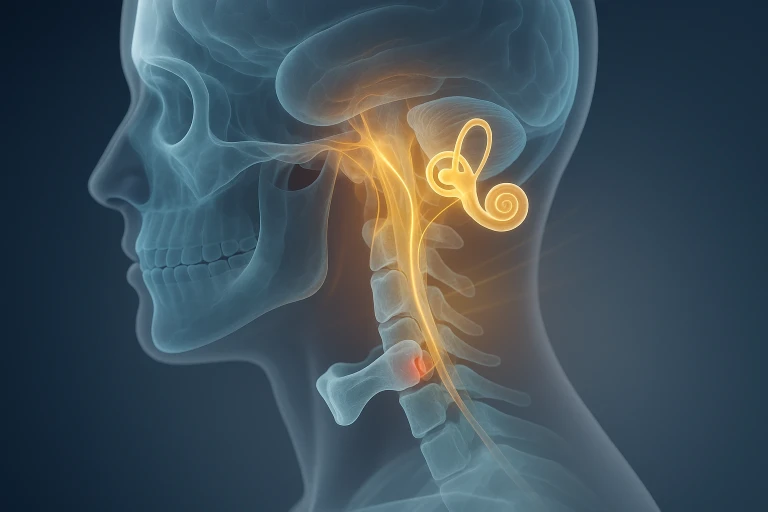
Gentle
Specific
Based entirely on imaging
Designed to restore alignment with minimal force
The goal is to reduce mechanical stress — not increase it.
Post-Surgical Support in Sarasota and Lakewood Ranch
If you live in Sarasota or Lakewood Ranch and continue to experience symptoms after Chiari decompression surgery, a biomechanical evaluation of the upper cervical spine may be an important step.
Upper cervical care does not replace neurosurgical management.
It is a conservative, supportive approach that focuses on:
Structural balance
Nervous system regulation
Reducing mechanical irritation
👉 Schedule a FREE consultation today to determine whether upper cervical misalignment may be contributing to your ongoing symptoms.
A Conservative, Neurologically-Focused Approach
Chiari malformation is complex.
Every case is different.
But one thing remains consistent:
The brainstem and upper cervical spine are intimately connected.
When the alignment at the top of the spine is restored, it may reduce secondary stress on the nervous system and support overall neurological function.
If you are searching for Chiari malformation relief and treatment in Sarasota or Lakewood Ranch, consider exploring whether upper cervical misalignment is part of your picture.
👉 Book your FREE consultation today and learn whether precision-based upper cervical care could support your recovery journey.
Your brain and spine function together.
Let’s make sure the foundation beneath your brainstem is stable, balanced, and aligned.

Leave a comment