

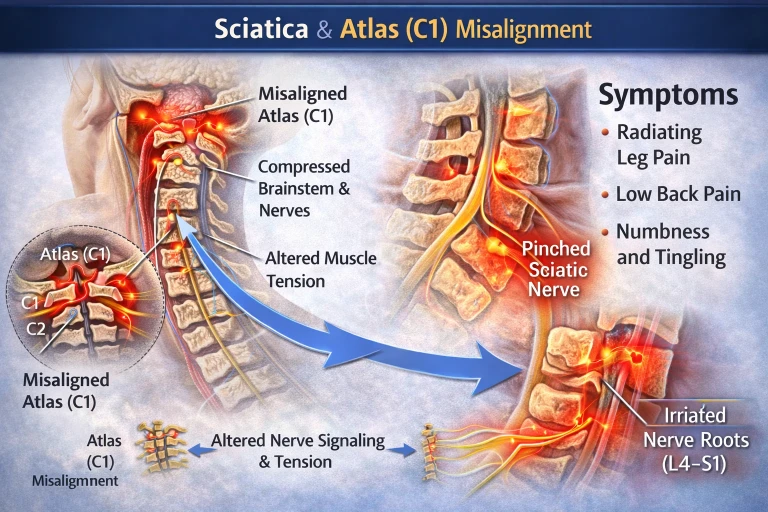
If you’re experiencing sharp, shooting pain down your leg… numbness in your foot… burning in your hip… or that constant pulling sensation from your lower back into your thigh — you may be dealing with sciatica.
And if you’re searching for sciatica treatment in Sarasota, Bradenton, or Lakewood Ranch, you’re likely tired of temporary fixes.
Schedule Your Appointment
Schedule appointmentStretching.
Steroids.
Pain medication.
Massage.
Epidural injections.
But here’s the question most people never ask:
Why did the nerve become irritated in the first place?
👉 Call 941-259-1891 to schedule your FREE consultation
Or click here to schedule online.
True healing begins by understanding the cause.
What Is Sciatica?
Sciatica isn’t a diagnosis — it’s a symptom.
It refers to irritation of the sciatic nerve, which runs from your lower back through the hip and down the leg.
Common symptoms include:
• Shooting leg pain
• Burning sensation
• Tingling or numbness
• Hip tightness
• Weakness in the leg
• Pain that worsens sitting
Two of the most common causes are:
Disc issues (bulging or herniated discs)
Piriformis syndrome
Let’s break them down.
Disc Issues and Sciatica
Between each vertebra in your spine is a disc — a cushion that absorbs shock and allows movement.
When trauma occurs — such as:
• Car accidents
• Slip and falls
• Sports injuries
• Heavy lifting
• Repetitive bending
The disc can become injured.
This may lead to:
• Bulging
• Herniation
• Inflammation
• Nerve root irritation
When the lumbar nerve roots are compressed or inflamed, sciatic symptoms can develop.
Related article
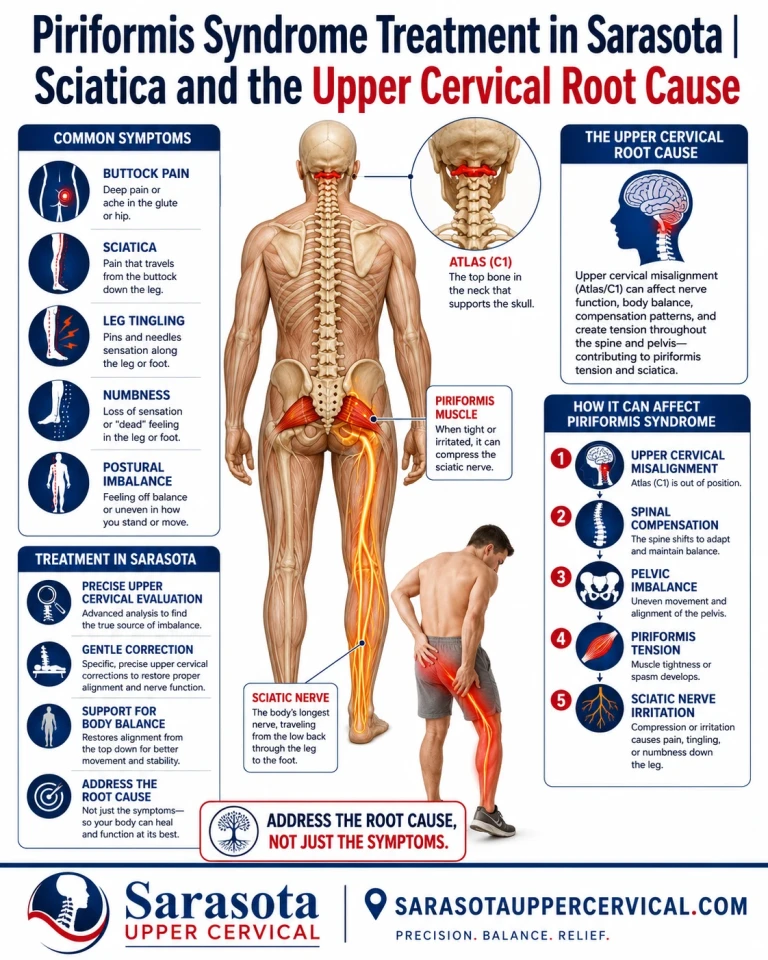
Piriformis Syndrome Treatment in Sarasota | Sciatica and the Upper Cervical Root Cause
Aug 13, 2026But here’s something many patients don’t realize:
The lower spine doesn’t function independently.
It compensates for what’s happening above.
Piriformis Syndrome Explained
The piriformis muscle is located deep in the hip.
It helps rotate the leg outward and stabilize the pelvis.
The sciatic nerve runs either underneath or through this muscle.
When the piriformis becomes tight or spastic, it can compress the sciatic nerve — creating symptoms similar to a disc problem.
But muscles don’t tighten randomly.
Muscle spasm is often a response to instability somewhere else in the system.
That brings us to the upper cervical spine.
How the Upper Neck Influences the Lower Back
The upper cervical spine (C1 and C2) sits directly beneath the skull and houses a dense concentration of neurological receptors.
When misalignment occurs at the top of the spine, it can:
• Distort proprioceptive input
• Create asymmetrical muscle tone
• Shift pelvic balance
• Alter posture
• Increase spinal compensation patterns
The body works as one integrated system.
If the head shifts off center due to upper cervical misalignment, the spine compensates below.
That compensation can:
• Increase stress on lumbar discs
• Create pelvic rotation
• Trigger piriformis spasm
• Increase sciatic nerve irritation
You may treat the lower back repeatedly — but if the compensation pattern remains, the problem returns.
Trauma and Joint Capsule Injury
Most misalignments begin with trauma.
Related article
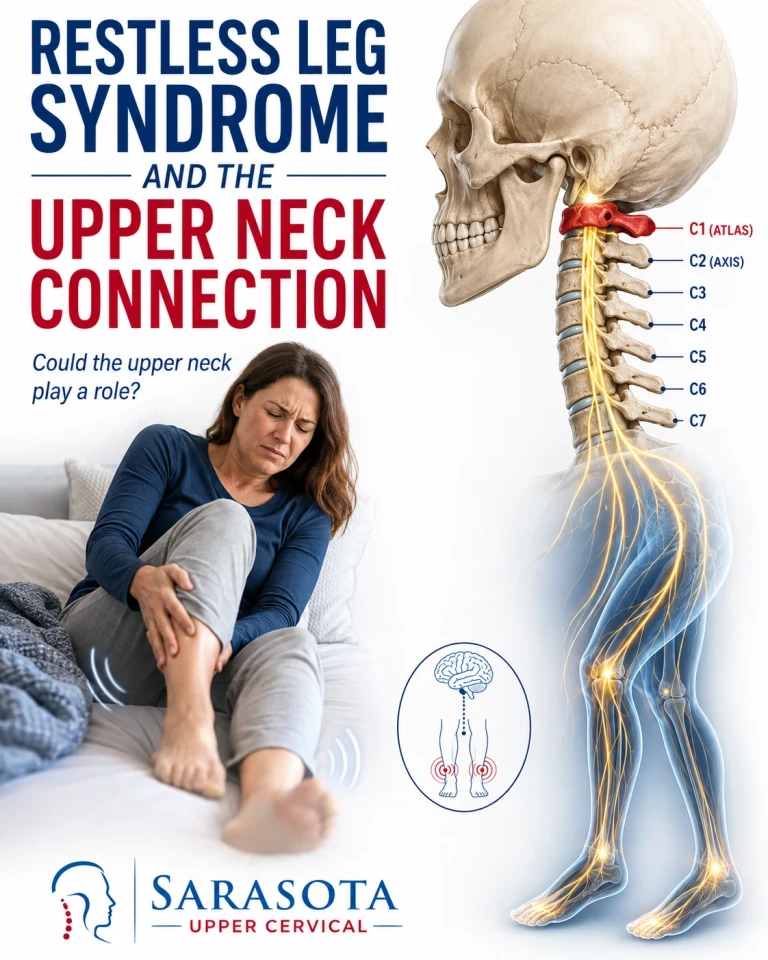
Restless leg syndrome and the upper cervical connection | Restless leg syndrome treatment Sarasota
Aug 31, 2026Even minor trauma can injure the joint capsule at C1 or C2.
When that capsule is injured:
• Inflammation occurs
• Motion becomes restricted
• Instability develops
• Muscles tighten protectively
Over time, the nervous system adapts to this imbalance.
The lower spine and pelvis shift to compensate.
Sciatica can become the downstream effect of an upstream problem.
👉 Call 941-259-1891 to schedule your FREE consultation
Or click here to schedule online.
Precision Matters: 3D CBCT Imaging
Every person’s misalignment pattern is unique.
That’s why we use advanced 3D Cone Beam CT (CBCT) imaging to measure:
• Exact rotational displacement
• Lateral deviation
• Angular misalignment
• Structural asymmetry
Without imaging, adjustments are generalized.
With CBCT imaging, we can custom tailor the correction to your exact anatomical pattern.
Precision is especially important when working near the brainstem and central nervous system.
No Twisting. No Cracking. No Pulling.
Many patients are hesitant about chiropractic due to fear of aggressive manipulation.
Upper cervical chiropractic is different.
There is:
• No forceful twisting
• No aggressive cracking
• No yanking or pulling of the neck
Adjustments are:
• Gentle
• Specific
• Minimal force
• Measured
The goal is to restore alignment and allow the body to stabilize naturally.
When and When Not to Adjust
We do not adjust on every visit.
We use objective testing to determine necessity.
Related article

Upper Cervical Chiropractor Sarasota, Bradenton, Venice and Tampa Bay Area
Nov 15, 2021These include:
Leg Length Analysis
Neurological imbalance can create subtle changes in leg length patterns.
Infrared Thermography
Thermal scanning detects heat differences along the spine, indicating nervous system irritation.
These tools help determine:
• If misalignment is present
• If correction is holding
• If adjustment is necessary
• When the body is stable
Adjustments are based on data — not routine.
True Healing vs Symptom Management
Most sciatica treatments focus on:
• Reducing inflammation
• Relaxing muscles
• Masking pain
• Injecting steroids
While these may provide temporary relief, they do not correct compensation patterns.
True healing focuses on:
• Restoring structural balance
• Reducing neurological interference
• Stabilizing the system
• Allowing soft tissue to heal
When alignment improves:
• Muscle spasm decreases
• Disc stress reduces
• Pelvic balance improves
• Nerve irritation may calm
Is Upper Cervical Care Right for You?
Consider evaluation if:
• Your sciatica keeps returning
• You’ve had past neck trauma
• You have chronic neck stiffness
• You feel uneven posture
• You’ve treated the lower back repeatedly with limited success
Your spine functions as a chain.
If the top link is unstable, the bottom links compensate.
Sciatica Treatment in Sarasota, Bradenton & Lakewood Ranch
If you are ready to investigate the root cause of your sciatica rather than chasing symptoms, upper cervical chiropractic may be the missing piece.
We focus on:
• Precision 3D imaging
• Gentle correction
• Objective testing
• Stabilizing the nervous system
• Long-term structural healing
👉 Call 941-259-1891 to schedule your FREE consultation
Or click here to schedule online.
Your sciatic nerve is not randomly irritated.
Let’s evaluate the entire system — starting at the top — and restore balance where it matters most.


Leave a comment