

Dysautonomia and POTS Treatment in Sarasota, Bradenton, and Lakewood Ranch
If you’re living with dysautonomia or Postural Orthostatic Tachycardia Syndrome (POTS), you know how disruptive it can be.
Schedule Your Appointment
Schedule appointmentRapid heart rate when standing.
Lightheadedness.
Fatigue.
Brain fog.
Temperature regulation issues.
Digestive problems.
Anxiety-like symptoms.
Many patients in Sarasota, Bradenton, and Lakewood Ranch are told to increase salt intake, hydrate more, wear compression garments, or take medication to manage symptoms.
While those strategies can help, they often don’t address one key structure:
The brainstem.
And the structure directly beneath it:
The upper cervical spine. Injury to the neck causes the postural muscles to engage and and this straightens the normal c shaped curve to straight, called straight neck syndrome. This stresses the central nervous system and impacts the brainstem to function normally.
👉 If you’re struggling with POTS or dysautonomia, schedule a FREE consultation to see whether upper cervical misalignment may be contributing to your symptoms.
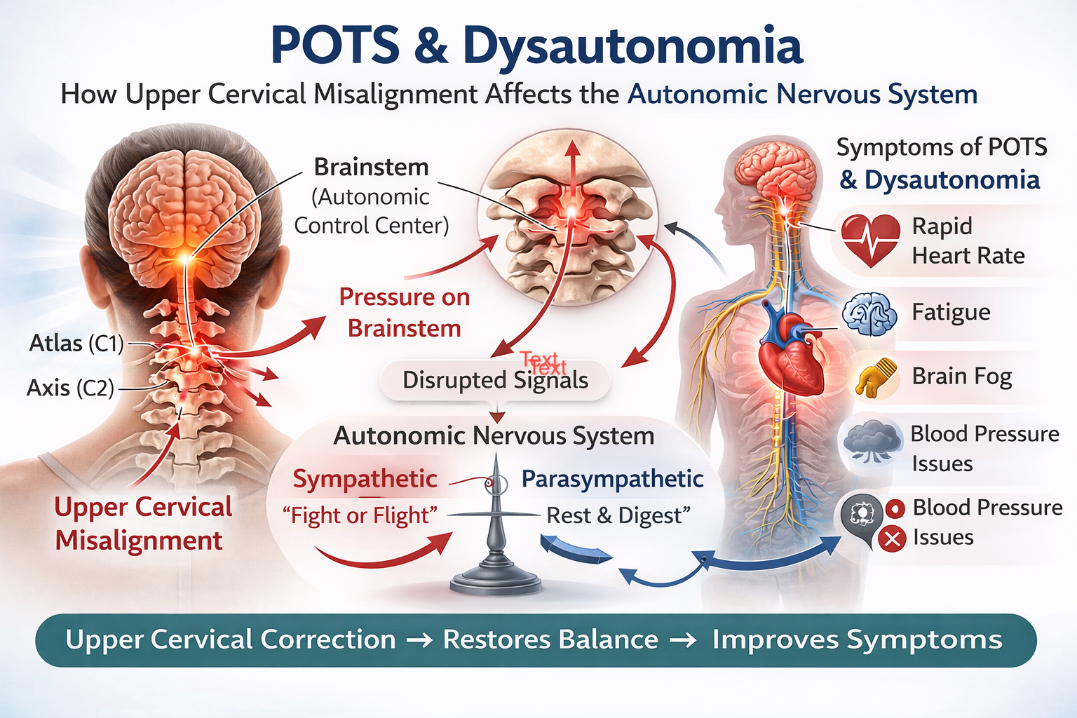
The Brainstem: Command Center of the Autonomic Nervous System
The autonomic nervous system controls:
Heart rate
Blood pressure
Digestion
Temperature regulation
Pupil response
Breathing patterns
Much of this regulation occurs in the brainstem.
The brainstem houses nuclei that coordinate sympathetic (“fight or flight”) and parasympathetic (“rest and digest”) balance.
In POTS and dysautonomia, this system becomes unstable.
Instead of smooth regulation, patients experience:
Exaggerated heart rate increases
Poor blood vessel tone control
Inconsistent blood pressure
Dysregulated vagal tone
The question becomes:
What is irritating or destabilizing brainstem function?

How Upper Cervical Misalignment May Influence Dysautonomia
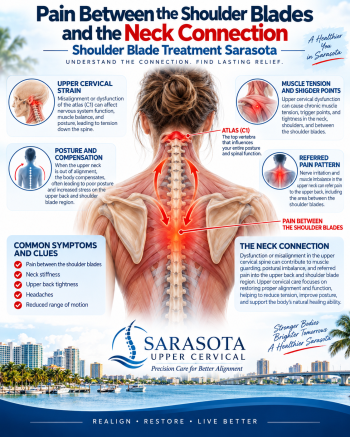
The top two bones of the spine,the atlas (C1) and axis (C2), sit directly beneath the skull and support the brainstem.
When the upper cervical spine is misaligned, it may contribute to:
Mechanical stress on the brainstem
Altered proprioceptive signaling
Increased dural tension
Asymmetrical muscle tone
Irritation of surrounding neurological structures
This mechanical stress may disrupt autonomic balance.
The result can include:
Rapid heart rate upon standing
Lightheadedness
Chronic fatigue
Brain fog
Digestive irregularities
While upper cervical care does not “cure” POTS, reducing mechanical stress on the brainstem may help support more stable autonomic regulation.
👉 If you suspect your symptoms may be neurologically driven, schedule your FREE consultation today.
Why the Neck Matters in POTS
The upper cervical spine has one of the highest concentrations of proprioceptive nerve receptors in the body.
These receptors constantly send information to the brainstem about head position and movement.
If this input is distorted due to misalignment, the brainstem may receive conflicting signals.
For someone with autonomic instability, even small mechanical irritations may contribute to exaggerated responses.
In some patients, POTS symptoms begin after:
Concussions
Car accidents
Whiplash injuries
Falls
Viral illness combined with neck trauma
Evaluating the upper cervical spine becomes especially important in these cases.
Upper Cervical vs. Regular Full-Spine Chiropractic
Not all chiropractic care is the same.
Traditional full-spine chiropractic often involves:
General spinal manipulation
Repetitive adjustments
Twisting or cracking
Adjusting multiple segments per visit
Upper cervical care is different.
It focuses exclusively on:
C1 and C2 alignment
Precise imaging analysis
Gentle, specific corrections
Minimal force
Rather than adjusting the entire spine repeatedly, upper cervical chiropractic aims to correct the primary misalignment at the top, allowing the rest of the spine and nervous system to stabilize naturally.
Precision is critical, especially in neurologically sensitive conditions like dysautonomia.
The Role of 3D CBCT Imaging
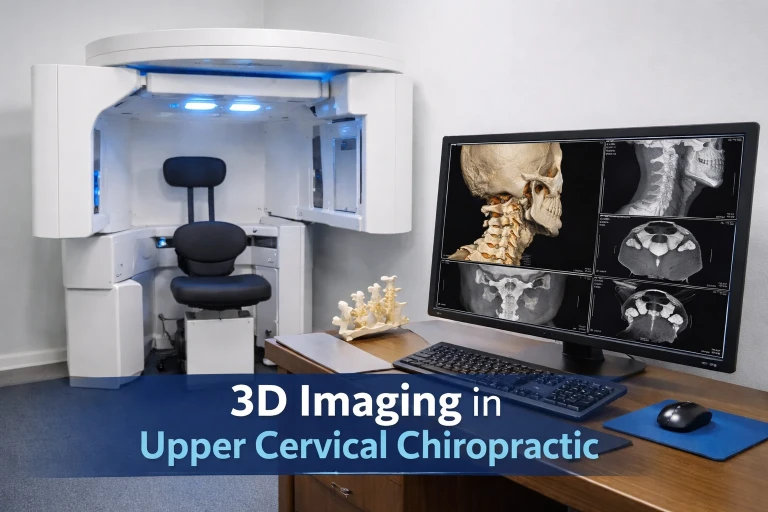
One of the most important differences in upper cervical care is the use of advanced 3D Cone Beam CT (CBCT) imaging.
CBCT allows us to:
Measure the exact direction of misalignment
Identify rotational displacement
Assess lateral and angular deviation
Determine the precise correction vector
Every patient’s misalignment pattern is unique.
Without 3D imaging, adjustments are generalized.
With CBCT imaging, the correction is custom-tailored to your specific anatomy.
In conditions like POTS and dysautonomia, where small changes in neurological input can influence symptoms, precision is crucial.
👉 Schedule your FREE consultation to determine whether advanced imaging is appropriate for your case.
No Twisting. No Aggressive Cracking.
Many dysautonomia patients are sensitive to stimulation and sudden movements.
Upper cervical adjustments are:
Related article
The Role of 3D Imaging in Upper Cervical Chiropractic in Sarasota, Florida
Apr 16, 2026Gentle
Specific
Low-force
Based on measured data
There is:
No aggressive twisting
No forceful cracking
No repetitive high-velocity adjustments
The goal is to reduce neurological stress — not add to it.
Could Upper Cervical Misalignment Be Contributing to Your POTS?
You may want to consider an upper cervical evaluation if:
Your POTS symptoms began after neck trauma
You experience chronic neck tightness
You feel pressure at the base of the skull
You have dizziness along with heart rate instability
Your symptoms fluctuate with posture
While dysautonomia is complex and often multi-factorial, evaluating the structural relationship between the spine and brainstem is an important piece that is frequently overlooked.
A Supportive Approach for Sarasota, Bradenton, and Lakewood Ranch
If you’re searching for dysautonomia and POTS treatment in Sarasota, Bradenton, or Lakewood Ranch, consider exploring whether upper cervical misalignment may be influencing your autonomic nervous system.
Upper cervical care is not a replacement for medical management.
It is a conservative, structural approach focused on:
Brainstem support
Nervous system balance
Precision alignment
Reducing mechanical stress
👉 Take the first step. Schedule your FREE consultation today and find out whether upper cervical chiropractic may support your recovery.
Your autonomic nervous system regulates nearly every function in your body.
Let’s make sure the foundation beneath your brainstem is stable, aligned, and functioning the way it was designed to.
Other Natural Therapies that may be beneficial
Iv vitamin therapy can help calm inlfamation and promote healing. To find an Iv therapy center near you click here.
To read about iv vitamin thearpy and how it can halep overall health click here.
Our office serves sarasota, Bradenton,Ruskin, Apollo Beach, Parish, Venice, Northport, Punta Gorda, Port Charlotte, Myaka City, and Arcadia.
Leave a comment