

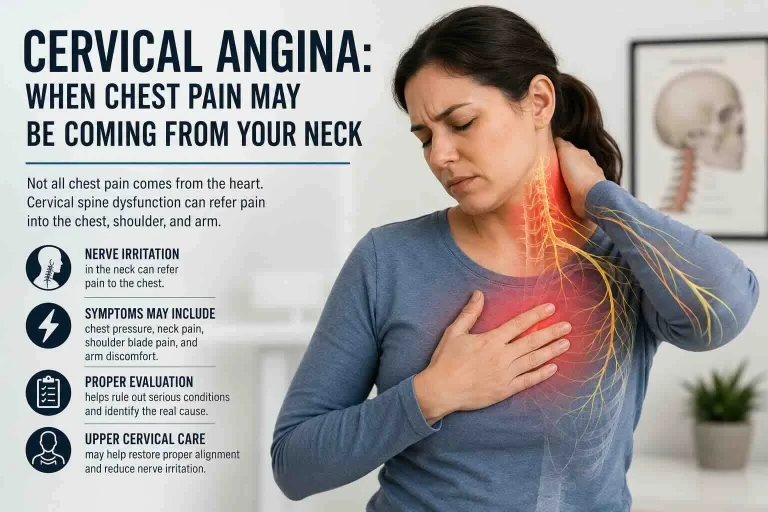
Chest pain gets your attention immediately—and it should.
Pressure, tightness, burning, or pain across the chest can signal a heart attack or another serious problem. New, severe, unexplained, or worsening chest pain requires immediate medical evaluation.
Schedule Your Appointment
Schedule appointmentCall 911, especially when it comes with shortness of breath, sweating, nausea, fainting, weakness, or discomfort spreading into the arm, back, neck, or jaw.
But what happens when the heart has been evaluated, the testing is reassuring, and the chest pain keeps returning?
For some patients, the missing piece may be in the cervical spine.
This condition is called cervical angina, or cervicogenic chest pain. It describes chest pain that resembles cardiac angina but originates from a neck disorder. Medical reviews describe it as an overlooked cause of noncardiac chest pain, often associated with cervical nerve-root irritation, disc degeneration, or spinal stenosis.
What Does Cervical Angina Feel Like?
Patients may describe:
- Pressure, aching, burning, squeezing, or sharp chest pain
- Neck stiffness or shoulder-blade pain
- Pain, tingling, numbness, or weakness in an arm or hand
- Headaches or pain at the base of the skull
- Symptoms that change with neck position or arm movement
Some people also report dizziness, nausea, sweating, or shortness of breath. Those symptoms require medical attention because they can occur with cardiovascular emergencies.
A clue appears when chest pain changes with neck movement, prolonged posture, lifting, or use of one arm. Another is a history of whiplash, concussion, a fall, a sports injury, cervical disc problems, or forward-head posture.
These clues do not prove the pain comes from the neck. Urgent causes must be ruled out first.
How Can the Neck Refer Pain Into the Chest?

The lower cervical nerve roots help supply the shoulder, arm, and upper chest. When a cervical disc, joint, or surrounding tissue irritates these nerves, the brain may interpret part of that signal as chest pain.
The pain does not always stay at the point of irritation.
It can spread into the shoulder blade.
It can move down the arm.
And it can be felt across the front of the chest.
Reviews report that cervical angina is commonly associated with lower-cervical nerve-root compression. Other proposed mechanisms include referred pain from cervical discs or joints, spinal-cord pathways, and sympathetic nervous-system irritation.
Where Does the Upper Cervical Spine Fit?
Cervical angina is usually discussed as a lower-cervical problem. Upper cervical chiropractic does not claim that every case begins at C1 or C2, and it does not replace cardiac, neurological, or orthopedic evaluation.
The upper neck may still influence the larger mechanical picture.
The atlas and axis sit beneath the skull and help control head position. When this region loses normal motion after trauma, the body may compensate through the rest of the neck and shoulders. The head shifts. Muscles tighten. Lower cervical segments may absorb more stress.
Research has established connections among cervical proprioception, head position, neck pain, balance, and postural control. Applying that research specifically to cervical angina remains a clinical hypothesis rather than proof that an upper-cervical problem causes the condition.
The useful question is not:

“Can an adjustment treat chest pain?”
It is:
“After dangerous causes have been ruled out, is a cervical mechanical problem contributing to the symptoms?”
Signs That Support a Cervical Evaluation
A cervical source becomes more plausible when:
- Cardiac and pulmonary causes have been appropriately evaluated
- Chest pain occurs with neck, shoulder, or arm symptoms
- Neck movement reproduces the pain
- Symptoms began after trauma
- Prolonged computer work aggravates symptoms
- Examination identifies altered sensation, reflexes, or strength
- Cervical imaging matches the clinical pattern
No single clue makes the diagnosis. Cervical angina is considered only after urgent causes have been excluded and the history, examination, and imaging point toward the neck.
What an Upper Cervical Assessment Looks For
At Sarasota Upper Cervical, the purpose of an assessment would not be to diagnose heart disease or declare chest pain “just the neck.”
The first boundary is medical safety.
After medical clearance, an evaluation may review trauma history, posture, cervical motion, muscle guarding, shoulder imbalance, neurological findings, and objective indicators of upper cervical dysfunction.
Cone beam CT may be used as a structural measurement tool to examine the relationship among the skull, atlas, and axis. It does not diagnose cervical angina, cardiac disease, or lower-cervical nerve compression. Lower cervical disc or nerve-root problems may require evaluation by a physician and MRI or other testing.
How Is Cervical Angina Managed?
Treatment depends on the confirmed cause. Spine literature describes conservative care as the usual starting point for appropriately selected patients. Management may include activity modification, medication, physical therapy, posture rehabilitation, or cervical traction.

Significant nerve or spinal-cord compression, progressive weakness, or persistent symptoms may require a surgical consultation.
Upper cervical care may be one part of a coordinated conservative plan when objective findings show dysfunction at the top of the neck. The goal is not aggressive manipulation or repeated twisting, popping, or pulling. It is a precise, low-force correction intended to improve upper cervical mechanics and reduce one possible source of compensation.
Research has not established upper cervical chiropractic as a cure for cervical angina. Care should be coordinated with the professionals evaluating the heart, lungs, nerves, and cervical spine.
Questions and Answers
1. Can neck problems really cause chest pain?
Yes. Cervical angina is a recognized form of noncardiac chest pain associated with cervical spine disorders. Chest pain must still be treated as potentially cardiac until medical professionals determine otherwise.
2. How can I tell cervical angina from a heart attack?
You cannot safely make that distinction at home. Neck movement or arm symptoms may suggest a neck component, but they do not rule out a heart problem.
3. Can upper cervical chiropractic cure cervical angina?
No cure claim is supported. After medical clearance, care may address an objectively identified upper-neck problem contributing to broader cervical and postural stress.
When should I call 911?
Call 911 for new, severe, unexplained, or worsening chest pain, especially with shortness of breath, sweating, nausea, fainting, weakness, or pain spreading into the arm, back, neck, or jaw.
Cervical Angina Evaluation in Sarasota, Florida
If your cardiac evaluation was reassuring but you still experience recurring chest pain with neck stiffness, shoulder-blade pain, arm symptoms, or a history of head and neck trauma, the cervical spine deserves a careful look.
Sarasota Upper Cervical serves Sarasota, Bradenton, Lakewood Ranch, Venice, Englewood, and surrounding Florida Gulf Coast communities. A consultation can help determine whether an upper cervical assessment belongs in your broader care plan.
Call 941-259-1891 to request a consultation.
This article is for general educational purposes and is not medical advice. Upper cervical chiropractic does not diagnose or treat cardiac disease and is not a substitute for emergency or medical care. Individual results vary. All chest pain should be evaluated promptly by qualified healthcare professionals.
Leave a comment