

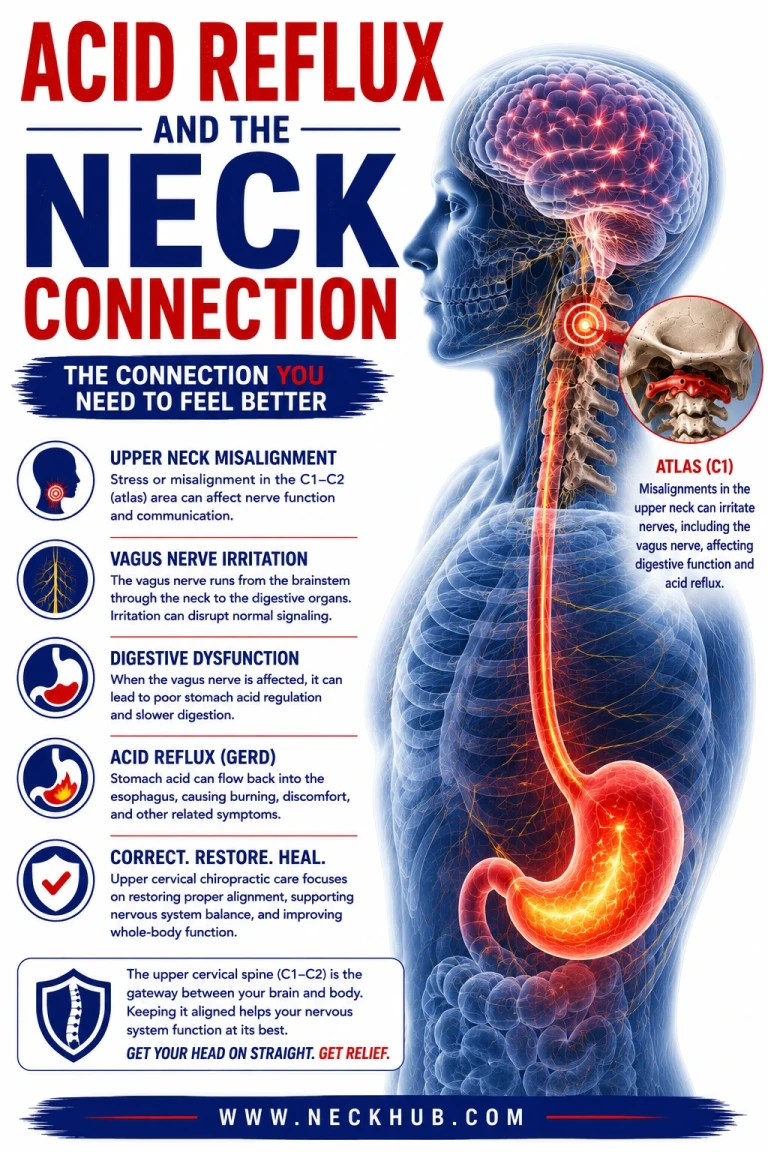
If you have been told that acid reflux is a problem with a valve at the bottom of your esophagus, that is true as far as it goes. What it leaves out is that the valve does not decide anything on its own. It opens and closes on instructions carried down the vagus nerve from the brainstem, and it very often relaxes at exactly the wrong moment because of a reflex loop that begins in the stomach, travels up to the medulla, and travels straight back down again. Reflux is a valve problem in roughly the same way that a flickering light is a bulb problem. Sometimes it is. Frequently the issue sits upstream, in the wiring.
That upstream wiring runs through the base of the skull and the very top of the neck. For patients across Sarasota who have spent years on acid suppression without ever getting a durable answer, that anatomy is worth understanding properly — along with an honest account of what it does and does not justify. This article gives you both, including the parts that cut against the usual chiropractic pitch.
Schedule Your Appointment
Schedule appointmentReflux is usually not a problem of too much acid
The most common misconception about gastroesophageal reflux disease is that it represents excessive acid production. In most patients, gastric acid secretion is entirely normal. What has gone wrong is the barrier.
The lower esophageal sphincter, or LES, is a ring of smooth muscle at the junction of the esophagus and stomach. It is reinforced from the outside by the crural portion of the diaphragm, so the antireflux barrier is really two structures working together — one smooth muscle under autonomic control, one skeletal muscle under partly voluntary control. When this barrier fails, stomach contents move upward.
The dominant way it fails is not a weak, permanently slack sphincter. It is a phenomenon called the transient lower esophageal sphincter relaxation, abbreviated TLESR. A TLESR is a relaxation of the sphincter that is not associated with swallowing, is typically triggered by stretch of the stomach wall after a meal, and lasts considerably longer than the brief relaxation that accompanies a normal swallow. TLESRs are the principal mechanism of reflux both in healthy people and in the majority of patients with reflux disease. Basal sphincter tone and hiatal hernia certainly matter, but the transient relaxation is the main event.
This matters enormously for the question of the neck, because a TLESR is not a mechanical failure. It is a neurological reflex. Something is telling the sphincter to open.
The vagus nerve is the wiring that runs the sphincter
The lower esophageal sphincter receives both sympathetic innervation, largely by way of the splanchnic nerves, and parasympathetic innervation from the vagus. The two are not equivalent partners. It is the vagal pathway that is essential for reflex relaxation of the sphincter, including the transient relaxations that produce reflux.
The circuit runs like this. Sensory fibers from the distal esophagus, the sphincter itself, and the stomach wall carry information up the vagus nerve, with their cell bodies in the nodose ganglion, and terminate in the nucleus tractus solitarius in the medulla. The motor limb originates in the dorsal motor nucleus of the vagus, which sends preganglionic fibers back down to synapse with the myenteric plexus in the wall of the gut. Together the nucleus tractus solitarius and the dorsal motor nucleus form the dorsal vagal complex, and it is within this small region of brainstem that the reflex is assembled. The final relaxation itself is produced by inhibitory enteric neurons releasing nitric oxide and vasoactive intestinal polypeptide.
The organization within the dorsal motor nucleus is remarkably specific. Preganglionic neurons are arranged viscerotopically, and stimulation of the caudal portion of the nucleus produces sphincter relaxation while stimulation of the more rostral portion produces contraction. In a ferret study published in the Journal of Physiology in 2002, microinjection into the caudal dorsal motor nucleus produced complete lower esophageal sphincter relaxation in twenty-eight of thirty-two attempts, and those responses were abolished by bilateral vagotomy or by ganglionic blockade with hexamethonium. That is about as direct as physiological evidence gets. Cut the vagus, and the relaxation stops happening.
So the sphincter that fails in reflux disease is, in a very literal sense, a vagally operated device.
Why "strengthen your vagus nerve to fix reflux" is the wrong frame
Here is where a great deal of online health content, including a great deal of chiropractic content, gets well ahead of the evidence. The claim usually runs that reflux is caused by low vagal tone, and that anything which raises vagal tone will therefore reduce reflux. That reasoning does not survive contact with the literature, and it is worth being blunt about why.
If transient sphincter relaxations are vagally mediated, then more vagal activity along that pathway is not automatically desirable. The pharmacological evidence points firmly in the opposite direction. Baclofen is a GABA-B receptor agonist that inhibits the vagovagal reflex arc at one or more points along its course. In a study of twenty healthy volunteers published in Gastroenterology in 2000, baclofen reduced reflux episodes by more than sixty percent and cut the rate of transient sphincter relaxations from roughly 5.7 to 2.2 per hour, while modestly raising basal sphincter pressure. The therapeutic benefit came from damping that vagal reflex, not from amplifying it.
The human autonomic data is also considerably messier than the slogan implies. Kuo and colleagues, publishing in Neurogastroenterology and Motility in 2013, measured cardiac vagal tone, sphincter pressure, gastric electrical activity and reflux simultaneously across a meal in ten healthy volunteers. Transient relaxations and reflux episodes both rose sharply after eating, while cardiac vagal tone fell — a relationship the authors themselves described as paradoxical, given that the transient relaxation is a vagally mediated event. That was a small study in healthy subjects using cardiac vagal tone as a proxy for what the gastric vagus is doing, so it settles nothing on its own. What it does show is that the tidy story of low vagal tone causing reflux is not supported by direct measurement.
The honest framing is therefore not more vagal activity. It is better-regulated vagal reflex behavior — a nervous system that triggers the relaxation reflex appropriately rather than inappropriately. That is a meaningfully different claim, and it is the only one the physiology supports.
Where impaired vagal function does appear to matter
None of the above means autonomic function is irrelevant to reflux. There is a real signal; it simply operates through different mechanisms than the popular version suggests.
A systematic review published in Diagnostics in 2023 examining heart rate variability across reflux disease and functional gastrointestinal disorders concluded that these conditions are associated with autonomic dysfunction characterized principally by suppressed parasympathetic and elevated sympathetic activity. That conclusion should be held loosely. Individual studies genuinely conflict, with some finding reduced high-frequency power in reflux patients and others finding the opposite, and heart rate variability measures cardiac vagal traffic rather than anything happening at the esophagus.
The more mechanistically plausible contributions of vagal function are indirect. Esophageal clearance depends on secondary peristalsis, which is vagally coordinated; if refluxed material is not cleared promptly, total acid exposure time rises even when the number of reflux events does not. Gastric accommodation and gastric emptying are likewise vagally controlled, and delayed emptying or impaired accommodation increases gastric distension — which is precisely the stimulus that triggers transient sphincter relaxations in the first place. Salivary flow and the esophago-salivary reflex contribute to neutralizing acid in the esophagus. Upper esophageal sphincter tone, also under brainstem control, governs how much refluxed material reaches the throat and airway, which is why reflux so often presents as hoarseness, throat clearing or chronic cough rather than heartburn.
In other words, the vagus is deeply involved in reflux, but it is involved on both sides of the ledger. This is a regulation problem, not a volume problem.
The neck connection: what is anatomically true
The brainstem nuclei running this entire reflex — the nucleus tractus solitarius and the dorsal motor nucleus of the vagus — sit in the medulla oblongata, which occupies the space at the craniocervical junction, immediately at and above the level of the foramen magnum and the ring of the atlas.
The vagus nerve then leaves the skull through the jugular foramen, sharing that opening with the glossopharyngeal and accessory nerves and the jugular bulb. Within the foramen it carries its superior ganglion, and just below the foramen it expands again into the larger nodose ganglion. It then descends through the neck inside the carotid sheath, positioned in the angle behind the internal carotid artery and the internal jugular vein.
Related article

MCAS and POTS: Mast Cells, Neurogenic Inflammation, and the Upper Cervical Connection | Sarasota
Jul 28, 2026Its immediate structural neighbor at that point is the atlas. The rectus capitis lateralis is the muscle most intimately related to the jugular foramen, running from the upper surface of the transverse process of the atlas to the jugular process of the occipital bone. Cadaveric work published in the Journal of Neurosurgery in 2017 and in World Neurosurgery in 2019 documents that this muscle lies directly posterior to the internal jugular vein and to cranial nerves nine through eleven as they emerge from the foramen, separated only by the carotid sheath.
The mechanical relationship between the atlas and the contents of that region is not merely theoretical. Dissection studies of the internal jugular vein found that in every specimen the posterior wall of the vein rested against the transverse process of the atlas as it descended below the jugular foramen; in roughly thirty-nine percent of cases the transverse process indented the vein wall, and in around eight percent the vein was severely kinked at that point. Head rotation, and to a lesser degree craniocervical extension, measurably changes that relationship.
Two further pieces of anatomy are relevant. The suboccipital muscles carry among the highest muscle spindle densities anywhere in the human body, making the upper cervical spine an unusually dense source of proprioceptive input. And upper cervical afferents converge onto brainstem nuclei, including the nucleus tractus solitarius, meaning that neck position and neck muscle tension are not neurologically sealed off from autonomic regulation.
Now the necessary honesty. What none of this establishes is that upper cervical misalignment compresses the vagus nerve and thereby causes acid reflux. The jugular vein findings concern a vein, not the nerve. There is no published study demonstrating measurable vagal conduction impairment resulting from atlas misalignment, and there is no controlled trial testing upper cervical correction as a treatment for reflux disease. Anatomical adjacency is a legitimate reason to investigate a relationship. It is not evidence that the relationship exists. Any practitioner who tells you with confidence that your reflux is caused by your atlas is asserting something the literature does not currently support, and you should treat that claim with appropriate skepticism regardless of who is making it.
What the manual therapy evidence actually shows
There is, however, direct evidence that the cervical spine and trunk can immediately alter esophageal sphincter pressures, and it is stronger than most people in this field realize.
Bitnar and colleagues, working at Charles University in Prague and publishing in the Journal of Manipulative and Physiological Therapeutics in 2021, used high-resolution manometry to measure sphincter pressures in fifty-four adults with diagnosed reflux disease during two manual interventions. Average resting lower esophageal sphincter pressure was 14.31 mmHg. During manual cervical traction it rose to 21.39 mmHg, and during a trunk stabilization maneuver it rose to 24.09 mmHg, both with p values below 0.001. Upper esophageal sphincter pressure, which began at an elevated resting average of 90.91 mmHg, fell to 42.13 mmHg during cervical traction. The authors framed this combined pattern — lowering an excessively tight upper sphincter while raising a weak lower one — as the desirable direction of change.
The limitations deserve equal billing. Those pressures were recorded during the maneuvers, not sustained afterward, and the study did not measure whether the effect persisted for minutes, hours or at all. No reflux symptom scores were collected, no pH monitoring was performed, and there was no follow-up period. Critically, manual cervical traction is a sustained longitudinal pull applied to the neck; it is not an upper cervical adjustment, and results from one cannot be transferred to the other. What this trial demonstrates is that cervical and trunk mechanics can modulate esophageal sphincter function in real time. What it does not demonstrate is that any manual intervention produces lasting symptom relief.
The diaphragm side of the barrier has better outcome evidence. Because the crural diaphragm is skeletal muscle and partly under voluntary control, it can be trained. In a randomized controlled trial published in the American Journal of Gastroenterology in 2021, Halland and colleagues at Mayo Clinic found that lower esophageal sphincter pressure rose substantially during the inspiratory phase of diaphragmatic breathing, from 23.1 to 42.2 mmHg, in patients with upright reflux. A 2023 systematic review in Dysphagia by Zdrhova and colleagues concluded that diaphragmatic breathing training has genuine potential in selected patients and that high-resolution manometry may help identify which patients those are. This remains a modest evidence base, largely in upright and non-erosive reflux, but it is the best-supported non-pharmacological intervention currently available.
It is worth noting that diaphragm function itself has a cervical dependency, though a lower one: the phrenic nerve arises from the third through fifth cervical nerve roots, not from the upper cervical segments. That is a mid-cervical relationship rather than an atlas relationship, and it should not be quietly folded into an upper cervical argument.
What the chiropractic literature can and cannot establish
Published chiropractic evidence on reflux consists almost entirely of case reports. A case study in Clinics and Practice in 2021 described a thirty-five-year-old woman with neck and upper back pain alongside endoscopically confirmed reflux esophagitis whose heartburn resolved during a course of cervical adjusting, soft tissue work and postural rehabilitation, with sustained resolution at twelve-month follow-up. Several case reports in subluxation-based journals describe resolution of infant reflux following adjusting, sometimes after very few visits.
These reports are worth reading and worth taking seriously as observations. They are not evidence that the treatment works, and it would be dishonest to present them as such. A case report has no control group, no blinding, and no mechanism for separating a treatment effect from natural history, regression to the mean, concurrent dietary or lifestyle change, or placebo response. Reflux symptoms fluctuate substantially on their own, and infant reflux in particular resolves spontaneously in the large majority of cases as the esophagogastric junction matures. A case report is a reason to design a trial. To date, no randomized controlled trial has tested upper cervical correction for gastroesophageal reflux disease.
When reflux needs a physician rather than a chiropractor
Some reflux symptoms are not reflux, and some reflux is not benign. These points are not soft cautions.
Difficulty swallowing, pain on swallowing, a sensation of food sticking, unintentional weight loss, vomiting blood, black or tarry stools, iron deficiency anemia, persistent vomiting, symptoms beginning after age sixty, or a family history of esophageal or gastric cancer all require prompt medical evaluation, generally including endoscopy. Long-standing reflux can produce Barrett's esophagus, a change in the esophageal lining that carries a measurable cancer risk and requires surveillance. No amount of structural care substitutes for that assessment.
Chest pain must never be assumed to be reflux. Cardiac causes have to be excluded first, every time, by a physician.
Anyone taking a proton pump inhibitor should not stop it abruptly on their own initiative. Rebound acid hypersecretion following withdrawal is well documented, and any taper should be planned with the prescribing physician.
On the structural side, frank craniocervical instability — whether arising from a connective tissue disorder such as Ehlers-Danlos syndrome, from rheumatoid arthritis affecting the transverse ligament, or from significant trauma — is a contraindication to high-velocity cervical manipulation. This must be identified before any adjusting takes place, not discovered afterward.
What upper cervical care actually involves
Upper cervical work as practiced here uses Blair, guided by cone beam CT imaging of the individual patient's craniocervical anatomy. These are low-force, precisely vectored corrections. There is no twisting of the neck, no rapid rotational thrust, and no forceful pulling. The governing principle is that a correction which holds is worth far more than a correction repeated frequently, so care is guided by objective re-assessment rather than by a fixed visit schedule.
The reasonable question for a patient with reflux is not whether an adjustment will cure it. Based on the current evidence, nobody can promise that. The reasonable question is whether there is an upper cervical component contributing to a broader autonomic picture, and whether correcting it changes anything measurable. That question becomes considerably more worth asking when reflux appears alongside neck pain, a history of head or neck injury, headaches, dizziness, unexplained tachycardia, or other symptoms suggesting autonomic dysregulation — and considerably less worth asking when reflux is the only symptom present and the neck examination is unremarkable.
It is also, always, a complement to gastroenterological evaluation rather than a replacement for it.
Getting evaluated in Sarasota
If you are dealing with persistent reflux alongside neck symptoms or other signs of autonomic dysregulation, and you want an honest assessment of whether the upper cervical spine is contributing anything to your picture, we are happy to look. You will get a straight answer about what we find, including the answer that we do not think we can help — which is sometimes the correct one. We serve patients throughout Sarasota, Bradenton and Lakewood Ranch.
To schedule an evaluation, call 9412 259-1891 or go to www.sarasotauppercervical.com
Medical disclaimer: This article is provided for educational purposes only and does not constitute medical advice, diagnosis or treatment. It is not a substitute for evaluation by a qualified healthcare provider. Persistent reflux symptoms, and particularly any of the alarm features described above, require assessment by a physician. Never disregard professional medical advice or delay seeking it because of something you have read here, and never discontinue prescribed medication without consulting the prescribing physician.
Written by Dr. Drew hall, Upper Cervical Chiropractor, Sarasota, Florida.

Leave a comment