

Dizziness can be one of the most frustrating and life-altering symptoms a person can experience. Whether it feels like spinning, lightheadedness, imbalance, or a sense of disconnection from your surroundings, it can interfere with work, relationships, and everyday life. If you’ve been searching for dizziness relief in Sarasota, you’re not alone—and more importantly, you may not have been given the full picture of what’s actually causing your symptoms.
Most people are told their dizziness is coming from the inner ear. While that is sometimes true, it is far from the most common cause—especially in patients who have tried traditional treatments without success. If you’ve already gone through the Epley maneuver or vestibular physical therapy and are still struggling, it may be time to consider a different explanation.
Book a FREE consult by clicking here.
The Common Misconception: It’s Always the Inner Ear
The inner ear, specifically the vestibular system, plays a major role in balance. Conditions like BPPV (benign paroxysmal positional vertigo) are often diagnosed when dizziness is triggered by head movements. The standard treatment—the Epley maneuver—is designed to reposition displaced crystals in the inner ear.
But here’s the critical point:
If the Epley maneuver and vestibular therapy did not resolve your dizziness, it is very unlikely that your problem is BPPV.
This is where many patients get stuck. They are told everything looks “normal,” yet their symptoms persist. They continue searching for dizziness relief in Sarasota, often without realizing that the root cause may not be in the ear at all.
The Overlooked Cause: Cervicogenic Dizziness
A large number of chronic dizziness cases are actually cervicogenic, meaning they originate from the neck—specifically the upper cervical spine.
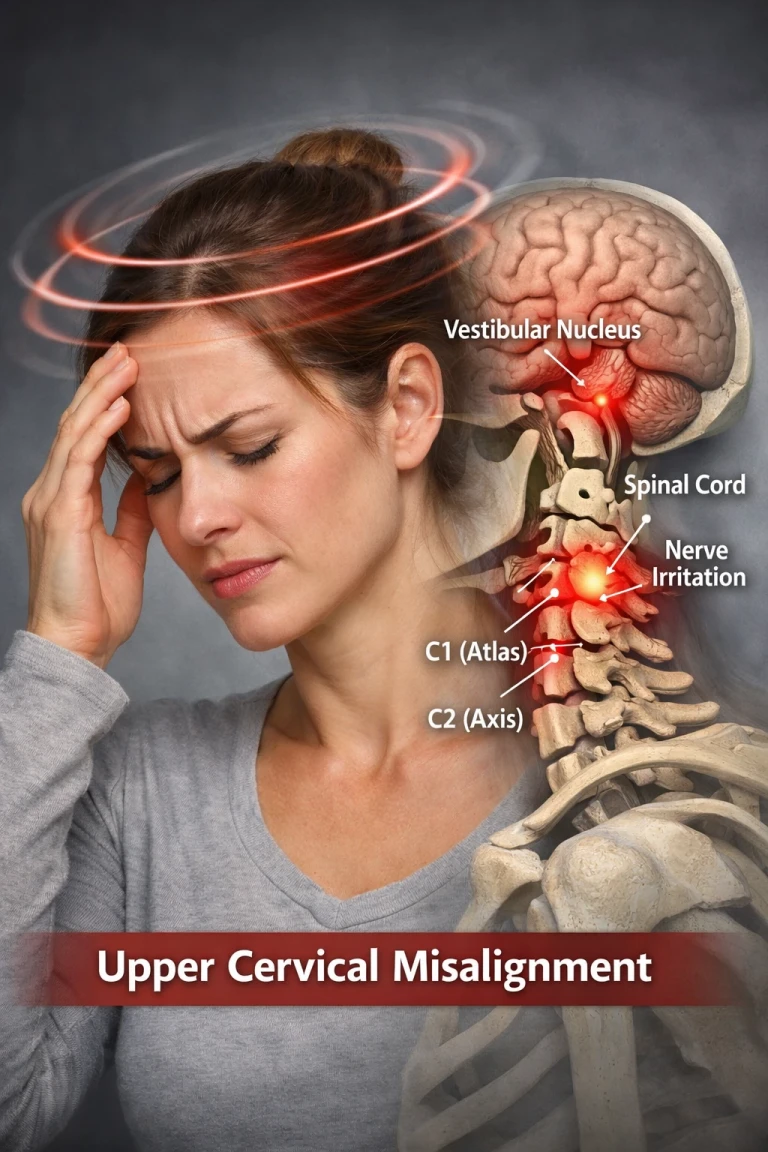
The upper cervical spine (the atlas and axis vertebrae) sits directly beneath the skull and surrounds the brainstem. This region is one of the most neurologically dense and mechanically sensitive areas in the body. When there is a structural misalignment here, it can disrupt normal communication between the brain and body.
This disruption can create dizziness that feels identical to inner ear problems—but comes from a completely different source.
Book a FREE consult by clicking here.
The Neurology Behind Dizziness
To understand why this happens, we need to look at the vestibular nucleus, a critical structure located in the brainstem. The vestibular nucleus acts as a central processing hub for balance, integrating information from three main sources:
The inner ear
The eyes
The proprioceptive input from joints—especially the upper neck
The upper cervical spine is packed with mechanoreceptors that constantly send information to the brain about head position and movement. When these joints are misaligned, they send abnormal or distorted signals.
This faulty input can confuse the vestibular nucleus, leading to symptoms such as:
Spinning sensations
Rocking or swaying
Lightheadedness
Disequilibrium
Difficulty focusing
In these cases, the issue is not the inner ear—it’s the bad data coming from the neck.
This is why so many patients continue to search for dizziness relief in Sarasota even after exhausting traditional vestibular treatments.
Structural Misalignment and Brainstem Irritation
The atlas (C1) and axis (C2) vertebrae are uniquely designed to support the skull and allow for head movement. However, they are also highly vulnerable to misalignment from:
Car accidents (even minor ones)
Sports injuries
Falls
Poor posture over time
When misalignment occurs, it can create subtle but significant irritation to the spinal cord and brainstem. This irritation can alter how the vestibular nucleus processes information, leading to persistent dizziness.
Additionally, misalignment can affect:
Blood flow into and out of the brain
Cerebrospinal fluid (CSF) circulation
Muscle tone in the suboccipital region
All of these factors can further contribute to dizziness and imbalance.
Why Vestibular Therapy Sometimes Fails
Vestibular physical therapy can be very effective—when the problem is truly vestibular in origin. But if the root cause is structural, no amount of exercises will correct the underlying issue.
Think of it this way:
If your foundation is crooked, retraining movement patterns won’t fix the foundation.
This is why patients who have completed weeks or even months of therapy without improvement often still need dizziness relief in Sarasota. The missing piece is addressing the structural integrity of the upper cervical spine.
Key Signs Your Dizziness Is Not from BPPV
If you’re unsure whether your dizziness is coming from your inner ear or your neck, here are some strong indicators that it may be cervicogenic:
The Epley maneuver didn’t work
If repositioning maneuvers failed to resolve your symptoms, it’s likely not a crystal issue.You have a history of neck injuryEven injuries from years ago can create long-term misalignment.
Neck movement triggers symptoms
Looking up, turning your head, or certain postures may reproduce dizziness.
You experience neck stiffness or tension
Tight suboccipital muscles often accompany upper cervical misalignment.
Your imaging or testing comes back “normal”
Standard tests often miss subtle structural issues in the upper neck.
If this sounds like you, then pursuing dizziness relief in Sarasota through a structural approach may be the breakthrough you’ve been looking for.
The Role of Upper Cervical Chiropractic Care
Upper cervical chiropractic focuses specifically on the alignment of the atlas and axis vertebrae. Unlike traditional chiropractic methods, this approach is highly precise and individualized.
One of the most important tools used is 3D imaging, such as CBCT (cone beam computed tomography). This allows for a detailed analysis of how each person’s spine is misaligned in three dimensions.
With this information, corrections can be made with:
No twisting
No cracking
No aggressive force
Instead, gentle and precise adjustments are used to restore proper alignment.
The goal is not to repeatedly “treat” symptoms, but to correct the structural cause so the body can function normally again.
How Correction Leads to Dizziness Relief
When the upper cervical spine is properly aligned:
Abnormal joint input to the brainstem is reduced
The vestibular nucleus receives accurate information
Muscle tone normalizes
Blood flow and CSF circulation improve
As a result, many patients experience a gradual reduction—and often resolution—of dizziness.
This is why more people are turning to this approach when seeking dizziness relief in Sarasota, especially after other treatments have failed.
A Different Perspective on Healing
One of the most important shifts for patients is understanding that dizziness is not always a symptom to be managed—it’s often a signal that something is structurally off.
By addressing the root cause rather than chasing symptoms, the body is given the opportunity to heal and stabilize naturally.
This approach is not about quick fixes or temporary relief. It’s about restoring proper function so that the nervous system can regulate balance the way it was designed to.
Final Thoughts
If you’ve been struggling with dizziness and feel like you’ve tried everything, it may be time to look beyond the inner ear. Many chronic cases are not vestibular—they are structural.
The connection between the upper cervical spine, brainstem, and vestibular system is profound. When that system is disrupted, dizziness can persist despite conventional care.
Finding true dizziness relief in Sarasota often requires identifying and correcting the underlying cause. For many patients, that cause lies in the alignment of the upper neck.
If the Epley maneuver didn’t work… if therapy hasn’t helped… if your symptoms are still there—it’s worth exploring whether your dizziness is coming from your neck.
Because sometimes, the answer isn’t in the ear at all.

Leave a comment