

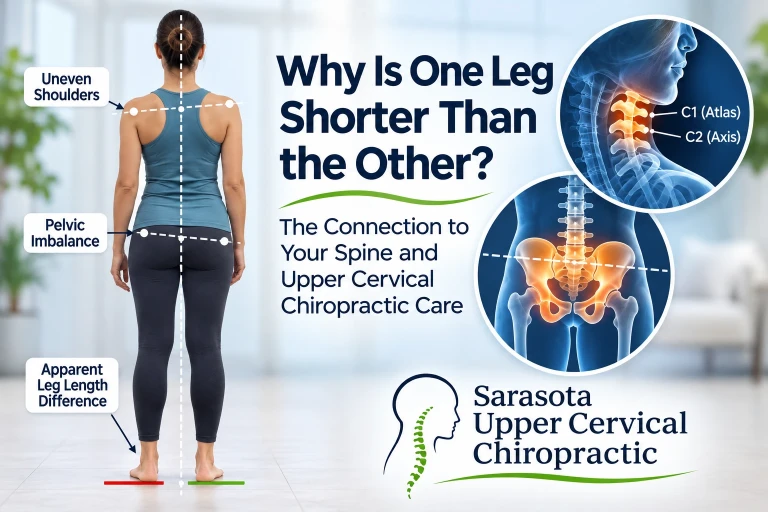
Have you ever noticed that one leg seems shorter than the other? Perhaps your pants fit unevenly, one hip sits higher, or you feel slightly off-balance when standing or walking.
You might assume that one leg is physically shorter. However, an apparent leg length difference does not always mean your leg bones are different lengths.
Schedule Your Appointment
Schedule appointmentSometimes, differences in posture, pelvic positioning, and muscle function can make one leg appear shorter than the other.
At Sarasota Upper Cervical Chiropractic, Dr. Drew Hall evaluates postural balance and upper cervical spine function as part of his Blair Upper Cervical Chiropractic approach.
But what causes unequal leg length, and what does your neck have to do with it?
Why Is One Leg Shorter Than the Other?
There are two main categories of leg length discrepancy: anatomical (structural) and functional.
Understanding the difference is important because the underlying causes and treatment options are not the same.
1. Anatomical Leg Length Discrepancy
An anatomical discrepancy occurs when the bones of one leg are physically shorter than those of the other.
Possible causes include:
- Natural differences in bone growth
- Previous fractures or injuries
- Developmental conditions
- Certain hip or joint conditions
Small anatomical differences are common and often cause no symptoms. More significant differences may require medical evaluation, shoe lifts, or other orthopedic treatment.
Chiropractic adjustments cannot lengthen a structurally shorter leg.
2. Functional Leg Length Discrepancy
A functional leg length discrepancy occurs when the legs are similar in actual bone length but appear unequal because of positional or mechanical factors.
Potential contributors include:
- Pelvic tilt or asymmetry
- Hip positioning
- Muscle tightness or imbalance
- Joint mobility restrictions
- Compensatory standing or walking patterns
This is where evaluating the body's overall mechanics may be helpful.
Can Your Spine Make One Leg Appear Shorter?
Your spine, pelvis, and lower extremities work together to support upright posture and movement.
When the position or movement of one region changes, other regions may compensate to help maintain balance.
For example, altered hip mechanics or pelvic positioning may contribute to an apparent difference in leg length.
The cervical spine also plays a role in head movement and postural control. Sensory information from neck muscles and joints contributes to your body's awareness of position.
However, a shorter-looking leg does not necessarily indicate that your spine is misaligned.
Multiple factors can contribute to postural asymmetry, and a clinical examination is needed to distinguish them.
What Is the Connection Between Upper Cervical Chiropractic and Leg Length?
Upper cervical chiropractic focuses on the uppermost region of the spine, particularly the atlas (C1) and axis (C2) vertebrae.
These vertebrae support the skull and contribute to head movement and neck function.
Within certain upper cervical chiropractic approaches, practitioners assess leg-length appearance as one indicator of possible postural asymmetry.
The theory is that altered upper cervical mechanics may influence compensatory muscle activity and posture elsewhere in the body, potentially contributing to an apparent leg-length difference.
Although neck function is involved in postural control, research has not established that atlas misalignment is a common cause of functional leg-length discrepancies.
Likewise, a leg check alone cannot confirm an upper cervical misalignment.
At Sarasota Upper Cervical Chiropractic, leg-length analysis is used alongside other assessment findings rather than as a measurement of actual leg-bone length.
How Does the Blair Upper Cervical Chiropractic Technique Work?
Dr. Drew Hall practices the Blair Upper Cervical Chiropractic Technique, a specialized approach focused on assessing the upper cervical spine.
Unlike chiropractic techniques that use conventional neck twisting or popping, Blair care emphasizes individualized evaluation and targeted adjustments.
Related article

Upper Cervical Chiropractor Sarasota, Bradenton, Venice and Tampa Bay Area
Nov 15, 2021The clinic's assessment process may include:
Health history: Reviewing symptoms, injuries, and postural concerns.
Postural evaluation: Observing asymmetry in head, shoulder, hip, and pelvic positioning.
Leg-length analysis: Comparing apparent leg alignment as one component of the examination.
Upper cervical assessment: Evaluating findings related to the atlas and axis.
Individualized recommendations: Determining whether chiropractic care is appropriate.
When clinically indicated, imaging may also be used to evaluate anatomy.
The purpose is to develop a more complete understanding of the patient's presentation rather than assume that every apparent short leg originates in the neck.
Can Upper Cervical Chiropractic Correct a Short Leg?
The answer depends on why the leg appears shorter.
If the difference is anatomical, chiropractic treatment will not change the actual length of the bones.
If the discrepancy is functional, an appropriate treatment plan may address contributing muscle, joint, or movement-related factors.
For selected patients, conservative care may include manual treatment, therapeutic exercises, mobility work, or postural rehabilitation.
However, there is currently insufficient clinical evidence to conclude that upper cervical adjustments reliably correct functional leg-length discrepancies.
Changes observed during a leg check do not necessarily demonstrate a permanent structural correction.
Treatment outcomes should be assessed using meaningful measures such as comfort, mobility, walking function, and daily activity.
What Symptoms Can Accompany Uneven Leg Length?
Some people with a significant leg length difference experience:
- Uneven hip positioning
- Lower back discomfort
- Changes in walking mechanics
- Muscle fatigue
- Difficulty maintaining comfortable posture
- Recurring discomfort during prolonged standing
However, minor leg-length differences are common and frequently produce no symptoms.
If pain, limping, or an apparent discrepancy persists, a qualified healthcare professional can determine whether further assessment is necessary.
How Is a Leg Length Discrepancy Diagnosed?
An accurate evaluation begins by identifying whether the difference is anatomical or functional.
A clinician may assess walking patterns, hip mobility, pelvic positioning, and standing posture.
The standing block test is one method used to estimate leg-length differences. When precise anatomical measurement is necessary, an appropriate imaging study may be recommended.
Chiropractic leg checks can provide observations about apparent alignment, but research shows that results can vary depending on examination methods and patient positioning.
For this reason, leg checks should not replace established methods for diagnosing a structural leg-length discrepancy.
Frequently Asked Questions
Can an atlas misalignment cause one leg to appear shorter?
Some upper cervical chiropractic models propose this connection through compensatory posture. However, direct evidence establishing atlas misalignment as a cause of leg-length discrepancy remains limited.
Can chiropractic care make my legs even?
Chiropractic care cannot change actual bone length. Some functional contributors to apparent asymmetry may respond to conservative treatment, but results are not guaranteed.
Is having one leg shorter than the other normal?
Yes. Small anatomical leg-length differences are common and often do not require treatment.
Why do chiropractors check leg length?
Some chiropractors use leg checks to observe apparent postural asymmetry or changes during an examination. These tests cannot independently diagnose an atlas misalignment or establish the need for an adjustment.
Where can I find upper cervical chiropractic care in Sarasota, FL?
Sarasota Upper Cervical Chiropractic provides Blair Upper Cervical Chiropractic care with Dr. Drew Hall at 3920 Bee Ridge Road in Sarasota, Florida.
Explore Upper Cervical Chiropractic Care in Sarasota, FL
If you have noticed uneven hips, an apparent short leg, or persistent postural discomfort, understanding the underlying cause is the first step toward appropriate care.
At Sarasota Upper Cervical Chiropractic, Dr. Drew Hall provides individualized upper cervical assessments using the Blair technique.
The practice serves patients throughout Sarasota and surrounding communities interested in a conservative approach to spinal health.
Schedule a consultation to learn whether an upper cervical evaluation is appropriate for your needs.
Sarasota Upper Cervical Chiropractic
Dr. Drew Hall
3920 Bee Ridge Rd, Building D, Suite 101
Sarasota, FL 34233
Phone: (941) 259-1891
Website: https://sarasotauppercervical.com
Medical disclaimer: This article is for educational purposes only and does not replace professional medical diagnosis or treatment.


Leave a comment