

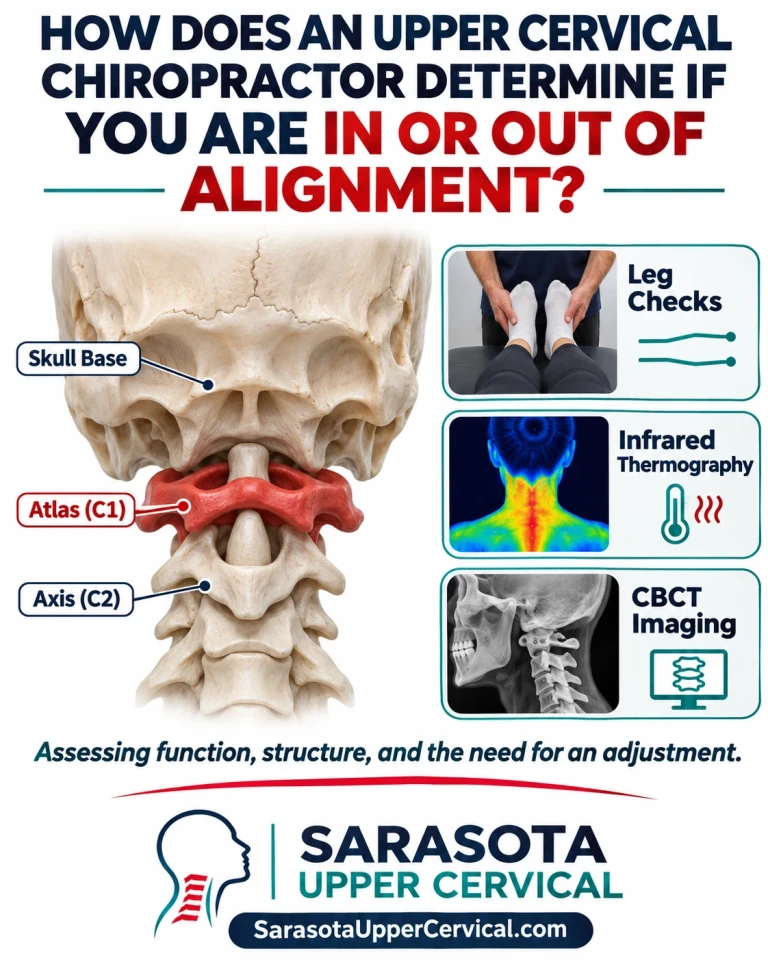
At Sarasota Upper Cervical, infrared thermography with the Tytron C-5000 is the primary tool we use to decide whether an upper cervical adjustment is needed on a given visit, for patients across Sarasota, Bradenton, and Lakewood Ranch.
Upper cervical care rests on one principle: the atlas, the top bone of the neck, is corrected only when it is out of alignment and left alone when it is holding. An unneeded adjustment adds nothing and can disturb a correction that is still stabilizing. That makes the decision not to adjust as important as the adjustment itself, and it calls for a check that does not depend on how a patient feels that morning or on a doctor's hunch.
Schedule Your Appointment
Schedule appointmentSkin Temperature as a Window Into the Autonomic Nervous System
The sympathetic branch of the autonomic nervous system controls how much the small blood vessels in the skin open or narrow. When those vessels narrow, the skin above them cools. When they relax, it warms. This is established physiology, and it is the basis for the statement in the chiropractic research literature that skin temperature is largely regulated by the autonomic nervous system.
The sympathetic nerves that control this run alongside the spine. Measuring skin temperature on the left and right sides of the neck at the same moment therefore gives an indirect, non-invasive view of how evenly that system is working. A healthy nervous system adapts constantly, so the readings shift from day to day in response to the environment. A difference between the two sides that stays fixed in the same shape visit after visit suggests something is keeping the system from adapting. What that fixed difference says about the upper neck is a clinical interpretation, and we explain its limits below.
Pattern Analysis With the Tytron C-5000

The Tytron C-5000, made by Titronics, is a handheld dual-probe infrared instrument. It glides along the neck and records the heat coming off the skin on both sides of the spine at once, then charts the side-to-side difference. The method we use to read those charts, called pattern analysis, was developed by B.J. Palmer and researchers at Palmer College. Instead of judging a single scan against a textbook norm, the doctor compares each scan with the patient's own earlier scans and looks for a recognizable shape that repeats.
When today's scan matches that established pattern, we read it as a sign the atlas has shifted and the nervous system is under stress. When the scan varies from the pattern, we read it as the body adapting normally, and we do not adjust. Because room temperature affects the readings, scans are taken under consistent conditions.
What the Research Does and Does Not Show
The measurement itself is highly repeatable. In a reliability study using the earlier Tytron C-3000, examiners reproduced paraspinal scans with intraclass correlation values between 0.918 and 0.984. That study tested 30 students without symptoms, so it shows the instrument gives consistent readings. It does not show that a given pattern identifies a misaligned atlas. A 2015 study in the Journal of the Canadian Chiropractic Association asked 17 experienced doctors to classify the same scans. They agreed well on clear full patterns (kappa 0.73) but poorly on in-between cases, with fair agreement overall (kappa 0.43). Researchers in this field have also acknowledged that controlled studies validating thermography as a test for spinal misalignment are lacking.
The honest summary is that thermography gives objective, repeatable data and makes the adjust-or-wait decision far more disciplined than guesswork. It is not a stand-alone diagnosis. That is why we never rely on it alone.
Related article

Post-Concussion Syndrome: Your Path to Recovery Through Upper Cervical Care
Jan 08, 2026The Prone Leg Check as a Secondary Indicator
The second check is the prone leg check. The patient lies face down, and the doctor compares where the heels line up. Research on prone leg checks has found good agreement between examiners, and one study of 50 low back pain patients found that prone measurements correlated closely with standing X-ray findings. Those studies show the test is repeatable, not what causes an imbalance.
How the Upper Neck Influences Postural Tone
The small suboccipital muscles between the skull, atlas, and axis are packed with muscle spindles, the sensors that report position and stretch to the brain. In a study of fetal tissue, the inferior oblique muscle held about 242 spindles per gram, among the highest densities measured in the body. Fetal tissue is not identical to adult tissue, but the finding is consistent with the broader anatomy. Input from these upper neck sensors feeds the brainstem reflexes that set muscle tone for posture throughout the trunk and limbs. That part is established neuroanatomy.
The upper cervical model builds on it with a reasoned hypothesis. When the atlas shifts, the altered signals from these sensors change muscle tone unevenly from top to bottom. The pelvis tilts, and one leg draws up and looks shorter when the patient lies face down. When the atlas is in alignment, tone evens out and the legs balance. This model is widely used in upper cervical practice, but controlled research has not confirmed it, and we present it to patients as a working clinical model rather than a proven fact.
Putting It Together in Upper Cervical Practice
Related article
At each visit, the scan and the leg check are read together. When the thermography matches the patient's established pattern and the legs are imbalanced, the two independent findings agree, and we make a gentle correction with no twisting, popping, or pulling, guided by the imaging taken at the initial exam. We then recheck to confirm the legs have balanced. When the scan shows normal variation and the legs are even, we do not adjust, and the patient rests so the correction can stabilize. Over time, the goal is for the atlas to hold longer and need correction less often.
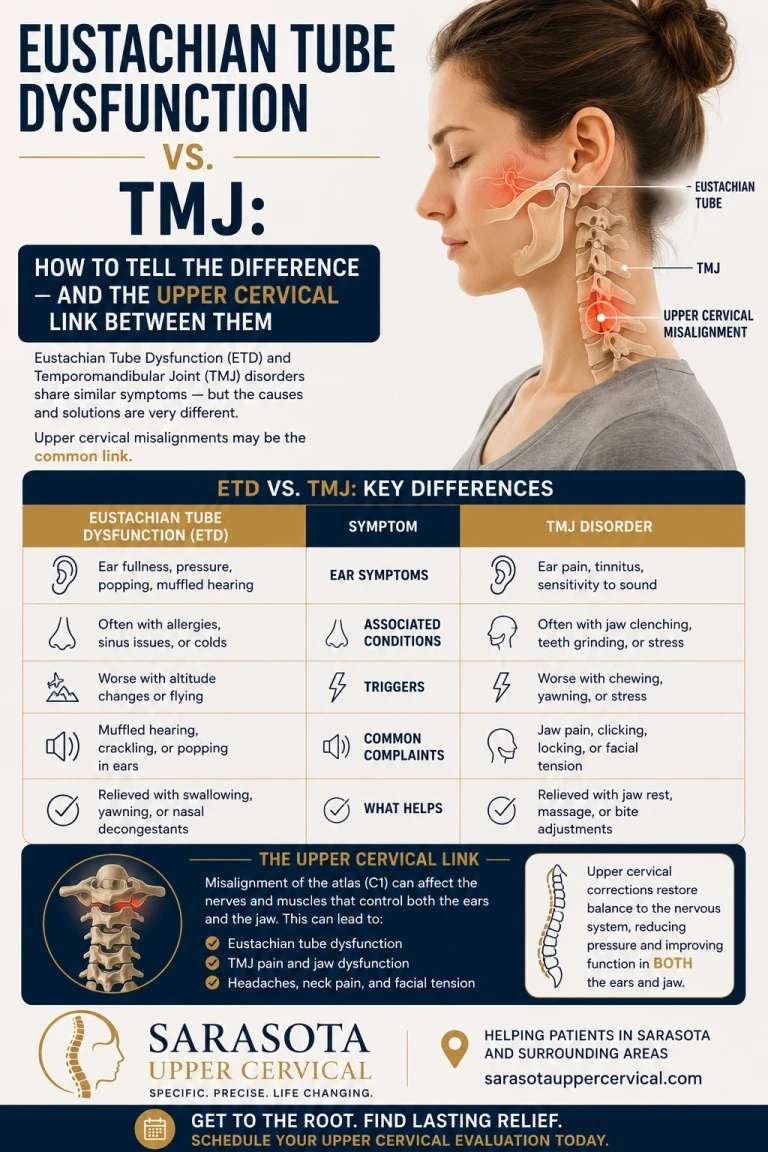
People who visit our Sarasota office commonly come in with occipital neuralgia, tension-type and cervicogenic headaches, migraines, vertigo, neck pain, back pain, and numbness or tingling in the arms or hands. Upper cervical care is not a cure for any of these, and many have causes unrelated to the neck. New numbness, sudden severe headache, or vertigo with other neurological symptoms needs prompt medical evaluation. People with known or suspected upper cervical instability, fracture, or certain vascular conditions also need medical clearance before any upper cervical correction. The goal of upper cervical care is narrow and specific: keep the upper neck aligned so the nervous system can work without irritation from that region.
Schedule a Consultation
If you live in Sarasota, Bradenton, or Lakewood Ranch and want to know whether upper cervical care is a fit for you, call 941-259-1891 to schedule a consultation, or book online at sarasotauppercervical.com/appointments.
Medical Disclaimer
This article is for general educational purposes only and is not medical advice, diagnosis, or treatment. Upper cervical chiropractic care focuses on the alignment of the upper cervical spine and is not a substitute for evaluation by a physician. Individual results vary, and no outcome is guaranteed. If you have new, severe, or worsening symptoms, contact your physician or seek emergency care. Dr. Drew Hall is a chiropractic physician licensed in Florida.


Leave a comment