

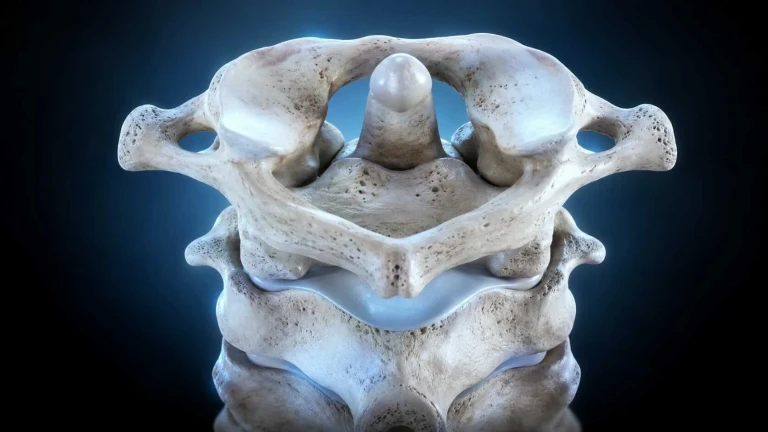
They know there is no cracking involved. Beyond that, the process is largely unfamiliar — and that unfamiliarity is worth addressing directly, because the evaluation process is one of the things that genuinely sets upper cervical care apart from almost every other manual therapy available.
At the Sarasota office on Bee Ridge Road, the evaluation is not a formality before treatment begins. It is the foundation ever. Most people who walk into an upper cervical chiropractic office for the first time do not know what to expect. They have heard it is different from regular chiropractic. Everything else is built on. No correction is delivered until there is objective data supporting it. That principle matters more than it might initially sound.
Schedule Your Appointment
Schedule appointmentWhat Makes Upper Cervical Chiropractic Different From the Start
Upper cervical chiropractic is a specialty focused exclusively on the top two vertebrae in the spine — the atlas (C1) and the axis (C2). These two bones occupy a uniquely critical position. The atlas sits directly beneath the skull and surrounds the brainstem. The axis sits below it and provides the rotational mechanics that allow you to turn your head.
The structural relationship between the skull, atlas, and axis is not just mechanically important. It is neurologically important. The brainstem — housed within the atlas ring — is the control center for your body's automatic functions: pain processing, cardiovascular regulation, balance, sleep, and the autonomic nervous system responses that run beneath conscious awareness.
When the atlas shifts out of its optimal position, the effects are not always localized to the neck. They can appear as headaches, dizziness, fatigue, jaw tension, or symptoms that seem entirely unrelated to the spine. This is why the evaluation process has to be precise. Treating a misalignment that has not been accurately measured is not upper cervical care — it is guesswork.
Three-Dimensional CBCT Imaging: Seeing What Standard X-Rays Miss

The first major distinction in an upper cervical evaluation is the imaging. Standard cervical X-rays show gross alignment — whether the spine looks broadly normal or not. They are not designed to detect the precise rotational and translational misalignments that upper cervical care addresses.
Cone beam computed tomography, commonly called CBCT, produces a true three-dimensional reconstruction of the upper cervical anatomy. It measures the structural relationship between the skull, atlas, and axis to within fractions of a degree. The rotation of the atlas, its lateral displacement, the tilt of the skull relative to C1 — all of it is mapped with a level of precision that conventional imaging simply cannot provide.
This matters for several reasons. First, it means the correction is calculated specifically for your anatomy, not applied generically. Second, it provides an objective baseline — a before image that documents exactly what was present prior to any intervention. Third, for patients who have been told their imaging is normal despite ongoing symptoms, CBCT often reveals the specific structural picture that was invisible on standard X-rays.
The imaging also provides answers. Many patients in Sarasota come in having accumulated years of symptoms without a structural explanation. The CBCT frequently identifies the misalignment that has been driving those symptoms — and seeing it objectively tends to reframe everything that came before.
Objective Testing Before Any Adjustment Is Made
CBCT imaging is one component of the evaluation. Two additional objective tests are performed before any correction is considered: leg length analysis and paraspinal infrared thermography.
Leg length analysis assesses functional imbalance in the pelvis and lower extremities that results from spinal compensation. When the atlas is misaligned, the spine adapts from top to bottom — one shoulder drops, one hip elevates, and the resulting postural shift often produces a measurable functional leg length difference. This is not a structural difference in bone length. It is a postural compensation pattern that appears when the spine is out of balance and resolves when alignment is restored.
Paraspinal infrared thermography measures temperature differentials along either side of the spine. The nervous system regulates skin temperature through the autonomic nervous system, and asymmetrical temperature patterns along the paraspinal region indicate areas of neurological stress or interference. Thermography provides a real-time functional picture of how the nervous system is responding to the current structural state of the spine.
Related article
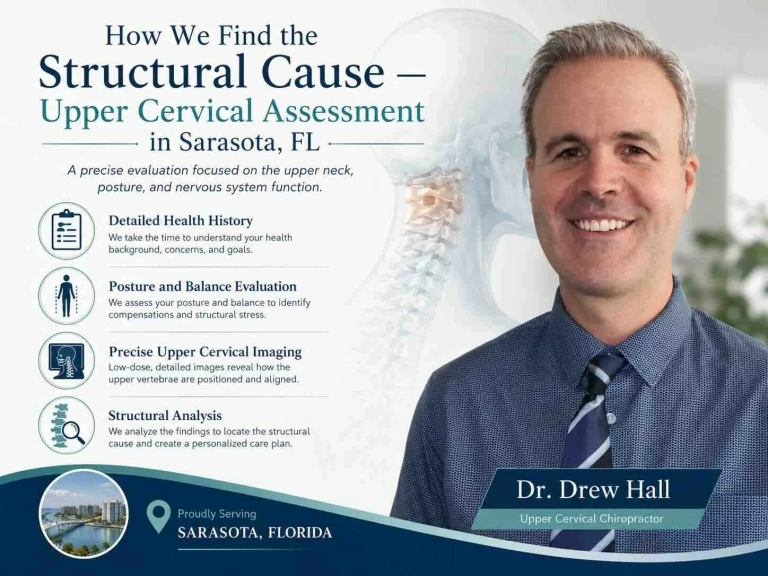
How We Find the Structural Cause — Upper Cervical Assessment in Sarasota, FL
Jun 16, 2026Together, these three objective measures — CBCT imaging, leg length analysis, and thermography — create a complete picture before anything is done. The correction is only delivered when the objective findings support it. Not based on symptoms alone. Not based on what the patient reports feeling. Based on what the data shows.
That restraint is not a limitation. It is a commitment to precision that protects the patient and ensures that every correction delivered has a measurable structural basis.
Precision Correction Without Manipulation
When the evaluation is complete and the data supports a correction, the adjustment itself is unlike anything most patients have experienced in manual therapy.
There is no twisting of the neck. No rotation. No audible pop or crack. The correction is calculated along a specific vector based on the CBCT measurements — the exact direction, angle, and depth determined by the imaging, not by feel or general protocol. The force applied is low. The contact is specific to the upper cervical segment.
For patients who are nervous about neck manipulation — particularly those who have heard concerns about cervical adjustment — this distinction is important. Upper cervical correction is not cervical manipulation in the conventional sense. It is a precision structural intervention delivered with a level of specificity that general spinal manipulation does not attempt.
The gentleness of the correction also matters for patients whose nervous systems are already under stress. Aggressive manipulation in the upper cervical region carries risks that precision upper cervical care deliberately avoids. The goal is to restore alignment with the minimum force necessary to achieve the correction — and to confirm through follow-up objective testing that the correction held.

What Happens After the First Correction
Post-correction thermography and leg length analysis are repeated to confirm that the structural shift occurred. This is not a formality. It is how the practice verifies that the atlas moved into its corrected position and that the nervous system is responding.
Follow-up visits include the same objective testing before each appointment. If the atlas has maintained its correction, no adjustment is delivered. The principle at work here is that the best correction is one that holds — meaning fewer visits, not more. Upper cervical care is not designed to create dependency. It is designed to achieve stability.
Patients are typically asked to rest briefly after their first correction to allow the surrounding musculature to begin adapting to the new atlas position. Changes are sometimes felt quickly — within hours or the following day. For others, the shift is more gradual as the spine works through its compensatory patterns.
Is an Upper Cervical Evaluation Right for You
If you have been managing chronic symptoms without a satisfying structural explanation, or if you have been told your imaging is normal despite ongoing pain, headaches, dizziness, or neurological symptoms, an upper cervical evaluation provides an objective assessment most conventional workups never offer.
The process is non-invasive, data-driven, and built around precision rather than assumption. It tells you what is actually present in your upper cervical spine — and whether correction is indicated.
The Sarasota office is located at 3920 Bee Ridge Rd, Building D, Sarasota, FL 34233.
Call (941) 259-1891 to schedule your evaluation. Understanding what is happening structurally is the first step — and the evaluation is where that understanding begins.



Leave a comment