


The cruise ended days ago, but your body has not received the message.
The floor feels as if it is moving. Standing at the kitchen counter feels strangely similar to standing on a boat. You may describe it as rocking, bobbing, bouncing, floating, or walking on a dock.
Schedule Your Appointment
Schedule appointmentSitting still does not always make it stop. Oddly, riding in a moving car may make you feel more normal for a while.
For someone living near the Gulf Coast, the symptoms can be especially confusing. A day on a boat or a long cruise was supposed to be restorative. Instead, the sensation of motion followed you home.
The Direct Answer
A persistent rocking or swaying sensation after a cruise, flight, or other prolonged motion exposure may be a condition called mal de débarquement syndrome, commonly shortened to MdDS.
MdDS is considered a neurological balance disorder. It should not automatically be blamed on the neck, inner-ear crystals, anxiety, or an atlas misalignment. However, some patients also have neck pain, restricted cervical movement, headaches, or abnormal neck-position signals that may complicate balance recovery.
That is why a careful evaluation should consider both the primary balance disorder and any coexisting cervical problem.
What Is Mal de Débarquement Syndrome?
The name means “sickness of disembarkment.”
A brief sense of movement after stepping off a boat is common. For most people, it fades within minutes or hours. MdDS is different because the rocking, swaying, or bobbing continues.
The condition most often begins after passive motion, including:
- A cruise
- A smaller boat trip
- Air travel
- A long train journey
- Extended automobile travel
- Other repeated motion exposure
Researchers describe MdDS as a persistent perception of motion after the actual motion has stopped. Its biology is still being studied, and diagnosis is based largely on the symptom pattern and exclusion of other conditions.
What Does MdDS Feel Like?
People rarely describe MdDS as a classic spinning sensation.

Instead, they say:
“I feel like I am still on the boat.”
“The floor is moving under me.”
“My body keeps swaying.”
“I feel as though I am walking on a trampoline.”
“The room is not spinning, but I am moving.”
“I feel better while riding in the car, then worse after I stop.”
Symptoms may be present while standing, sitting, or lying down. Visual motion, crowded stores, computer work, fatigue, stress, and poor sleep may make the sensation more intrusive.
Associated symptoms can include brain fog, difficulty concentrating, fatigue, headaches, anxiety, motion sensitivity, or visual discomfort. The constant need to correct an invisible movement is exhausting.
Is MdDS the Same as Vertigo?
Not exactly.
“Vertigo” usually describes the illusion that you or the environment is spinning. MdDS is more often a rhythmic rocking, bobbing, or swaying sensation.
Benign paroxysmal positional vertigo, or BPPV, is commonly triggered by specific head positions and involves displaced particles in the inner ear. The Epley maneuver can be effective when BPPV is correctly diagnosed.
MdDS has a different pattern. Repeatedly performing inner-ear maneuvers without confirming BPPV may delay the appropriate evaluation.
Other conditions that may resemble part of the MdDS experience include:
- Vestibular migraine
- Persistent postural-perceptual dizziness
- Inner-ear disease
- Medication effects
- Cervicogenic dizziness
- Post-concussion symptoms
- Neurological disorders
There is no single home test that safely separates all of these possibilities.
Where the Neck May Enter the Picture
Balance depends on information from three major sources:

1. The vestibular system in the inner ear
2. Vision
3. Position and movement receptors in muscles and joints
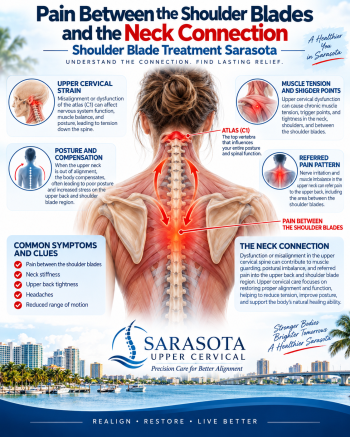
The upper cervical region contains extensive proprioceptive input. These receptors help the brain understand where the head is positioned in relation to the body.
Research on cervicogenic dizziness suggests that disturbed cervical input can contribute to non-spinning dizziness, unsteadiness, or sensory mismatch in some patients with neck dysfunction. Cervicogenic dizziness remains a diagnosis of exclusion because there is no single definitive test.
This distinction matters:
A neck problem does not automatically cause MdDS.
A patient may have MdDS without meaningful cervical dysfunction. Another may have MdDS plus neck stiffness from travel posture, an earlier whiplash injury, or years of compensation. The second problem may amplify the first.
Signs a Cervical Evaluation May Be Relevant
A focused neck evaluation may be reasonable when rocking or disequilibrium occurs alongside:
- Persistent neck stiffness
- Pain at the base of the skull
- Headaches linked to neck movement
- A history of whiplash, concussion, falls, or sports injuries
- Reduced ability to turn the head
- Symptoms that worsen after prolonged screen use
- A sense that the head is difficult to hold upright
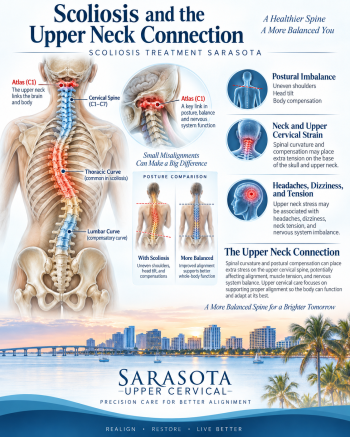
- Uneven posture or muscle tension
The purpose is not to relabel every balance disorder as a neck misalignment. It is to determine whether abnormal cervical mechanics may be adding inaccurate position information to an already sensitive balance system.
What a Sarasota Upper Cervical Evaluation May Include
Sarasota Upper Cervical uses the Blair Upper Cervical technique, which focuses on the relationship among the skull, atlas, and axis. The practice describes the method as precise and gentle, without pulling, popping, or twisting the neck.
Depending on the history and clinical findings, an evaluation may include:
- A detailed timeline of the motion exposure
- Questions about whether riding in a vehicle changes symptoms
- Review of previous vestibular and neurological testing
- Posture and balance observations
- Cervical range-of-motion testing
- Neurological screening
- Examination of upper neck muscles and joints
- Specialized imaging when clinically appropriate
Upper cervical care should not replace evaluation by an otolaryngologist, neurologist, vestibular specialist, or primary healthcare provider when MdDS or another neurological balance disorder is suspected.

The roles can be complementary. One clinician may evaluate the primary vestibular or neurological condition while another investigates a coexisting mechanical neck component.
When to Seek Immediate Medical Care
Do not assume a new balance problem is MdDS merely because it began after travel.
Seek urgent medical attention for dizziness or imbalance accompanied by:
- Facial drooping
- New weakness or numbness
- Difficulty speaking
- Fainting
- Severe trouble walking
- New double vision
- A sudden, severe headache
- Chest pain
- Sudden hearing loss
- Symptoms after a significant head injury
New neurological symptoms require timely assessment.
Frequently Asked Questions
1. How long should rocking last after a cruise?
A temporary sense of movement may resolve shortly after disembarking. Symptoms that persist, interfere with daily life, or continue beyond the expected adjustment period warrant professional evaluation.
2. Why do I feel better in a moving car?
Temporary improvement during passive motion is a commonly described clue in motion-triggered MdDS. It is useful information to share with the clinician conducting your evaluation.
3. Is MdDS caused by anxiety?
MdDS is not simply anxiety. Persistent symptoms can understandably create anxiety, sleep disruption, and avoidance, and those effects may intensify how disruptive the condition feels.
4. Can an upper cervical chiropractor diagnose MdDS?
MdDS is a neurological balance disorder. An upper cervical chiropractor may screen your presentation and evaluate cervical mechanics but should coordinate referral or co-management when a neurological or vestibular diagnosis is needed.
5. Can neck treatment cure MdDS?
Current evidence does not justify promising that a neck correction will cure MdDS. The clinical question is whether treatable cervical dysfunction is contributing to the total symptom burden.
MdDS and Dizziness Evaluation in Sarasota
Patients in Sarasota, Bradenton, Lakewood Ranch, Venice, and nearby Gulf Coast communities spend a great deal of time around boats, cruises, and travel. Persistent rocking after returning to land should not be dismissed as imagination or ordinary seasickness.
It also should not be reduced to one presumed cause before a proper examination.
Sarasota Upper Cervical is located at 3920 Bee Ridge Road, Building D, Suite 101, Sarasota, Florida. The office offers focused upper cervical evaluation using a gentle Blair approach.
Call (941) 259-1891 to ask whether an upper cervical assessment may be appropriate alongside your medical or vestibular care.

Leave a comment