

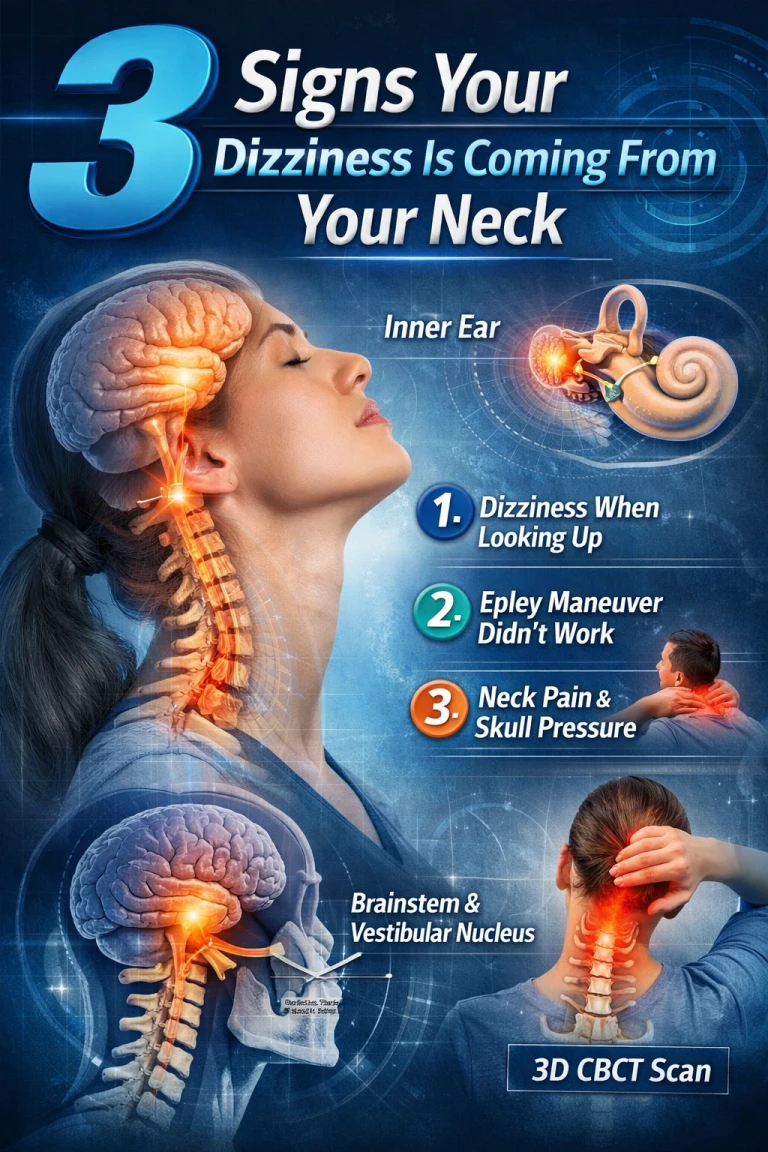
Dizziness is one of the most frustrating symptoms a person can experience. For many, the first assumption is that the problem must be coming from the inner ear—especially if you’ve been diagnosed with BPPV (Benign Paroxysmal Positional Vertigo).
But what happens when the typical treatments don’t work?
What if the real issue isn’t your inner ear at all—but your neck?
There is a growing understanding in neurology and upper cervical care that many cases of chronic dizziness are actually cervicogenic, meaning they originate from dysfunction in the upper neck and its influence on the brainstem and balance centers.
Here are the top three signs your dizziness may be coming from your neck—not your inner ear.
1. Looking Up (Head Extension) Reproduces Your Dizziness
If bending your head backward—like looking up at the ceiling, washing your hair, or reaching overhead—reliably triggers your dizziness, this is a major clue.
Why?
Because this motion directly stresses the upper cervical spine, particularly the atlas (C1) and axis (C2). If these joints are misaligned, extending the head can:
Increase mechanical irritation near the brainstem
Alter joint receptor signaling
Disrupt normal balance coordination
This type of dizziness is often not consistent with inner ear crystal problems, but instead points to a mechanical and neurological issue in the neck.
Book a FREE consultation by clicking here.
2. You Were Diagnosed with BPPV… But the Epley Maneuver Didn’t Help
BPPV is one of the most common diagnoses for dizziness. It’s caused by displaced calcium crystals in the inner ear, and the Epley maneuver is designed to reposition them.
When BPPV is truly the cause, the Epley maneuver is often highly effective.
But here’s the key:
If you’ve had the Epley maneuver done multiple times and it didn’t resolve your dizziness… it’s very likely not BPPV.
At that point, continuing to treat the inner ear may miss the real issue.
Instead, your symptoms may be coming from abnormal nerve input originating in the upper cervical joints, which can mimic inner ear dysfunction.
3. You Have Neck Pain and Pressure at the Base of the Skull
This is one of the biggest overlooked clues.
If your dizziness is accompanied by:
Tightness in the upper neck
Pressure at the base of the skull
Occipital headaches
Shoulder or upper back tension
…it strongly suggests involvement of the suboccipital region and upper cervical spine.
These muscles and joints are densely packed with proprioceptors—specialized nerve endings that constantly send position and movement information to the brain.
When this input becomes abnormal due to misalignment or tension, it can confuse the brain’s balance system, leading to dizziness.
Book a FREE consultation by clicking here.
The Missing Link: The Brainstem & Vestibular Nucleus
Your sense of balance is not controlled by the inner ear alone.
It is coordinated by the vestibular nucleus, located in the brainstem. This system integrates three major inputs:
Inner ear (vestibular system)
Visual system (eyes)
Proprioception from joints—especially the upper neck
The upper cervical spine plays a critical role in this system.
When the atlas or axis becomes misaligned—often due to trauma such as:
Car accidents
Sports injuries
Falls
Repetitive stress or poor posture
…it can create aberrant nerve signals from the joints into the vestibular nucleus.
This mismatch of information can lead to:
Dizziness
Imbalance
Spatial disorientation
A “floating” or “off” feeling
Even if the inner ear is functioning normally.
Why Trauma to the Neck Matters
Many patients with chronic dizziness can trace their symptoms back to a prior injury—even if it happened years earlier.
Trauma can subtly shift the alignment of the upper cervical spine, leading to:
Mechanical stress on the brainstem
Altered cerebrospinal fluid (CSF) dynamics
Distorted proprioceptive input to the brain
Over time, the body compensates—but those compensations can eventually break down, resulting in persistent dizziness.
The Role of 3D CBCT Imaging
One of the biggest challenges in identifying cervicogenic dizziness is precision.
Standard X-rays often miss the complexity of upper cervical misalignment.
That’s where 3D CBCT (Cone Beam CT) imaging comes in.
This advanced imaging allows doctors to:
Visualize the exact position of the atlas and axis in three dimensions
Measure angular misalignments unique to each patient
Identify asymmetries that affect neurological function
This level of detail is essential because no two misalignments are the same.
Precision Corrections—Without Twisting or Popping
Once the exact misalignment is identified, correction is not about force—it’s about precision.
Upper cervical care uses:
Gentle, calculated adjustments
No twisting, cracking, or aggressive manipulation
Specific vectors based on your unique anatomy
The goal is to restore proper alignment so the nervous system—especially the brainstem and vestibular pathways—can function normally again.
When this happens, many patients experience:
Improved balance
Reduced dizziness
Less neck tension
Better overall neurological function
Final Thoughts
If you’ve been dealing with dizziness and:
Looking up triggers your symptoms
The Epley maneuver didn’t help
You have neck pain or pressure at the base of your skull
…it may be time to look beyond the inner ear.
Your neck—specifically the upper cervical spine—could be the missing piece.
Understanding the connection between structure and neurology is often what leads patients out of the cycle of chronic dizziness and toward real, lasting relief.


Leave a comment