

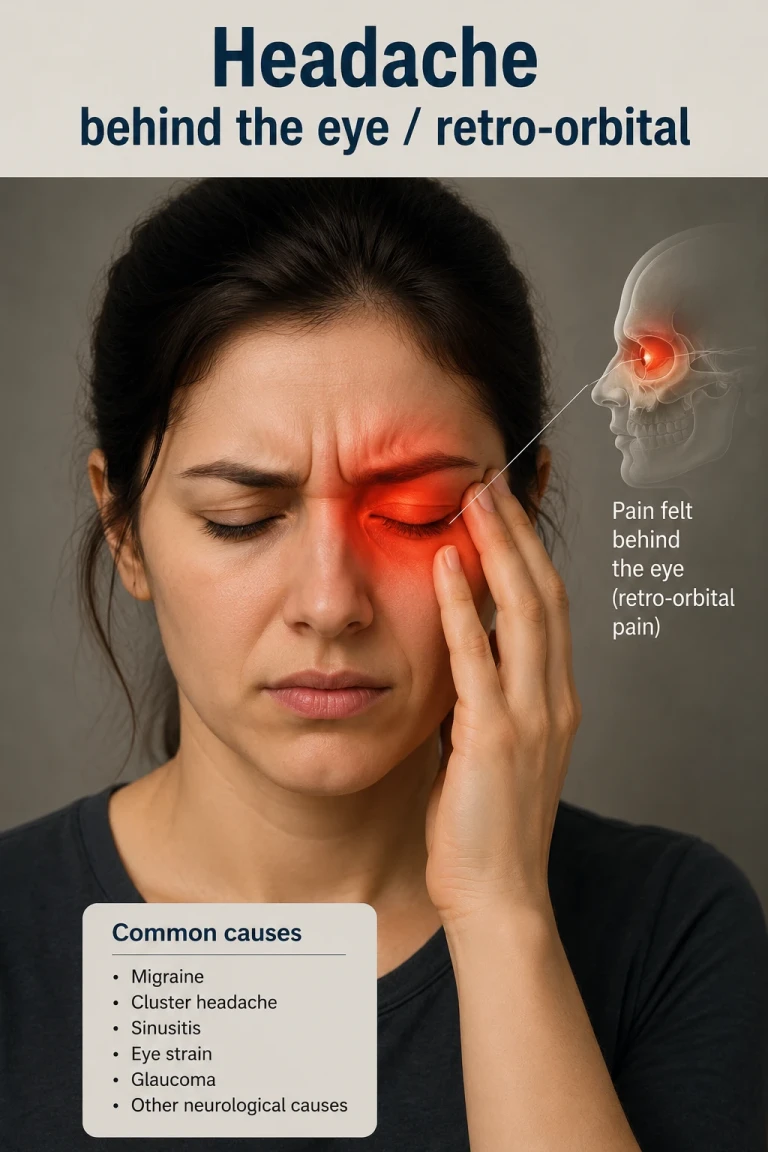
That deep, pressing ache behind one eye can feel like an eye problem. Often, the eye is only where the pain is felt — not where it begins.
Sarasota Upper Cervical · Serving Sarasota & Bradenton
You know the feeling: a dull, boring ache set deep behind one eye, sometimes with the sense that the eye itself is being pushed from the inside. You may have had your vision checked and your eyes declared healthy — and yet the pain keeps returning. When that happens, it's worth understanding a connection most people are never told about: the nerves that carry sensation from your eye share the same neurological junction as the nerves from your upper neck.
That shared junction is the reason a problem in the top of your neck can be felt behind your eye, even when your eye is perfectly fine. Below, we'll walk through how that referral happens, what else can cause pain in this area, and where upper cervical care does — and does not — fit in.
What "retro-orbital" pain actually means
Retro-orbital simply means behind the eye socket. It's a location, not a diagnosis. Pain felt there is usually deep rather than on the surface, and people often describe it as pressure-like, boring, or throbbing. Because the eye is such a sensitive, important structure, the brain tends to interpret pain in that region as urgent — which is part of why retro-orbital headaches can feel so distressing even when they aren't dangerous.
The key idea is this: where pain is felt and where pain comes from are not always the same place. This is called referred pain, and it's the same phenomenon that makes a heart problem hurt in the left arm. For headaches behind the eye, one common and under-recognized source is the upper neck.
The neck–eye connection: a shared junction in the brainstem
At the base of your skull, sensory nerves converge in a region called the trigeminocervical complex. Think of it as a busy switchboard where two major nerve systems meet:
The trigeminal nerve, which carries sensation from the face — including, through its ophthalmic branch, the region around and behind the eye.
The upper cervical nerves (C1, C2, and C3), which carry sensation from the joints, muscles, and tissues at the very top of the neck.
Here's the part that matters: fibers from the eye region and fibers from the upper neck don't just pass near each other — they can connect to the very same second-order neurons in this complex. When signals from the upper neck and signals from the eye region feed into shared pathways, the brain can have difficulty telling them apart. Persistent irritation arising from the upper neck can therefore be interpreted, and felt, as pain behind the eye.
Listen to one of our patient's recovery stories in our office by clicking here.
In plain terms
Your upper neck and the area behind your eye report to the same "front desk" in your brainstem. When the upper neck keeps sending irritated signals to that desk, the message can get filed under "behind the eye" — which is exactly where you feel it.
Why the upper neck specifically?
The top two vertebrae of your spine — the atlas (C1) and axis (C2) — sit directly beneath your skull and are built for a remarkable amount of movement. That mobility is part of what lets you turn and nod your head freely, but it also means this region relies heavily on balanced alignment and steady muscular support.
When the alignment of these upper vertebrae is disturbed — by an old injury, a fall, a car accident, repetitive strain, or sustained poor posture — the surrounding joints and tissues can become a source of ongoing irritation. Because those same upper cervical structures feed into the trigeminocervical complex, that irritation has a direct line to the pathways your brain associates with the eye and forehead.
This is why a meaningful number of people with stubborn headaches behind the eye also have a history of neck trauma, neck stiffness, or tension at the base of the skull — even if their neck doesn't hurt much on its own.
Other causes of pain behind the eye — and why this matters
Upper cervical involvement is one important piece of the picture, but it is not the only cause of retro-orbital pain. Being honest about the full list is part of getting the right care. Pain behind the eye can also be associated with:
Migraine, which frequently produces throbbing pain in and around one eye, often with light sensitivity or nausea.
Cluster headache, marked by severe, piercing pain behind or around one eye in distinct attacks, often with tearing or a runny nostril on the same side.
Sinus inflammation, which can create pressure around the eyes and cheeks, usually alongside congestion.
Eye-related conditions such as significant uncorrected vision strain, or — less commonly — problems with the eye itself or the optic nerve.
When to seek medical care first
Some causes of eye pain need prompt evaluation by a physician or eye doctor. Seek medical attention right away if your pain behind the eye comes with sudden vision loss or changes, a red or bulging eye, eye pain with movement of the eye, severe pain described as "the worst headache of your life," fever and stiff neck, or new pain following a head injury. Upper cervical care is not a substitute for emergency or ophthalmologic evaluation when these signs are present.
What upper cervical care does — and what it does not do
Upper cervical chiropractic focuses on restoring balanced alignment to the atlas and axis using gentle, precise corrections — without the twisting or forceful movements many people associate with general chiropractic. The goal is straightforward: reduce the mechanical irritation arising from the upper neck so the structures feeding into the trigeminocervical complex are calmer and better supported.
To be clear about scope:
Upper cervical care does not treat the eye, the optic nerve, or any primary eye disease.
It does not cure migraine, cluster headache, or any headache disorder.
It is not a replacement for evaluation by your physician or eye doctor when that's needed.
What it does focus on is the structural contribution from your upper neck — a contribution that is easy to overlook when attention is fixed on the eye where the pain is felt. For people whose retro-orbital headaches have a cervical component, addressing the alignment and function of the upper neck can be a meaningful part of the picture. Individual results vary, and a thorough examination is the only way to know whether your upper neck is involved in your particular case.
How we look at it in Sarasota
At Sarasota Upper Cervical, the first step is never a correction — it's an evaluation. We work to understand your history (including any past injuries), examine how your upper neck is moving and aligning, and determine whether there's a structural pattern that fits your symptoms. If your headaches behind the eye appear connected to your upper cervical spine, we'll explain what we found in plain language and whether upper cervical care is appropriate for you. If we don't think we're the right fit, we'll tell you that too, and point you toward the kind of provider who is.
Wondering if your neck is part of the picture?
If you've had recurring pain behind the eye and conventional answers haven't added up, an upper cervical evaluation can help clarify whether your upper neck is involved.
Request a Consultation-941 259-1891
Frequently asked questions
Can a neck problem really cause pain behind my eye?
Yes. Sensory nerves from the upper neck and from the region around the eye converge at a shared junction in the brainstem called the trigeminocervical complex. Because of this overlap, irritation originating in the upper neck can be referred to — and felt as — pain behind the eye, even when the eye itself is healthy.
My eye exam was normal, so why does it still hurt behind my eye?
A normal eye exam means the eye structures are healthy, which is reassuring. But it doesn't rule out referred pain — pain that is generated elsewhere and felt behind the eye. The upper neck is one common source of this kind of referred head pain, which is why some people with normal eye exams still have persistent retro-orbital aching.
Is pain behind the eye ever an emergency?
It can be. Sudden vision loss, a red or bulging eye, pain when moving the eye, fever with a stiff neck, or the sudden "worst headache of your life" all warrant prompt medical evaluation. Pain behind the eye following a head injury should also be checked by a physician. Upper cervical care is not a substitute for emergency or eye-specialist care in these situations.
What does upper cervical care involve for this kind of headache?
It begins with an evaluation of your upper neck's alignment and movement, along with your health history. If a structural pattern is found that fits your symptoms, gentle and precise corrections are used to restore balanced alignment to the top of the neck — with the aim of reducing the irritation that may be contributing to your head pain. It does not treat the eye itself.
Where is Sarasota Upper Cervical located?
Sarasota Upper Cervical serves patients throughout the Sarasota and Bradenton area. You can request a consultation to find out whether your headaches behind the eye may have an upper cervical component.
References
Bartsch T, Goadsby PJ. Anatomy and physiology of pain referral in primary and cervicogenic headache disorders. Headache Currents / Cephalalgia, 2008.
Goadsby PJ, et al. Convergence of trigeminal (ophthalmic, V1) and upper cervical afferents in the trigeminocervical complex.
Bogduk N, Govind J. Cervicogenic headache: assessment of the evidence on clinical diagnosis, invasive tests, and treatment.
Djavaherian DM, Guthmiller KB. Occipital Neuralgia. StatPearls, NCBI Bookshelf, 2026.
This article is for general educational purposes only and does not constitute medical advice, diagnosis, or treatment. It does not establish a doctor–patient relationship. Results of upper cervical care vary from person to person, and no specific outcome is promised or guaranteed. If you are experiencing eye pain, vision changes, or a severe or sudden headache, consult a qualified physician or eye-care provider promptly. Always seek the advice of your physician or other qualified health provider with any questions you may have regarding a medical condition.
Leave a comment