

Find Relief from Vertigo, Ménière’s Disease, and MDDS in Sarasota | Upper Cervical Chiropractor Near Me
If you’re suffering from vertigo, Ménière’s disease, or Mal de Débarquement Syndrome (MDDS), you know how debilitating balance disorders can be.
Schedule Your Appointment
Schedule appointmentThe spinning.
The rocking.
The nausea.
The ear pressure.
The fear of when the next episode will hit.
If you’re searching for answers in Sarasota, you may have already tried medications, vestibular therapy, dietary changes, or injections — yet still feel unstable.
One major piece that is often overlooked?
The upper cervical spine.
👉 If you’re tired of living with dizziness, schedule a FREE consultation today to determine whether upper cervical misalignment may be contributing to your condition.
Listen to one of our patients vertigo healing stories - click here.
The Balance System: More Than Just the Inner Ear
Most people are told their dizziness is purely an inner ear issue.
But your balance system actually relies on three primary inputs:
The inner ear (vestibular system)
The eyes (visual system)
The upper cervical spine (proprioceptive system)
The joints at the top of your neck — the atlas (C1) and axis (C2) — contain some of the highest concentrations of proprioceptive nerve receptors in the body.
These receptors constantly send positional information to the vestibular nucleus in the brainstem.
When the atlas is misaligned, the brain receives distorted input from the neck.
Now the brain is trying to interpret:
Related article
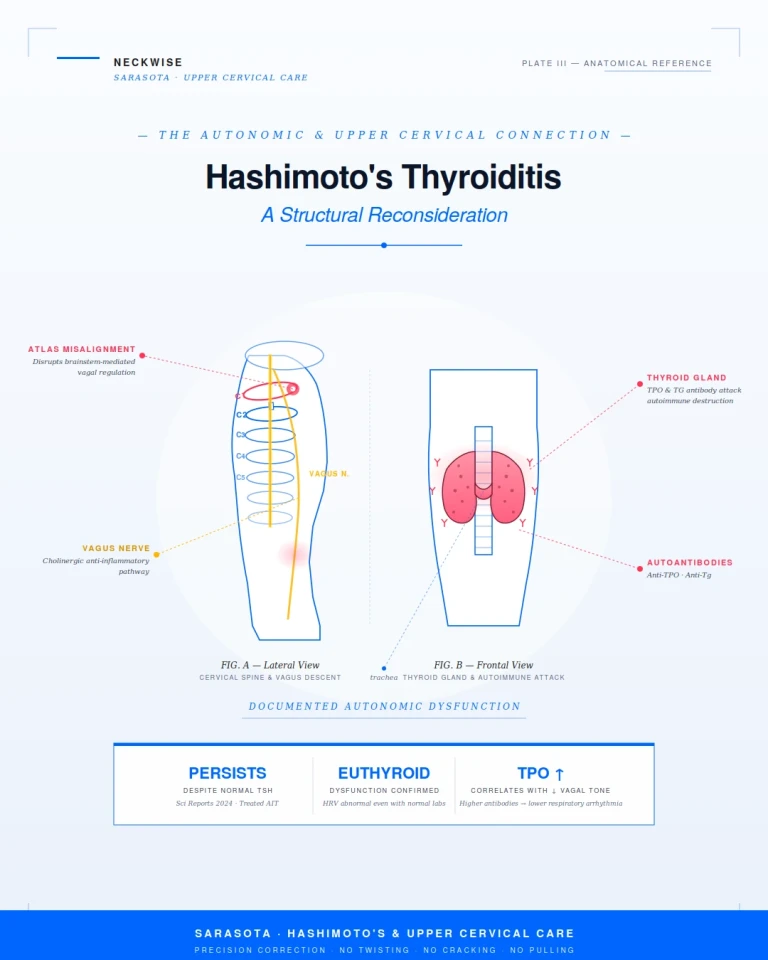
Hashimoto's Thyroiditis Treatment Support in Sarasota | The Autonomic and Upper Cervical Connection
May 14, 2026One message from the inner ear
Another from the eyes
A conflicting one from the neck
That mismatch can trigger dizziness, imbalance, and spinning sensations.
Vertigo and Upper Cervical Misalignment
Vertigo is the sensation that you or your surroundings are moving when they are not.
Upper cervical misalignment may contribute to vertigo by:
Altering proprioceptive signaling
Irritating brainstem structures
Affecting blood flow regulation
Increasing muscular tension asymmetrically
Many patients notice their vertigo began after:
A car accident
A fall
A sports injury
A concussion
Chronic forward head posture
The upper cervical spine sits directly beneath the brainstem — the control center for balance and autonomic function.
Reducing mechanical stress in this region may help stabilize balance processing.
👉 If you experience spinning or disequilibrium in Sarasota, schedule your FREE consultation today.
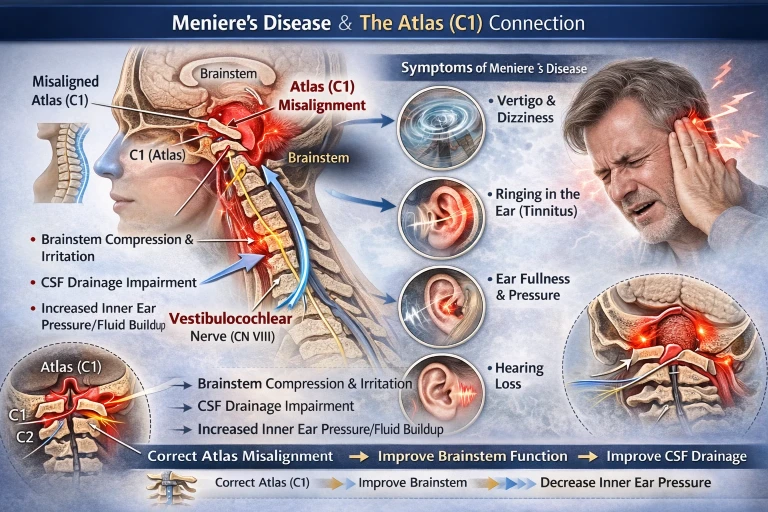
Ménière’s Disease and the Neck Connection
Ménière’s disease is often characterized by:Vertigo episodes
Ear fullness
Tinnitus
Fluctuating hearing loss
While Ménière’s involves inner ear fluid dynamics, the upper cervical spine may influence:
Brainstem processing of vestibular input
Autonomic regulation of fluid balance
Cranial nerve signaling
Muscle tension around the jaw and ear
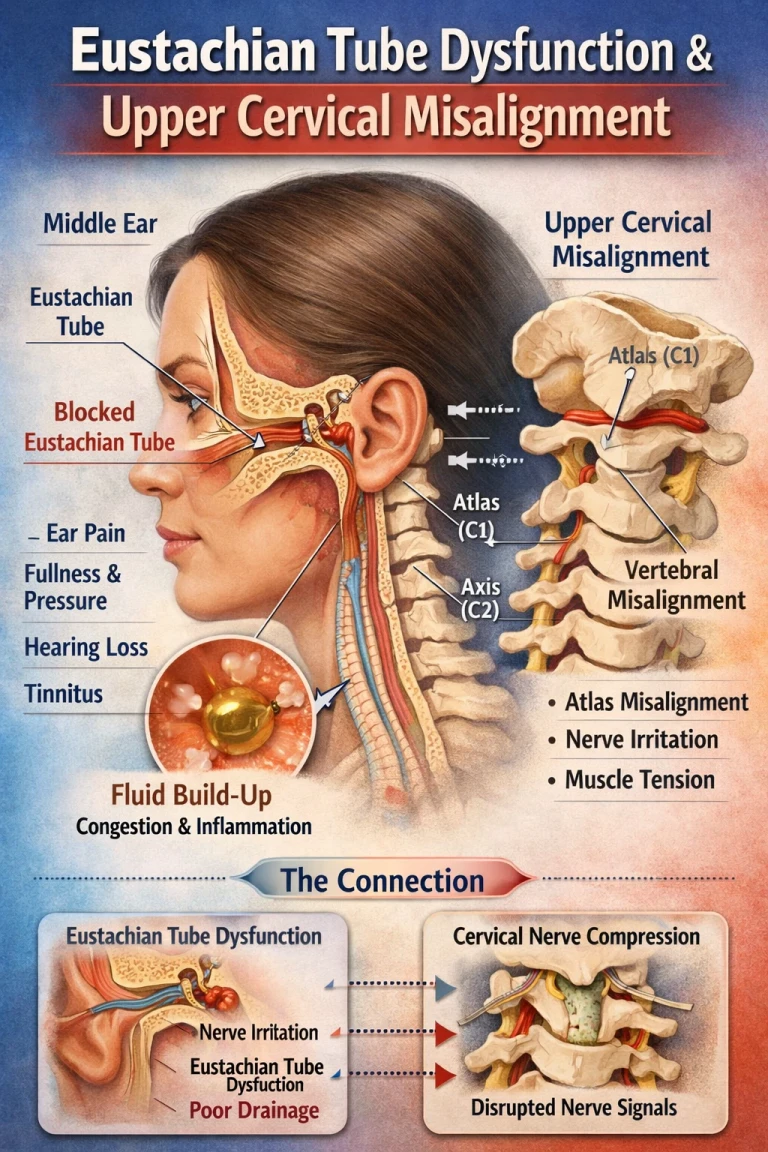
Misalignment at C1 can create abnormal neurological signaling that affects how the brain interprets vestibular input.
Some patients report improvement in the frequency or intensity of episodes when upper cervical alignment is restored.
Upper cervical care does not “cure” Ménière’s — but reducing mechanical irritation at the brainstem may support more stable neurological function.
👉 Don’t just manage flare-ups. Book your FREE consultation and investigate whether the top of your neck is involved.
MDDS (Mal de Débarquement Syndrome) and Neurological Mismatch
MDDS often presents as:
A persistent rocking or swaying sensation
Feeling like you’re still on a boat
Symptoms that improve with motion but worsen when still
This condition involves abnormal central processing of motion and balance signals.
Because the upper cervical spine heavily influences proprioceptive input to the brainstem, misalignment may contribute to:
Persistent sensory mismatch
Abnormal vestibular integration
Autonomic instability
Correcting upper cervical alignment may help normalize the input being sent to the brainstem, reducing the mismatch contributing to symptoms.
Listen to one of our pateints revcovery stories - click here.
👉 If you feel like you’re constantly rocking or swaying, schedule your FREE consultation today.
Precision Matters: Why Upper Cervical Is Different
Not all chiropractic care is the same.
Traditional full-spine chiropractic often involves:
Repetitive adjustments
Twisting and cracking
General spinal manipulation
Upper cervical care focuses specifically on C1 and C2.
We utilize advanced 3D CBCT imaging to:
Measure the exact angle of misalignment
Identify rotational and lateral displacement
Customize the correction to your anatomy
Every misalignment pattern is unique.
Without imaging, adjustments are generalized.
With CBCT, the correction is precise and tailored.
And most importantly:
There is no aggressive twisting or forceful cracking of the neck.
Upper cervical corrections are:
Gentle
Specific
Based on measurable data
Designed to reduce neurological stress
Is Your Dizziness Coming From Your Neck?
You may want to consider an upper cervical evaluation if:
Your symptoms began after neck trauma
You have chronic neck stiffness with dizziness
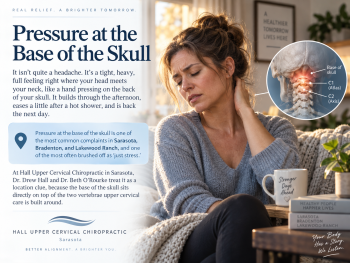
You feel pressure at the base of your skull
You’ve tried vestibular therapy without lasting results
You’ve been told everything looks “normal”
Your brainstem sits directly above the upper cervical spine.
Mechanical stress in this area can influence balance processing more than most people realize.
Take the Next Step in Sarasota
If you’re searching for relief from:
Vertigo
Ménière’s disease
MDDS
And you’re in Sarasota or surrounding areas, it may be time to evaluate the foundation beneath your brainstem.
Upper cervical chiropractic focuses on:
Reducing mechanical stress
Supporting brainstem function
Normalizing proprioceptive input
Restoring balance stability
👉 Schedule your FREE consultation today and discover whether upper cervical misalignment may be contributing to your dizziness.
You don’t have to live in fear of the next episode.
The answer may be closer to the top of your neck than you think.
Leave a comment