

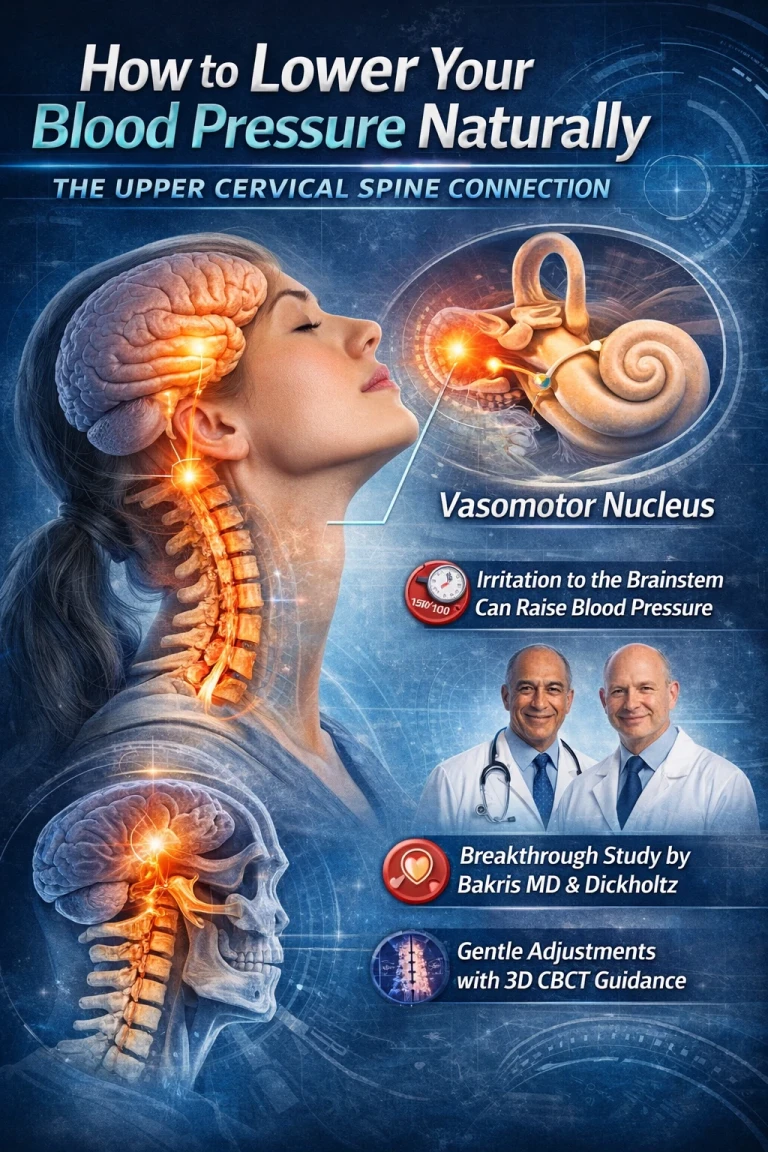
High blood pressure, also known as hypertension, is one of the most common and dangerous health conditions in the world today. It’s often called the “silent killer” because it can quietly damage your heart, brain, and blood vessels for years before symptoms ever appear.
In this article we will talk about how the upper cervical spine intimatley connected to blood pressure regulation and explain how the root cause in many cases can be a neck misalignment.
Most people are told the same things:
Reduce salt
Exercise more
Manage stress
Take medication
While these approaches can be helpful, they often don’t address a deeper neurological component that plays a critical role in regulating blood pressure:
The brainstem—and more specifically, the vasomotor nucleus.
What if part of the reason your blood pressure is elevated isn’t just lifestyle… but mechanical irritation to the brainstem caused by misalignment in the upper cervical spine?
Let’s break this down.
Click here to schedule a FREE consultation.
Understanding Blood Pressure Regulation in the Brain
At the core of your body’s blood pressure control system is a small but incredibly powerful area in your brainstem called the vasomotor nucleus.
This center is responsible for:
Regulating blood vessel diameter (vasoconstriction vs. vasodilation)
Controlling heart rate
Maintaining proper blood flow to vital organs
It does this automatically—every second of every day—without you having to think about it.
When functioning properly, the vasomotor nucleus keeps your blood pressure within a healthy range by constantly adjusting your vascular tone.
Click here to schedule a FREE consultation.
The Brainstem: A Critical Control Center
The brainstem sits at the base of your skull, directly above the upper cervical spine (C1 and C2)—also known as the atlas and axis.
This region is incredibly sensitive because:
It houses vital autonomic control centers (like the vasomotor nucleus)
It is responsible for communication between the brain and body
It regulates functions like heart rate, breathing, and blood pressure
Because of this close anatomical relationship, any structural misalignment in the upper cervical spine can directly affect brainstem function.
How Upper Cervical Misalignment Can Raise Blood Pressure
When the atlas (C1) or axis (C2) becomes misaligned—often due to trauma such as:
Car accidents
Falls
Sports injuries
Repetitive postural stress…it can create mechanical irritation or stress on the brainstem.
This irritation can disrupt the normal function of the vasomotor nucleus.
What Happens Next?
Instead of maintaining balance, the nervous system may shift into a state of increased sympathetic activity, leading to:
Vasoconstriction (tightening of blood vessels)
Increased resistance in the vascular system
Elevated blood pressure
In simple terms:
If the brainstem is irritated, your body may interpret it as a stress signal—and respond by raising your blood pressure.
Click here to schedule a FREE consultation.
The Neurology Behind Vasoconstriction
The vasomotor nucleus sends signals through the autonomic nervous system to control the smooth muscles in your blood vessels.
When functioning normally:
Blood vessels dilate and constrict as needed
Blood pressure stays balanced
But when disrupted:
Signals can become excessive or unregulated
Blood vessels remain in a more constricted state
Blood pressure rises chronically
This is not just a chemical issue—it can be neurological and structural.
The Upper Cervical Spine: A Neurological “Choke Point”
The atlas vertebra is uniquely designed to support the skull and allow for a wide range of motion.
However, it also represents a critical junction where:
The brainstem transitions into the spinal cord
Cerebrospinal fluid (CSF) flows between the brain and body
Major blood vessels pass into and out of the skull
Even a slight misalignment here can:
Alter pressure dynamics
Affect nerve signaling
Interfere with normal autonomic regulation
This is why the upper cervical spine is often referred to as a neurological choke point.
The NUCCA Study: Evidence That Alignment Matters
One of the most compelling pieces of research on this topic comes from a study conducted by George Bakris and Marshall Dickholtz Jr..
This study examined the effects of upper cervical correction on patients with hypertension.
Key Findings:
Patients who received a precise upper cervical correction experienced significant reductions in blood pressure
The average drop was comparable to taking two blood pressure medications at once
The correction was sustained over time without additional intervention
This research highlighted something profound:
Correcting structural misalignment in the upper neck can have a measurable impact on blood pressure regulation.
Why This Approach Is Different
Most traditional approaches to hypertension focus on:
Chemistry (medications)
Lifestyle (diet, exercise)
While important, they often overlook structural and neurological factors.
Upper cervical care addresses:
The root cause of nervous system interference
The relationship between structure and function
The body’s ability to self-regulate once interference is removed
The Role of 3D CBCT Imaging
One of the biggest advancements in upper cervical care is the use of 3D CBCT (Cone Beam CT) imaging.
Unlike traditional X-rays, CBCT provides:
A full 3D view of the upper cervical spine
Precise measurements of misalignment
Exact direction and degree of displacement
This is critical because:
No two misalignments are the same.
CBCT allows doctors to create a custom correction plan based on your unique anatomy.
Precision Corrections—Without Force
A common misconception about chiropractic care is that it involves twisting, cracking, or aggressive manipulation.
Upper cervical care is completely different.
Corrections are:
Extremely gentle
Highly specific
Based on detailed imaging
Delivered without twisting, popping, or pulling
The goal is not force—it’s precision.
By restoring proper alignment:
Pressure on the brainstem can be reduced
Nervous system function can normalize
The body can begin regulating blood pressure more effectively
A Natural Path to Better Blood Pressure
For patients dealing with high blood pressure, this approach offers something unique:
A non-invasive option
A neurologically focused solution
A potential way to reduce reliance on medication (under medical supervision)
It’s not about replacing all other approaches—but about addressing a missing piece of the puzzle.
Who Should Consider This?
You may want to explore the upper cervical connection if you:
Have high blood pressure with no clear cause
Have a history of head or neck trauma
Experience neck pain, tension, or headaches
Feel like your condition isn’t fully improving with traditional care
Final Thoughts
Your body is designed to regulate itself.
The brainstem—and specifically the vasomotor nucleus—plays a central role in controlling blood pressure. When that system is disrupted, the effects can be widespread.
By addressing the structural alignment of the upper cervical spine, it may be possible to restore proper neurological function and support the body’s natural ability to maintain healthy blood pressure.
If you’ve been searching for answers beyond medication and lifestyle changes, this may be a direction worth exploring.
Because sometimes, the key to lowering blood pressure naturally… isn’t just in what you take—but in how your body is aligned.


Leave a comment