

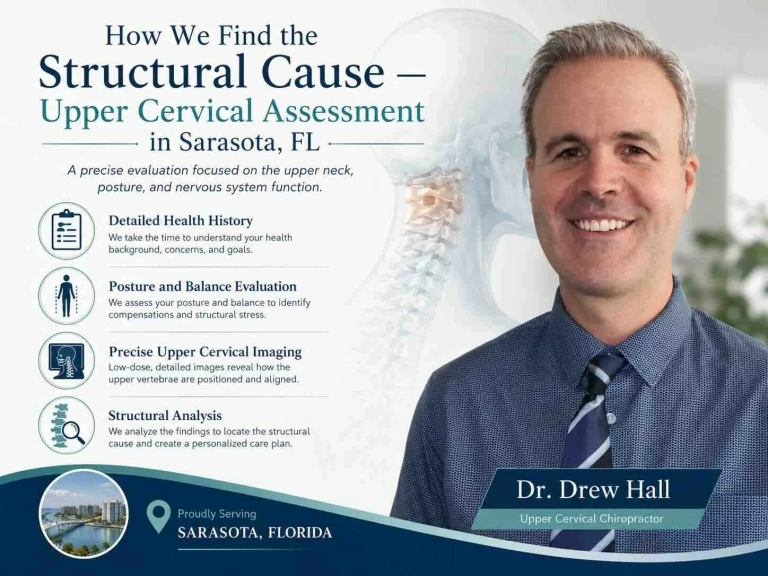
Most people who walk into a chiropractic office for the first time expect to be adjusted on the first visit. At Sarasota Upper Cervical Chiropractic on Bee Ridge Road, that is not how it works — and the reason why matters more than most patients initially realize.
Before any correction is considered, before any adjustment is delivered, there is a structured assessment process designed to answer one specific question: is the upper cervical spine contributing to what this patient is experiencing, and if so, exactly how?
Schedule Your Appointment
Schedule appointmentThat question cannot be answered by feel, by assumption, or by a general physical examination. It requires a layered process built around objective data. At this office, that process has three distinct layers — the history conversation, the examination, and the structural measurement. Each one builds on the last. Together they create a complete picture of the patient's structural situation before anything else happens.
This is what separates upper cervical chiropractic from general manual therapy. The precision of the assessment is what makes the precision of the correction possible.
Why the Assessment Comes Before Everything Else
Upper cervical chiropractic is not a treatment applied to everyone who walks in with pain. It is a specific structural intervention for a specific structural problem — misalignment of the atlas (C1) and axis (C2) vertebrae at the top of the spine, and the neurological consequences that follow from it.
Not every patient who presents with symptoms has an upper cervical component to their problem. Not every headache originates from atlas displacement. Not every case of dizziness or neck tension has a structural cause that upper cervical correction can address.
The assessment process exists to determine which patients do have that structural component — and to measure it precisely enough that the correction, when delivered, is specific to their anatomy rather than generic to their symptoms.
Delivering a correction without that assessment is guesswork. At Sarasota Upper Cervical Chiropractic, the commitment is to never adjust what has not been objectively measured.
Layer One: The History Conversation

The assessment begins with a conversation. Not a form. Not a checklist handed to the patient in the waiting room. A real conversation between the patient and the practitioner, designed to understand the full picture of what has been happening and when.
The history conversation covers several areas that a standard intake process rarely explores in depth:
- The timeline of symptoms — when they began, whether onset was gradual or sudden, whether there was a specific event that preceded them
- Trauma history — accidents, falls, sports injuries, surgical procedures, birth history where relevant.
- Events that may have occurred years or even decades before the current symptoms and that the patient may not immediately connect to their present condition
- Previous treatments — what has been tried, what helped temporarily, what made things worse, and what has produced no change at all
- Symptom pattern — how symptoms behave throughout the day, what aggravates them, what positions or activities provide relief, whether they are constant or episodic
This last category is particularly important in upper cervical assessment. The pattern of symptoms — not just their presence — often tells a structural story. Symptoms that worsen with sustained postures, that change with head position, or that began following a specific physical event are consistent with upper cervical involvement and point the assessment in a productive direction.
The history conversation also establishes something that clinical data alone cannot provide: context. Understanding the patient as a person — their occupation, their daily physical demands, their stress load, their sleep quality — shapes how the subsequent examination findings are interpreted and how care is approached if structural involvement is confirmed.
This layer takes time. It is not rushed. The information gathered here directly informs what the examination looks for and what the structural measurement is calibrated to find.
Layer Two: The Examination
The second layer is a structured physical and neurological examination focused on identifying objective signs of upper cervical involvement. This is not a general chiropractic examination covering the full spine. It is targeted specifically at the region and the mechanisms relevant to upper cervical function.
The examination at Sarasota Upper Cervical Chiropractic includes several components that work together to build the objective picture:
Postural analysis documents how the body is currently compensating for any structural imbalance at the top of the spine. When the atlas is displaced, the spine adapts from top to bottom — the head tilts, one shoulder drops, the pelvis shifts, and a functional leg length difference often develops as a result.
Related article

Still Rocking After a Cruise? Understanding Mal de Débarquement Syndrome in Sarasota
Jul 30, 2026These postural findings are not incidental. They are the body's adaptation to the atlas misalignment, and they provide a measurable baseline that changes when the structural correction is achieved.
Leg length analysis assesses the functional asymmetry in the pelvis and lower extremities that results from spinal compensation. A measurable functional leg length difference in the context of other upper cervical findings is a meaningful objective indicator of structural involvement.
Paraspinal infrared thermography measures temperature differentials along either side of the spine. The autonomic nervous system regulates skin temperature, and asymmetric temperature patterns along the paraspinal region indicate areas of neurological stress.
Thermography provides a real-time functional picture of how the nervous system is responding to the current structural state — and it is repeatable, allowing direct before-and-after comparison following correction.
Cervical range of motion assessment evaluates how the head and neck move through their full range and identifies restrictions, asymmetries, and pain patterns that help localize the structural involvement.
Neurological screening where indicated — assessing reflexes, sensory function, and cranial nerve responses that may be relevant to the patient's symptom picture.
Together these examination findings either support or do not support the presence of upper cervical structural involvement. If the findings are equivocal or absent, the patient is informed honestly and referred to the appropriate provider. If the findings indicate upper cervical involvement, the assessment moves to its third and most precise layer.
Layer Three: The Structural Measurement
The third layer is where upper cervical chiropractic diverges most fundamentally from every other assessment approach in manual medicine. It is the structural measurement — objective, three-dimensional imaging of the upper cervical spine that quantifies the misalignment with a level of precision that standard imaging cannot approach.
At Sarasota Upper Cervical Chiropractic, this measurement is performed using cone beam computed tomography — CBCT imaging — which produces a true three-dimensional reconstruction of the atlas and axis and their relationship to the skull. The imaging measures:
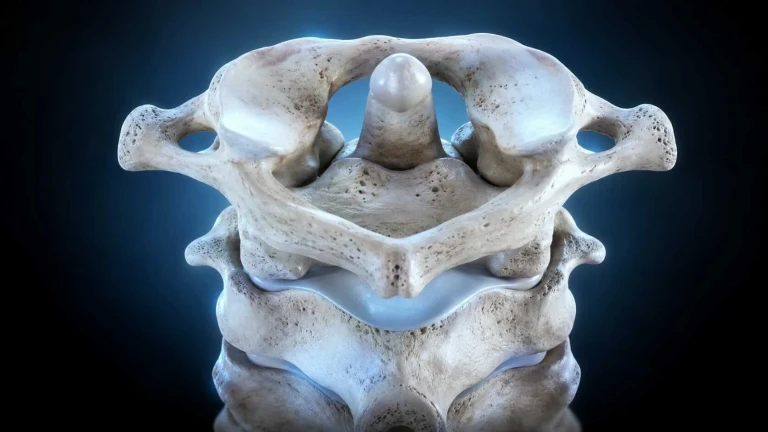
- The rotational position of the atlas relative to the skull and axis
- The lateral displacement of the atlas from its neutral position
- The angular deviation of the atlas in multiple planes
- The specific direction and magnitude of the misalignment
These measurements are expressed in degrees and millimeters. They are not estimates or clinical impressions. They are objective structural data that define exactly what is present before any correction is considered.
This precision matters for two reasons. First, it makes the correction specific. Upper cervical adjustments are not applied generically — the vector, the direction, and the force are all calculated from the imaging data. No two corrections are identical because no two misalignments are identical. The measurement is what makes that specificity possible.
Second, it provides a verifiable baseline. Post-correction imaging confirms that the atlas moved into its corrected position. Follow-up thermography and postural analysis document how the nervous system is responding. The entire process is measurable from start to finish — not dependent on patient report or practitioner feel, but anchored in objective data at every stage.
What Patients Experience After the Assessment
The assessment process at Sarasota Upper Cervical Chiropractic is thorough by design, not by habit. Patients who go through it leave with something most healthcare encounters do not provide: a clear, objective understanding of what is structurally present in their upper cervical spine and whether it is contributing to what they have been experiencing.
For patients who have accumulated years of symptoms, multiple diagnoses, and a long list of treatments that produced partial or temporary relief, that clarity is often significant in itself. Seeing the structural picture on imaging — understanding why the body has been compensating the way it has — reframes the entire symptom history in a way that makes sense for the first time.
For patients who do not have upper cervical involvement, the assessment provides an equally valuable answer: the problem is elsewhere, and the appropriate referral is made. Upper cervical chiropractic is a specific intervention for a specific structural problem. The assessment process is how that specificity is maintained.
Sarasota Upper Cervical Chiropractic is located at 3920 Bee Ridge Rd, Building D, Sarasota, FL 34233.
Call (941) 259-1891 to schedule your assessment.
Understanding what is structurally present in your upper cervical spine is the first step — and that understanding begins with a conversation.



Leave a comment