

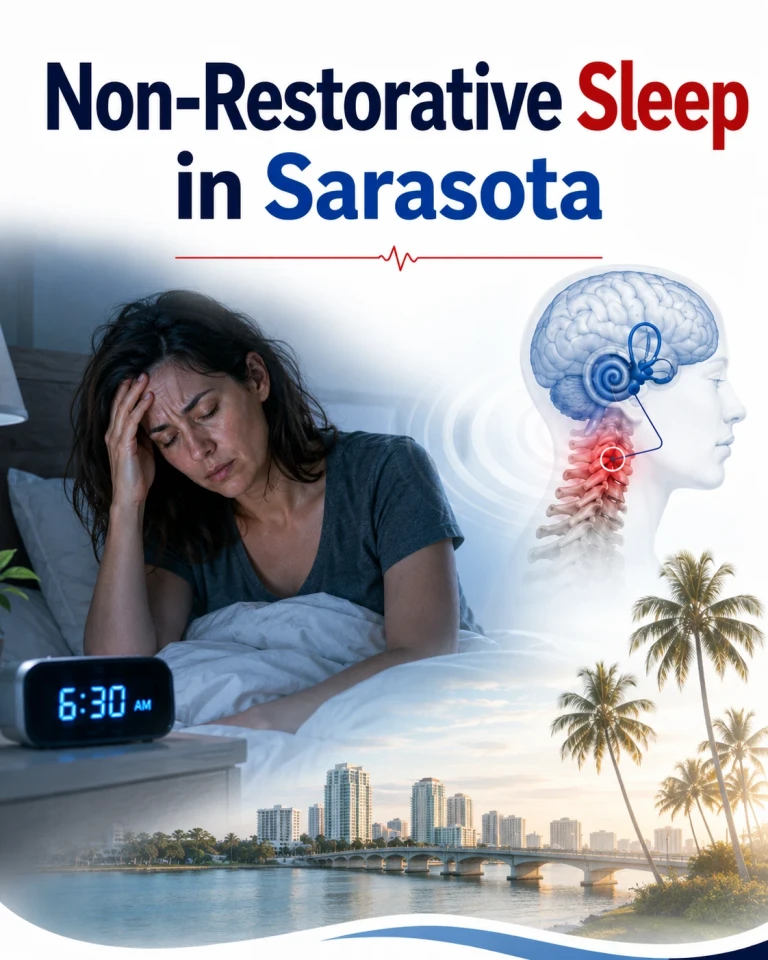
Non-restorative sleep in Sarasota is one of the hardest complaints to get taken seriously, because on paper nothing is wrong. You go to bed at a reasonable hour, you fall asleep, you stay asleep, and you wake up seven or eight hours later feeling as though you never slept at all. Your sleep tracker says the duration was fine. Your bloodwork is normal. And the standard advice — go to bed earlier, cut the caffeine, stop looking at your phone — is useless, because none of it addresses the actual problem. This article explains why sleep quantity and sleep quality come apart, and what should be objectively measured before anyone tells you it is just stress.
Sleep Duration Is the Wrong Measurement
Schedule Your Appointment
Schedule appointment
The assumption buried in most sleep advice is that hours asleep and restoration achieved are roughly the same thing. They are not. Sleep is a structured sequence of physiological states, and the restorative work happens during specific ones. If those states are degraded, you can spend eight hours unconscious and get very little of the benefit.
This is why consumer sleep trackers mislead so many people. They estimate time in bed and time asleep reasonably well. What they cannot reliably measure is whether the deep sleep you appear to be getting is doing anything. A person can log a normal amount of slow-wave sleep by the clock and still wake unrefreshed, because time-in-stage and quality-of-stage are different variables.
What Deep Sleep Is Supposed to Do to Your Body
Descending into deep non-REM sleep is not a passive fade. It is accompanied by a coordinated autonomic shift: heart rate falls, blood pressure dips, and vagal tone rises while sympathetic outflow withdraws. This nocturnal dip is one of the more reliable physiological markers of genuinely restorative sleep, and it is the window in which most of the body's overnight repair work happens.
In insomnia patients with objectively short sleep duration, that dip is blunted. The reduction in heart rate from wake to sleep is smaller than in good sleepers, and heart rate variability measures are reduced. I will be straightforward that this literature is mixed — several well-designed studies have failed to find the autonomic differences, so this is a pattern rather than a universal finding. But the pattern is consistent with the broader hyperarousal model of insomnia, which is supported by elevated twenty-four-hour cortisol, raised metabolic rate, and increased core body temperature in these patients. That much is established and widely replicated.
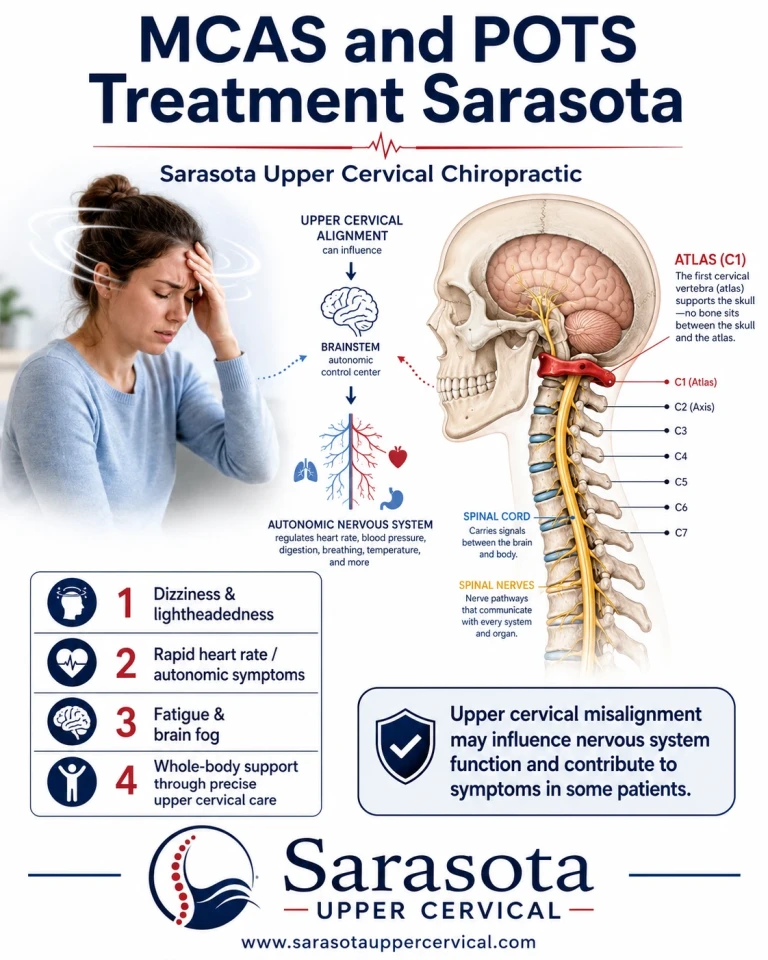
If sympathetic tone never fully withdraws overnight, the physiological conditions for restoration are never established. The clock says you slept. The body never got the signal to switch modes.
Arousal Inside Sleep
The most direct evidence that unrefreshing sleep is an arousal problem rather than a duration problem comes from EEG. One of the best-replicated findings in insomnia polysomnography is an increase in fast-frequency activity — beta and gamma bands, the signature of an alert cortex — persisting into sleep. Micro-arousals, brief intrusions of wakefulness too short to be remembered, are similarly well documented.
The clearest example is the alpha-delta sleep anomaly, first described by Harvey Moldofsky and colleagues in Psychosomatic Medicine in 1975. Studying patients with what was then called fibrositis syndrome, they found alpha activity — the rhythm of relaxed wakefulness — intruding into deep delta sleep. The body reaches slow-wave sleep, but the brain runs a low-level waking pattern simultaneously. Moldofsky interpreted this explicitly as an arousal disorder occurring within sleep, associated with the subjective experience of non-restorative sleep.
The same group then did the experiment in reverse: they disrupted stage four sleep in healthy volunteers using tones loud enough to induce the alpha-delta pattern but not loud enough to wake them, and within days those healthy subjects developed musculoskeletal aching, reduced pain tolerance, and morning stiffness that resolved once normal sleep returned. Lentz and colleagues replicated this in 1999. Two honest caveats: alpha intrusion has been observed in some healthy sleepers, so it is not a pathognomonic finding, and the causal relationship between alpha-delta sleep and chronic pain remains debated.
Still, the principle is sound and directly relevant. Sleep contaminated by arousal does not restore, regardless of how long it lasts.
Where the Upper Neck Comes In
Related article
Why Do My Hands Always Get Cold and Then Hot? | Raynaud's Relief and Doctor in Sarasota
May 12, 2026
If unrefreshing sleep is fundamentally a failure of the nervous system to downshift, then anything sustaining elevated sympathetic tone becomes relevant — and there is a specific reason to look at the upper cervical spine.
Bolton, Kerman, Woodring and Yates, publishing in Brain Research Bulletin in 1998, stimulated the C2 dorsal root ganglion and the C2 and C3 branches supplying dorsal neck muscles in anaesthetised cats, and recorded measurable changes in splanchnic sympathetic nerve activity. Upper cervical afferent input reaches autonomic circuitry directly. That region is also built to generate an unusual volume of that input: Kulkarni and colleagues reported suboccipital muscle spindle densities between 98 and 242 per gram, against roughly 17 for opponens pollicis, though those measurements came from fetal specimens and should not be applied uncritically to adults.
The most striking finding for this particular complaint comes from Schlesinger and colleagues, who published objective sleep findings after whiplash injury in Headache in 2001. In chronic whiplash patients, trapezius muscle tone failed to show the normal atonia during REM sleep — muscles that should go quiet stayed switched on. That is a physiological description of exactly what patients report: the body never stood down.
What I cannot tell you is that this is proven. That a chronic upper cervical misalignment sustains enough sympathetic elevation to degrade sleep architecture is a reasoned hypothesis extrapolated from established physiology — it has not been demonstrated in clinical trials, and Bolton's own data showed cervical input could excite or inhibit sympathetic activity depending on conditions. The fuller mechanistic account is in our pillar article on the brainstem, sympathetic tone, and the upper cervical connection.
What Should Be Measured
Total sleep time is the wrong outcome measure here, and tracking it will tell you nothing useful. What matters is autonomic state, and heart rate variability is the most accessible measure — the same class of measurement the insomnia literature relies on. Measured before and after a defined trial period, it at least tells you whether anything changed.
Where a structural hypothesis is in play, we image the
craniocervical junction with cone beam computed tomography, which reconstructs volumetric anatomy rather than forcing three-dimensional position to be inferred from a flat shadow. The honest qualifiers are that effective dose varies with field of view and protocol, and that CBCT images bone rather than nerve or soft tissue. The correction itself involves no twisting of the neck, no forced rotation, no pulling of the head, and no cracking or popping, since no joint cavitation is induced — a low-force contact applied along a vector derived from your own imaging.
When It Is Not the Neck
Obstructive sleep apnoea is by a wide margin the most common cause of unrefreshing sleep, and it is the first thing to rule out. It fragments sleep hundreds of times a night through arousals too brief to remember, which is precisely why sufferers report adequate duration and total exhaustion. Snoring, witnessed breathing pauses, waking gasping, morning headaches, or significant daytime sleepiness means you need a sleep study before pursuing anything else. Periodic limb movement disorder does the same thing by a different route.
Fibromyalgia and chronic fatigue syndrome both feature this pattern centrally, as does hypothyroidism, iron deficiency, uncontrolled pain, depression, and a long list of medications. Any of these deserves proper evaluation rather than a structural explanation.
Seek urgent medical assessment rather than adjustment for severe sudden headache unlike any you have had, progressive weakness or numbness, changes in bowel or bladder control, difficulty swallowing or speaking, or any suspicion of craniocervical instability.
Evaluation in Sarasota, Bradenton, and Lakewood Ranch
If sleep apnoea has been ruled out, your labs are clean, and you are still waking exhausted after a full night — particularly if your sleep changed after a car accident, a fall, a concussion, or a sports injury — an upper cervical evaluation will at minimum tell you whether there is a structural finding to account for it. To learn more or to schedule, visit www.neckwise.com.
Medical Disclaimer
This article is provided for general educational purposes only and does not constitute medical advice, diagnosis, or treatment, and does not establish a doctor-patient relationship. Upper cervical chiropractic care is not a treatment or cure for insomnia, non-restorative sleep, or any other named condition, and no guarantee of any particular result is made or implied. Individual results vary, and the mechanisms described include both established physiology and hypotheses not demonstrated in clinical trials, as indicated in the text. Always consult a qualified healthcare provider regarding any sleep disorder or medical condition. In accordance with Florida Administrative Code Rule 64B2-15.001, this content is offered without any claim of superiority of one method of treatment over another and without any promise of cure or guaranteed outcome.
Written by Dr. Drew Hall, upper cervical chiropractor, Sarasota Upper Cervical , serving Sarasota, Bradenton, and Lakewood Ranch, Florida.
Leave a comment