


Insomnia after a car accident is one of the most commonly dismissed injuries in Sarasota, because it rarely starts on the day of the crash. The neck pain gets documented, the imaging comes back clean, the soreness fades over a few weeks, and then three or four months later the sleep falls apart — long enough after the collision that most people never connect the two. This article explains the neurological reason that delay happens, and what should be objectively measured before anyone tells you it is stress.
The Timeline That Confuses Everyone
Schedule Your Appointment
Schedule appointment
Patients almost always describe the same sequence. Emergency room or urgent care visit, plain films, nothing broken, released with muscle relaxants. Neck stiffness for a few weeks that gradually improves. Then, somewhere between one and six months out, difficulty falling asleep with no obvious trigger, or waking at two in the morning fully alert, or sleeping a full night and waking as though they had not slept at all.
By that point the accident feels like old news, and the sleep problem gets attributed to work stress, to the insurance claim, to age — to anything except the collision. That delay is precisely why the connection gets missed.
What Whiplash Actually Damages
The reason plain imaging comes back clean is that the injury mechanism does not produce the kind of damage plain imaging detects. Manohar Panjabi, Beth Winkelstein and their collaborators demonstrated that in whiplash loading, the cervical facet capsular ligaments undergo strains exceeding physiological range but falling short of gross rupture. This is called subfailure injury: real tissue damage, no fracture, no dislocation, normal radiographs. That is established biomechanics.
Related article
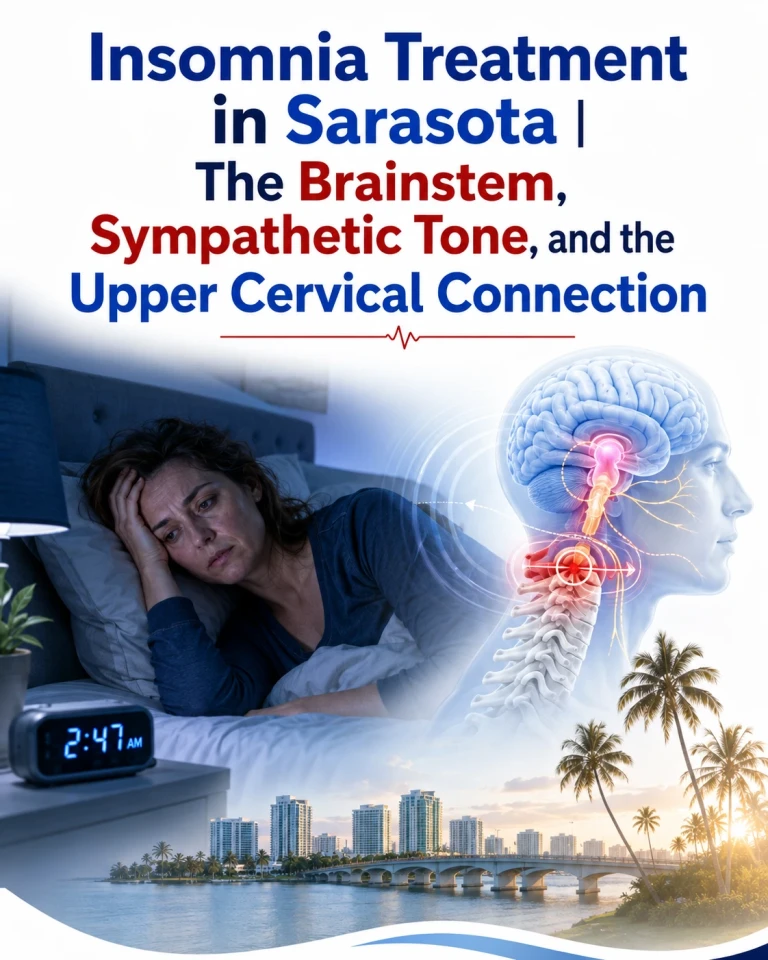
Insomnia Treatment in Sarasota | The Brainstem, Sympathetic Tone, and the Upper Cervical Connection
Aug 13, 2026What makes subfailure injury at the top of the neck different from the same injury elsewhere is what those tissues do. The suboccipital region carries an extraordinary density of muscle spindles — Kulkarni and colleagues, measuring in Neurology India in 2001, reported figures ranging from 98 to 242 spindles per gram across the suboccipital muscles, against roughly 17 for opponens pollicis, a muscle we already consider finely controlled. Those measurements came from stillborn fetuses, so the absolute numbers should not be applied uncritically to adults, but the qualitative point holds across multiple independent studies: this region is built to report position, not to generate force.
Damage the tissues carrying that signal and the signal itself degrades. Hallgren, McPartland and others have documented fatty atrophy of rectus capitis posterior minor after whiplash, correlating with chronic neck pain and reduced standing balance.
Why Corrupted Neck Signalling Shows Up at Two in the Morning
Chronic insomnia is best understood not as a shortage of sleepiness but as an excess of arousal — the hyperarousal model, supported by elevated 24-hour cortisol, raised metabolic rate, increased heart rate, and a heart rate variability shift toward sympathetic dominance in insomnia patients. That is established and widely replicated.
The link to the neck runs through the brainstem. Bolton, Kerman, Woodring and Yates, publishing in Brain Research Bulletin in 1998, stimulated the C2 dorsal root ganglion and the C2 and C3 branches supplying dorsal neck muscles in anaesthetised cats and recorded measurable changes in splanchnic sympathetic nerve activity. Upper cervical afferent input demonstrably reaches autonomic circuitry. Later tracing work by Edwards, Deuchars and colleagues followed those same C2 afferents to the intermedius nucleus of the medulla, embedded in cardiorespiratory control — and those authors framed their investigation explicitly around the autonomic abnormalities seen in whiplash-associated disorders.
Two caveats matter. Bolton's work showed cervical input could either excite or inhibit sympathetic activity depending on conditions, so this is not a simple dial. And the proposition that a chronic post-traumatic atlas misalignment sustains enough sympathetic elevation to fragment sleep is a reasoned hypothesis extrapolated from that established physiology — it has not been demonstrated in clinical trials.
What is independently documented is the association. Schlesinger and colleagues published objective and subjective sleep findings after whiplash injury in Headache in 2001, including the notable observation that trapezius muscle tone in chronic whiplash patients failed to show normal atonia during REM sleep. A 2022 systematic review in Frontiers in Psychiatry found sleep disturbance consistently reported after whiplash, though prevalence varied widely. A study of 165 people with chronic whiplash-associated disorders found greater sleep disturbance associated with longer symptom duration, higher pain and disability, and worse quality of life. The fuller mechanistic account is in our pillar article on the brainstem, sympathetic tone, and the upper cervical connection.
Related article
Tinnitus Relief: Understanding the Upper Cervical Connection to Ear Ringing
Jan 26, 2026What Should Be Measured
A structural explanation for your sleep is worth nothing unless it is measured before and after. We use cone beam computed tomography of the craniocervical junction, which reconstructs actual volumetric anatomy rather than forcing three-dimensional position to be inferred from a two-dimensional shadow. A 2022 literature review found CBCT visualisation of craniocervical junction findings superior to radiography at comparable or lower effective dose, with the honest qualifiers that dose varies substantially by field of view and protocol, and that CBCT images bone rather than nerve or soft tissue.
Alongside imaging, some measure of autonomic state belongs in the workup — heart rate variability is the most accessible, and it is the same class of measurement the insomnia literature relies on. A validated sleep diary or actigraphy matters too, since subjective sleep reporting is unreliable in this population.
The correction itself involves no twisting of the neck, no forced rotation, no pulling of the head, and no cracking or popping, because no joint cavitation is induced. A precisely calculated low-force contact is applied along a vector derived from your own imaging. That approach follows from the mechanism — introducing a high-velocity rotational stimulus into an already-sensitised, recently injured region works against the goal — though I will state plainly that superiority of low-force technique for sleep outcomes specifically has not been established in comparative trials.
When It Is Not the Neck
Obstructive sleep apnoea is the first thing to rule out. Snoring, witnessed breathing pauses, waking gasping, or significant daytime sleepiness means you need a sleep study before anything else. Restless legs syndrome, thyroid dysfunction, uncontrolled pain, and many medications disrupt sleep through mechanisms unrelated to your atlas. Post-traumatic stress after a serious collision causes insomnia directly and warrants mental health assessment, not a structural explanation. Where concussion also occurred, the picture overlaps heavily with post-concussion syndrome.
Related article
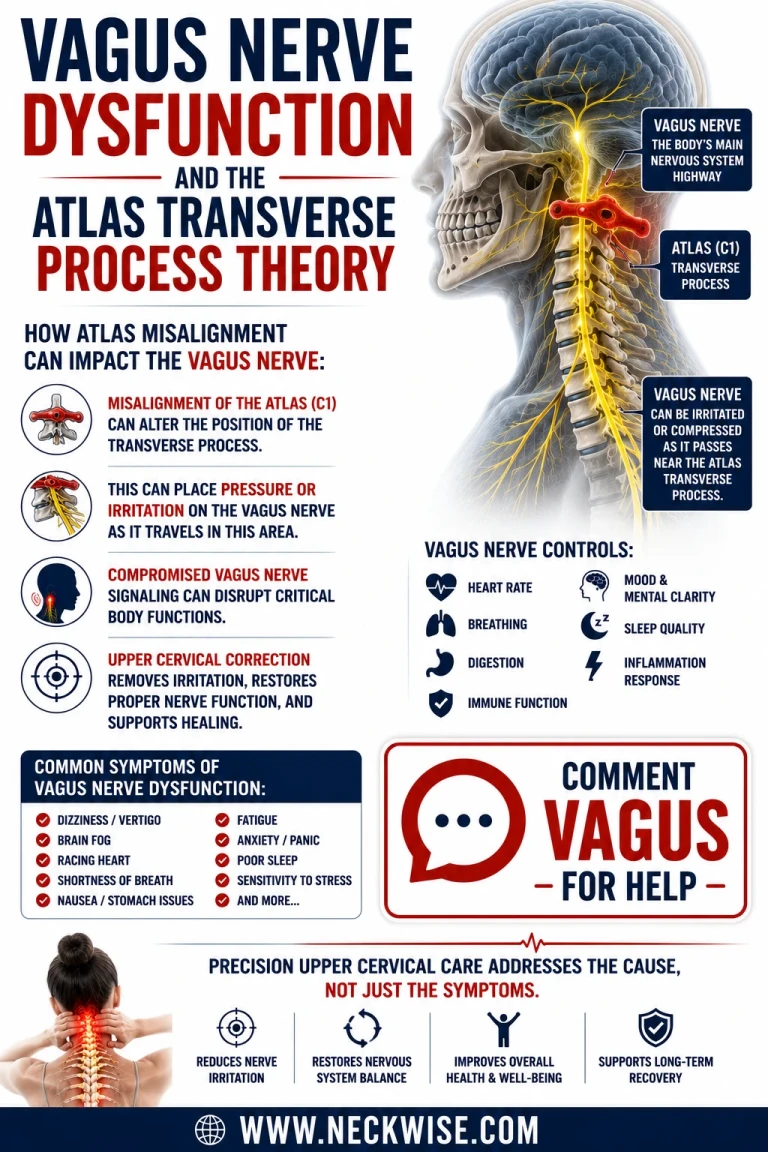
Seek urgent medical evaluation rather than adjustment for severe sudden headache unlike any you have had, progressive weakness or numbness, changes in bowel or bladder control, difficulty swallowing or speaking, or any suspicion of craniocervical instability.
Evaluation in Sarasota, Bradenton, and Lakewood Ranch
One practical note for Florida drivers: personal injury protection coverage generally requires that initial services be sought within fourteen days of the accident, so if your collision is recent, timing matters independently of your symptoms.
If your sleep changed after a crash and nobody has connected the two, an upper cervical evaluation will at minimum tell you whether there is a structural finding to explain it. To learn more or to schedule call 941 259-1891
Medical Disclaimer
This article is provided for general educational purposes only and does not constitute medical or legal advice, diagnosis, or treatment, and does not establish a doctor-patient relationship. Upper cervical chiropractic care is not a treatment or cure for insomnia or any other named disease, and no guarantee of any particular result is made or implied. Individual results vary, and the mechanisms described include both established physiology and hypotheses not demonstrated in clinical trials, as indicated in the text. Always consult a qualified healthcare provider regarding any sleep disorder or injury. In accordance with Florida Administrative Code Rule 64B2-15.001, this content is offered without any claim of superiority of one method of treatment over another and without any promise of cure or guaranteed outcome.
Written by Dr. Drew Hall, upper cervical chiropractor, Sarasota Upper Cervical / Hall Upper Cervical Chiropractic PC, serving Sarasota, Bradenton, and Lakewood Ranch, Florida.
Leave a comment