


Multiple sclerosis is one of the most challenging neurological conditions a person can face. The unpredictability of symptoms, the slow progression, and the limited options outside of long-term medication leave many patients searching for something more. If you live in Sarasota and have been diagnosed with MS, you have likely tried medications, supplements, lifestyle changes, and physical therapy. You may have read everything available online. And you may still feel like no one has addressed the underlying mechanics of why your nervous system is misfiring.
At Sarasota Upper Cervical Chiropractic, we focus on a different question than most of conventional medicine asks. Instead of looking only at the immune system or at the demyelination itself, we look at the structural relationship between the head, the upper neck, and the brainstem. There is a growing body of research suggesting that a misalignment in the upper cervical spine — specifically at the atlas (C1) and axis (C2) — can interfere with the function of the central nervous system in ways that may contribute to MS symptoms and disease progression.
This article walks through what the research shows, why the upper cervical spine matters in MS, and how natural, structural care has helped many people living with this condition find meaningful relief.
What Multiple Sclerosis Is, and Why Standard Care Often Falls Short
Multiple sclerosis is an autoimmune and neurodegenerative disease in which the body's immune system attacks the protective myelin sheath surrounding nerve fibers in the brain and spinal cord. As the myelin breaks down, electrical signals between the brain and the rest of the body become disrupted. Symptoms vary enormously from person to person but commonly include fatigue, numbness, tingling, vision changes, muscle weakness, balance problems, cognitive difficulties, and bladder dysfunction.
Nearly one million people in the United States are living with MS, and the disease is roughly three times more common in women than in men. Most patients are diagnosed between the ages of 20 and 50, although onset can occur outside that range.
Conventional MS care relies heavily on disease-modifying therapies designed to slow progression and reduce relapses. These medications can be valuable, but they do not address what initially set the nervous system off course, and they often come with significant side effects. For patients who want a complementary, drug-free option that focuses on the mechanics of the nervous system itself, upper cervical chiropractic care has emerged as an avenue worth understanding.
The Upper Cervical Connection: Why C1 and C2 Matter
The atlas (C1) is the top vertebra of the spine and the one that supports the skull. Just below it sits the axis (C2). Together, these two vertebrae form a region unlike any other in the spinal column. There are no discs between them, the brainstem passes directly through the opening they create, and the vertebral arteries weave through specific channels in the bone before entering the skull to supply the brain with blood.
When the atlas shifts even a small amount out of its proper position — often as the result of an old head or neck injury, a fall, a car accident, a sports concussion, or a difficult birth — it can create what upper cervical chiropractors call an atlas displacement complex. This is not the same as a typical neck ache. It is a structural shift that can subtly affect the brainstem, alter cerebrospinal fluid flow, irritate nerve pathways, and disrupt venous drainage from the brain.
These last two points — cerebrospinal fluid flow and venous drainage — have become major areas of MS research. Three independent bodies of work in particular illuminate why.
Dr. Erin Elster's Case Series on MS and Upper Cervical Care
One of the most cited researchers on the connection between upper cervical injury and MS is Dr. Erin Elster, D.C. Her published case series stands out because it was the first body of work to formally document outcomes for MS patients receiving specific upper cervical correction.
In 2001, Dr. Elster published a case report in the *Journal of Vertebral Subluxation Research* describing the management of a 47-year-old woman with chronic progressive MS. She had been diagnosed two years earlier after MRI showed multiple lesions, and she presented with cognitive issues, loss of bladder control, leg weakness, and paresthesias in her arms and legs. After receiving specific upper cervical chiropractic care addressing an atlas misalignment, her symptoms reportedly went into remission within several months. Her case was striking enough that it prompted further investigation.
In 2004, Dr. Elster published a retrospective analysis of 81 patients with either multiple sclerosis or Parkinson's disease in the same journal. Every patient in the study was found to have a history of upper cervical trauma — events that ranged from car accidents to falls to sports injuries, sometimes occurring years or even decades before MS or Parkinson's symptoms appeared. After receiving upper cervical chiropractic care to address the atlas misalignment, 91 percent of the MS patients and 92 percent of the Parkinson's patients reported significant symptomatic improvement, and progression of their conditions appeared to halt during the period of care.
Dr. Elster summarized the implication of her work this way in a press release accompanying her research: head and neck injuries have long been considered a possible contributing factor in MS, but her work was among the first to document that correction of those underlying injuries can be associated with meaningful change in MS symptoms.
These outcomes are not typical of every MS patient, and a case series is not the same as a randomized controlled trial. But the consistency of the findings across so many patients — and the biological plausibility of the mechanism — has made this work foundational in upper cervical research.
The Italian Study: Atlas Correction and CCSVI
A second important study appeared in the *Annals of Italian Chiropractic*, examining the relationship between upper cervical structural correction, chronic cerebrospinal venous insufficiency (CCSVI), and multiple sclerosis. The aim of the study, as stated in its abstract, was to evaluate the clinical and X-ray results of upper cervical chiropractic care through specific adjustments of C1-C2 in patients with CCSVI and MS.
Seventy-seven patients diagnosed with MS were examined for both atlas displacement complex and CCSVI. The investigators used three measurements to track patient outcomes: post-correction X-rays to confirm structural realignment, a symptom questionnaire to track changes in MS symptoms, and a standardized disability index to measure functional change.
The results were significant across all three measures. Reduction of the atlas displacement complex was documented on post-imaging, and patients reported subjective symptomatic improvement that the authors characterized as the most significant finding of the study.
What makes this study particularly compelling is that it was not just measuring how patients felt. It was correlating an objective structural change — a measurable correction of atlas position — with both a reduction in MS symptoms and an improvement in functional disability scores. That kind of three-way correlation is unusual in any chiropractic literature, and it provides further support for the idea that the structural position of the upper neck is mechanically tied to nervous system function in MS patients.
Dr. Michael Flanagan's Research on Craniospinal Hydrodynamics
The third major piece of research worth understanding is the work of Dr. Michael F. Flanagan, whose 2015 paper in *Neurology Research International* — "The Role of the Craniocervical Junction in Craniospinal Hydrodynamics and Neurodegenerative Conditions" — laid out a unified mechanical model for why the upper neck matters so much in conditions like MS.
Dr. Flanagan describes the craniocervical junction — the area where the skull meets the top of the spine — as a potential "choke point" for craniospinal hydrodynamics. By that, he means the flow of blood and cerebrospinal fluid into and out of the brain. His paper proposes that misalignment, injury, or structural compromise at the craniocervical junction may play a causative or contributory role in the pathogenesis and progression of neurodegenerative diseases including Alzheimer's, Parkinson's, multiple sclerosis, and ALS, as well as a range of other neurological conditions including hydrocephalus, idiopathic intracranial hypertension, migraines, and seizures.
The mechanism Dr. Flanagan describes is mechanical rather than autoimmune. When the craniocervical junction is structurally compromised, the pathways that allow venous blood to drain from the brain and that allow cerebrospinal fluid to circulate freely can become restricted. The resulting changes — chronic ischemia, oxidative stress, altered intracranial pressure, and reduced clearance of metabolic waste — can contribute to a brain environment that is more vulnerable to neurodegeneration.
For MS patients specifically, this model dovetails directly with the CCSVI research that emerged out of Italy. If venous drainage from the brain is restricted, and if upper cervical structural integrity influences that drainage, then a structural correction at C1-C2 has a plausible mechanism for influencing the underlying physiology of the disease — not just the symptoms.
Dr. Flanagan's work matters because it gives the clinical observations of researchers like Dr. Elster a coherent anatomical and physiological framework. The case studies show what happens. Dr. Flanagan's research helps explain why.
The Role of CBCT Imaging in Precision Upper Cervical Care
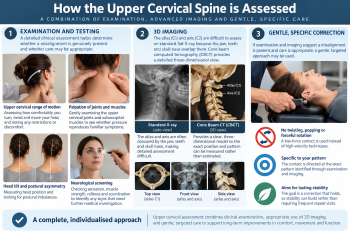
One of the reasons upper cervical chiropractic care has evolved over the past two decades is the availability of advanced imaging — specifically, cone beam computed tomography, or CBCT. Traditional two-dimensional X-rays can show the upper cervical spine, but they have limitations when the goal is to map the precise three-dimensional relationship between the skull, the atlas, and the axis.
CBCT changes that. It produces a high-resolution, three-dimensional image of the upper cervical region that allows the doctor to see exactly how the atlas is positioned relative to the skull above and the axis below. Angles, rotations, and lateral shifts that would be invisible or ambiguous on a standard X-ray become measurable to a fraction of a degree. For a region of the body where small structural changes can have outsized effects on the nervous system, this level of precision matters.
At Sarasota Upper Cervical Chiropractic, CBCT imaging is used to inform the structural correction itself. Every spine is unique, and the angle of an atlas misalignment in one patient may be very different from another. Without precise imaging, the correction becomes a generalized adjustment. With CBCT, the correction can be calculated specifically for that patient's anatomy, delivered with the appropriate vector, and verified afterward with post-correction imaging to confirm that the structural change actually occurred.
For MS patients in particular, this precision is important. The research from Dr. Elster and the Italian study points to structural correction of the atlas displacement complex as the variable that correlates with symptom improvement. Achieving that correction reliably — and confirming it — is what CBCT-guided care is designed to do.
What This Means for MS Patients in Sarasota
If you have been diagnosed with multiple sclerosis and you live in the Sarasota area, here is what the research above suggests is worth considering.
First, a history of head or neck trauma — even old trauma from years before your MS diagnosis — may have created an underlying structural problem in your upper cervical spine that is still affecting the function of your central nervous system today. Many people who do not remember a single dramatic injury have a history of accumulated smaller events: a sports concussion in high school, a rear-end car accident in their twenties, a fall down stairs. Any of these can affect the craniocervical junction.
Second, upper cervical chiropractic care does not claim to cure multiple sclerosis. What the research does suggest is that for a meaningful percentage of MS patients, addressing the underlying structural problem in the upper neck is associated with reduced symptoms, improved function, and in some cases halted progression. Results vary from person to person, and outcomes documented in case series are not typical of every patient.
Third, the kind of care we are describing is specific. It is not the same as a general chiropractic adjustment. It focuses on the precise structural relationship at C1 and C2, uses imaging to inform the correction, and avoids the kinds of high-force manipulations that most people associate with chiropractic care. The adjustments are gentle and targeted.
A Different Kind of Conversation About MS
Most MS patients are used to a particular kind of medical conversation: a list of symptoms, a discussion of medications, and a focus on managing decline. Upper cervical chiropractic care offers a different conversation — one centered on the mechanical health of the nervous system and the structural environment in which the brain and spinal cord operate.
It is not a replacement for neurological care. It is a complement to it. And for many MS patients in Sarasota who have felt that something fundamental was being missed in their treatment plan, that different conversation has been worth having.
If you would like to learn whether your MS symptoms may be connected to an underlying upper cervical structural issue, the first step is a thorough evaluation that includes precision imaging of your craniocervical junction. From there, you and your doctor can discuss whether a structural correction is appropriate for your case.
The research is real. The mechanism is biologically plausible. And the option is available right here in Sarasota.
---
**References**
1. Elster EL. *Upper Cervical Chiropractic Management of a Multiple Sclerosis Patient: A Case Report.* Journal of Vertebral Subluxation Research, 2001; 4(2): 22-30.
2. Elster EL. *Eighty-One Patients with Multiple Sclerosis and Parkinson's Disease Undergoing Upper Cervical Chiropractic Care to Correct Vertebral Subluxation: A Retrospective Analysis.* Journal of Vertebral Subluxation Research, 2004.
3. *A study published in the Annals of Italian Chiropractic on Upper Cervical Chiropractic care and the Atlas Displacement Complex in patients with chronic cerebrospinal venous insufficiency (CCSVI) and multiple sclerosis.*
4. Flanagan MF. *The Role of the Craniocervical Junction in Craniospinal Hydrodynamics and Neurodegenerative Conditions.* Neurology Research International, 2015.


Leave a comment