

Vertigo is one of the most disorienting symptoms a person can experience. Whether it feels like the room is spinning, you’re drifting off balance, or your vision can’t quite stabilize, the root cause is often far more complex than just “an ear problem.” At the center of this complexity lies a critical structure in the brainstem known as the vestibular nucleus—a processing hub that integrates three essential streams of sensory information:
Visual input (eyes)
Vestibular input (inner ear)
Proprioceptive input (joint and muscle sensors, especially from the upper neck)
When these three systems are in harmony, your brain maintains a stable sense of orientation, balance, and coordination. But when even one of these inputs becomes distorted—particularly from the upper cervical spine—the entire system can become disrupted, leading to vertigo, dizziness, and a cascade of neurological symptoms.
The Vestibular Nucleus: The Brain’s Balance Integration Center
The vestibular nucleus is located in the brainstem, just adjacent to the cerebellum, and serves as a central relay station for balance and spatial awareness. It receives incoming data from the eyes, inner ear, and body, then integrates and compares this information to determine where you are in space.
The inner ear detects head motion and acceleration.
The eyes provide visual confirmation of movement and orientation.
The proprioceptive system, especially from the upper cervical spine, tells the brain where the head is positioned relative to the body.
Under normal conditions, these three systems agree. If you turn your head to the right:
Your inner ear detects the motion,
Your eyes adjust to maintain visual stability,
Your neck proprioceptors confirm the position change.
The vestibular nucleus compares all three inputs and generates a coordinated response, keeping you balanced, upright, and visually stable.
Book a FREE consultation by booking here.
The Upper Cervical Spine: A Critical Source of Proprioception
The upper cervical spine—specifically the atlas (C1) and axis (C2)—plays a uniquely important role in this system. These joints contain one of the highest densities of proprioceptive receptors in the entire body.
These specialized mechanoreceptors constantly send information to the brain about:
Head position
Movement
Muscle tension
Joint alignment
This input is not optional—it is essential. In fact, the brain relies heavily on upper cervical proprioception to calibrate balance and coordinate movement.
When the Inputs Don’t Match: The Root of Vertigo
Vertigo often occurs when there is a sensory mismatch between the three systems.
Imagine this scenario:
Your inner ear says you are still.
Your eyes confirm that the room is not moving.
But your upper cervical spine—due to misalignment—is sending distorted signals that your head is tilted or moving.
Now the vestibular nucleus receives conflicting information. It cannot reconcile the mismatch, and the result is:
Dizziness
Spinning sensations
Disorientation
Nausea
Difficulty focusing
This is why many patients with persistent vertigo, especially those who have not responded to treatments like the Epley maneuver may actually have a cervical-driven cause, not an inner ear crystal problem.
Book a Free consult by clicking here.
Aberrant Proprioception from Upper Cervical Misalignment
When the atlas or axis becomes misaligned, even slightly, it can alter the normal mechanics of the joint. This leads to abnormal stimulation of mechanoreceptors within the joint capsule and surrounding muscles.
Instead of sending accurate positional data, the nervous system receives:
Distorted joint position signals
Abnormal muscle tone feedback
Inconsistent spatial orientation information
This phenomenon is often referred to as dysafferentation—a disruption in normal sensory input.
The vestibular nucleus depends on precise, synchronized information. When aberrant proprioceptive input from the upper neck is introduced into the system, it disrupts:
Eye tracking (leading to visual instability)
Postural control
Coordination
Balance reflexes
This is why patients with upper cervical issues often report:
Feeling “off” or disconnected
Difficulty with head movements
Dizziness when extending or rotating the neck
Chronic imbalance without a clear diagnosis
The Brain’s Hydrodynamic Pressure Gradient and CSF Flow
Beyond sensory integration, the upper cervical spine also plays a crucial role in the hydrodynamics of the brain, particularly the flow of cerebrospinal fluid (CSF).
CSF circulates around the brain and spinal cord, serving several vital functions:
Cushioning the brain
Removing metabolic waste
Maintaining pressure equilibrium within the cranial vault
There exists a delicate pressure gradient that allows CSF to flow efficiently between the brain and spinal canal. This system is highly sensitive to structural alignment—especially at the cranio-cervical junction, where the skull meets the upper neck.
How Misalignment Can Affect CSF Drainage and Intracranial Pressure
When the upper cervical spine is misaligned, it can subtly alter:
The alignment of the dura mater (the membrane surrounding the brain and spinal cord)
Venous outflow from the brain
The mechanical pathways that facilitate CSF movement
This can lead to impaired CSF drainage and a disruption in the normal pressure gradient.
As a result:
Intracranial pressure may increase
Fluid dynamics become inefficient
The brainstem and surrounding structures may experience subtle mechanical stress
Since the vestibular nucleus is located in the brainstem, any disruption in this region—whether from altered pressure, fluid dynamics, or structural tension—can further contribute to:
Vertigo
Head pressure
Brain fog
Visual disturbances
Why Head Movement Can Trigger Vertigo
Many patients notice that their dizziness worsens when they:
Look up (head extension)
Turn their head quickly
Change positions
This is not random.
Head movement directly engages:
The vestibular system
The visual tracking system
The upper cervical proprioceptive system
If the upper neck is misaligned, certain movements exaggerate the abnormal input coming from cervical mechanoreceptors. This amplifies the mismatch at the vestibular nucleus, triggering vertigo episodes.
The Role of Upper Cervical Chiropractic Care
Addressing this problem requires precision. The upper cervical spine is not an area that responds well to generalized or forceful manipulation.
Upper cervical chiropractic care focuses specifically on:
The atlas (C1)
The axis (C2)
The cranio-cervical junction
But more importantly, it emphasizes individualized analysis.
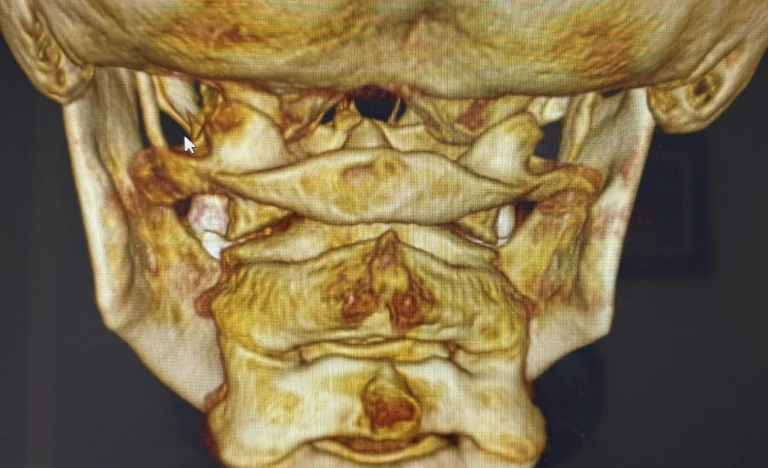
The Importance of 3D Imaging (CBCT)
Every person’s anatomy is unique. Misalignments in the upper cervical spine occur in three dimensions—rotation, tilt, and translation.
This is why advanced practices utilize 3D imaging, such as CBCT (Cone Beam CT), to:
Accurately measure the alignment of the upper cervical spine
Determine the exact angle and direction of misalignment
Create a customized correction plan for each patient
This level of precision is critical. Guesswork has no place when dealing with the brainstem and the body’s balance system.
Gentle, Precise Corrections—No Twisting or Popping
One of the most important distinctions in upper cervical care is the nature of the correction itself.
Unlike traditional spinal manipulation, upper cervical adjustments:
Do not involve twisting
Do not involve popping or cracking
Do not use forceful thrusts
Instead, they use a specific, calculated correction based on 3D imaging findings.
The goal is simple:
Restore proper alignment
Normalize proprioceptive input
Reduce interference at the brainstem
Allow the body to stabilize and heal
Restoring Balance at the Source
When the upper cervical spine is properly aligned:
Proprioceptive input becomes accurate again
The vestibular nucleus receives consistent information
The sensory mismatch is resolved
At the same time:
CSF flow and hydrodynamics can normalize
Intracranial pressure can stabilize
Brainstem function improves
As a result, many patients experience:
Reduction or elimination of vertigo
Improved balance and coordination
Clearer vision and focus
Decreased head pressure and brain fog
Connecting It All: The Neck and Vertigo
Vertigo is not always an inner ear problem. In many cases—especially chronic, unresolved dizziness—the true source lies in the upper cervical spine.
A misalignment at the top of the neck can:
Distort proprioceptive input
Disrupt the integration of sensory signals at the vestibular nucleus
Alter CSF flow and intracranial pressure dynamics
Trigger dizziness with simple head movements
By addressing the root structural issue with precise, image-guided corrections, upper cervical chiropractic care offers a fundamentally different approach—one that focuses on restoring normal function rather than masking symptoms.

Leave a comment