

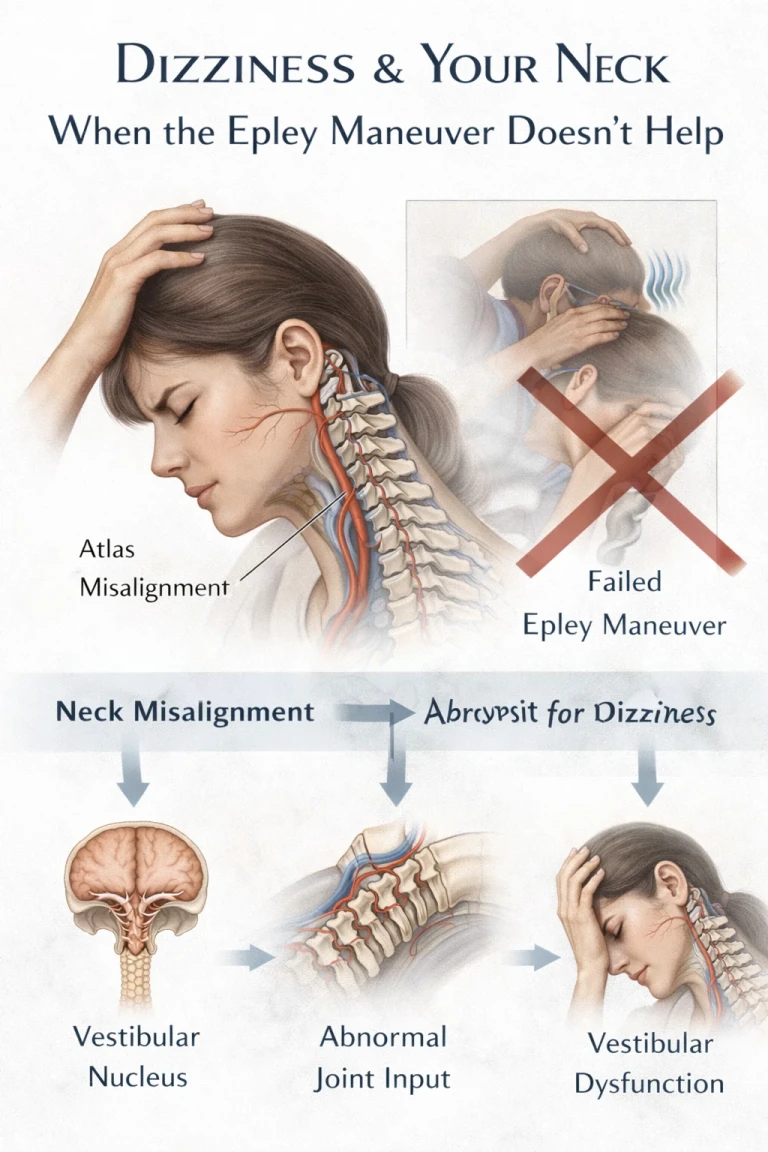
Vertigo can be one of the most frustrating and disorienting conditions a person experiences. Many patients are diagnosed with Benign Paroxysmal Positional Vertigo (BPPV) and told that the issue is caused by “crystals” in the inner ear. The standard treatment—the Epley maneuver—is often recommended to reposition those crystals.
And for many people, it works.
But what if it doesn’t?
If you’ve had the Epley maneuver performed repeatedly and your vertigo continues—or only temporarily improves—there’s a strong possibility that the root cause is not your inner ear at all.
In many cases, the true source of vertigo is the upper cervical spine.
In this article, we’ll break down three key signs that your dizziness may not be coming from the crystals in your ears, but instead from dysfunction in your neck.
Book a free consult by clicking here.
Understanding the Overlap: Ear vs. Neck
Before diving into the signs, it’s important to understand something critical:
Your sense of balance is not controlled by just one system.
It is a combination of:
The vestibular system (inner ear)
The visual system (eyes)
The proprioceptive system (joint and muscle input—especially from the neck)
These systems all feed into the brainstem, specifically the vestibular nucleus, where balance is coordinated.
If one system is disrupted—especially the neck—it can create symptoms that feel exactly like inner ear vertigo.
Sign #1: Head Extension Reproduces Your Dizziness
One of the biggest clues that vertigo is coming from the neck is this:
Looking up (head extension) triggers your dizziness
This is commonly reported by patients who:
Look up to reach something
Tilt their head back in the shower
Lean back at the dentist
Extend their neck during exercise
Why this matters:
When you extend your head backward, you are placing mechanical stress on the upper cervical spine, particularly the atlas (C1) and axis (C2).
If there is:
Joint misalignment
Abnormal motion
Altered muscle tone
It can distort the joint input signals being sent to the brain.
The Role of Joint Input and the Vestibular Nucleus
The upper cervical spine contains a high density of proprioceptors—specialized sensors that tell the brain where your head is in space.
These signals feed directly into the vestibular nucleus, where they integrate with inner ear input.
When the neck is functioning properly:
Signals are accurate
Balance is stable
When the neck is misaligned:
Signals become distorted
The brain receives conflicting information
This mismatch can cause:
Spinning sensations
Disequilibrium
Sudden dizziness
So when head extension triggers vertigo, it’s often not the crystals—it’s abnormal joint input from the upper cervical spine.
Book a FREE consult by clicking here.
Sign #2: The Epley Maneuver Didn’t Work
The Epley maneuver is designed to reposition calcium crystals (otoconia) in the inner ear.
If your vertigo is truly BPPV:
The Epley maneuver should significantly improve or resolve your symptoms.
But if:
You’ve had it done multiple times
Relief is temporary or nonexistent
Symptoms keep returning
That’s a major red flag.
Why the Epley Fails in Neck-Based Vertigo
If the root cause is not the inner ear, then repositioning crystals will not fix the problem.
Instead, the issue may be:
Abnormal joint signaling from the neck
Misalignment affecting neurological input
Dysfunction in how the brain processes position and movement
In these cases, the Epley maneuver may:
Provide short-term relief (due to temporary sensory reset)
Or do nothing at all
Because the actual problem—faulty cervical input—is still present
The Bigger Picture
This is where many patients get stuck.
They are told:
“It must still be crystals”
“Let’s try the maneuver again”
But in reality: The vertigo is being driven by neurological confusion caused by the neck
Sign #3: Your Dizziness Started After a Neck Injury
This is one of the most overlooked but important clues.
If your vertigo began after:
A car accident
A fall
A sports injury
A sudden head movement
There is a high likelihood that the upper cervical spine was involved.
Why Neck Injuries Matter
The atlas (C1) is uniquely designed for mobility, not stability.
Even a minor trauma can cause:
Subtle misalignment
Altered joint mechanics
Changes in muscle tone
Because of its close relationship with the brainstem and vestibular system, even small changes here can have big neurological consequences.
Abnormal Efferent Input and Balance Dysfunction
The brain not only receives input from the neck—it also sends signals back (efferent signals) to regulate muscle tone and coordination.
When the upper cervical spine is misaligned:
Afferent (incoming) signals become distorted
Efferent (outgoing) responses become inappropriate
This leads to:
Poor coordination
Instability
Persistent dizziness
Essentially, the brain is trying to maintain balance using faulty data
The Root Cause: Cervicogenic Vertigo
When vertigo originates from the neck, it is often referred to as:
This type of vertigo is:
Not caused by inner ear crystals
Driven by abnormal cervical spine input
Often resistant to traditional vestibular treatments
A Different Approach: Upper Cervical Chiropractic Care
If the neck is the root cause, then the solution must address the neck—specifically the upper cervical spine.
Upper cervical chiropractic care focuses on:
The atlas (C1)
The axis (C2)
Their relationship to the skull and brainstem
Precision Through 3D Imaging (CBCT)
One of the defining features of upper cervical care is its precision.
Before any correction is made, advanced 3D imaging (CBCT scans) is used to:
Analyze your unique anatomy
Identify the exact misalignment
Determine a precise correction vector
This is not guesswork—it’s a highly individualized, data-driven approach
Gentle, Specific Corrections—No Twisting or Yanking
Many patients are concerned about chiropractic adjustments, especially in the neck.
Upper cervical care is different.
Corrections are:
Gentle and controlled
Performed with no twisting, popping, or cracking
Designed to restore alignment with minimal force
The goal is not repeated adjustments—it’s:
Making the right correction and allowing the body to hold it
Why This Matters for Vertigo
When the upper cervical spine is properly aligned:
Joint input to the brain normalizes
The vestibular nucleus receives accurate signals
Neurological coordination improves
Balance stabilizes
Over time, this can lead to:
Reduced dizziness
Improved stability
Resolution of vertigo symptoms
Bringing It All Together
If you’ve been struggling with vertigo and told it’s BPPV—but treatments haven’t worked—it’s time to consider a different perspective.
The three key signs your vertigo may be coming from your neck:
Head extension reproduces dizziness
The Epley maneuver didn’t work
Your symptoms started after a neck injury
These signs point toward a cervical origin, not an inner ear problem.
Final Thoughts
Your body relies on precise communication between the neck and brain to maintain balance.
When that communication is disrupted—especially at the upper cervical level—it can create symptoms that mimic inner ear disorders but require a completely different solution.
The good news is:
When the true cause is identified and addressed, many patients experience significant improvement—even after months or years of frustration.
If you’ve been dealing with unresolved vertigo, it may be time to evaluate your upper cervical spine. Schedule a free consultation by clicking here or call 941-259-1891 to find out if you’re a candidate for care.

Leave a comment