

Most people walk into a chiropractor's office expecting to get adjusted. Every time. That's how it usually works across the profession. You show up, you get on the table, something gets popped or pressed, and you're on your way.
Upper cervical chiropractic care in Sarasota works differently. At our office on Bee Ridge Road, the decision to adjust is never automatic. It's never based on the calendar. It's based entirely on what your body is telling us through objective testing, and that distinction changes everything about how your care actually works.
Schedule Your Appointment
Schedule appointmentHow We Know Whether You Need an Adjustment
Before any correction happens, two specific tests run every single visit: a functional leg length analysis and paraspinal infrared thermography. These aren't formalities. They are the gatekeepers.
The leg length check is a functional assessment performed with you lying face up on the table. When the upper cervical spine shifts out of alignment, the body compensates by tightening muscles unevenly, which creates a measurable difference in how the legs present.
This isn't about one leg being structurally shorter than the other. It's about the neurological response to spinal misalignment pulling things off-center. When the atlas or axis shifts, the compensation pattern shows up in the legs almost immediately.
Thermography measures skin temperature differences along both sides of your spine using infrared sensors. The nervous system controls blood flow regulation, and when there's interference at the brainstem level, temperature patterns along the paraspinal region become asymmetrical in consistent, reproducible ways.
A scan that shows a specific disrupted pattern tells us something is off. A scan that reads clear tells us the spine is holding its correction and the nervous system is functioning without interference.
Here's where it gets interesting for patients who have never experienced this approach. If both tests come back indicating alignment, we do not adjust. Period. You came in, you got checked, and your body is doing its job. That's a good visit. That's actually a great visit.

What Happens When the Tests Say You've Shifted
If the leg length analysis shows a functional imbalance and the thermographic scan confirms a disrupted pattern, the adjustment happens.
But it's not a generalized neck manipulation. The correction delivered is calculated from a cone beam computed tomography scan (CBCT) taken during your initial evaluation.
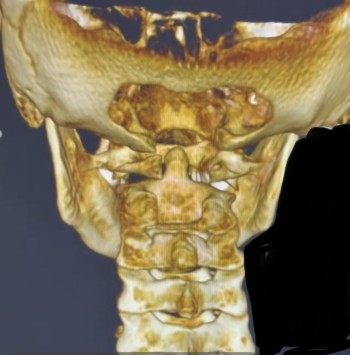
CBCT imaging captures a full three-dimensional view of your upper cervical spine. Traditional X-rays flatten a 3D structure into two dimensions, which means angles, rotations, and translations can be missed or distorted.
CBCT eliminates that problem. It shows the atlas and axis exactly as they sit in space, with their actual shape, their real joint angles, and their true relationship to the skull above and the cervical spine below.
Every person's C1 and C2 vertebrae are shaped differently. Joint surfaces vary. Asymmetries that are completely normal for one patient would be a problem in another.
The CBCT data lets us calculate a correction vector that matches your specific anatomy. Direction, angle, depth. That vector stays consistent across your care unless new imaging indicates otherwise.
So when the tests confirm a shift, the correction isn't a guess. It's a precise input along a path your anatomy already defined.
Why Restraint Is the Point

This approach runs counter to what most people associate with chiropractic care. Routine adjusting, three-times-a-week visit schedules, maintenance plans that assume you need to be corrected on every appointment. None of that applies here.
The governing principle is restraint guided by data. Adjusting when the body hasn't lost its correction can actually work against you. The tissues around the upper cervical spine need time to stabilize after a correction. Ligaments remodel. Muscles recalibrate.
The neurological patterns that have been running for months or years need uninterrupted time to reorganize. Adjusting into that healing window disrupts the very process you're paying for.
Patients in our Sarasota office often go weeks between adjustments. Some hold their correction for a month or longer. That's not a failure to treat. That's the treatment working. The longer you hold, the more your body adapts to its corrected position, and the more resilient the correction becomes over time.
What This Means for People in Sarasota Searching for Answers
If you've been dealing with migraines, vertigo, neck pain, post-concussion symptoms, or unexplained neurological issues and you've already tried the conventional route, the testing-first model is worth understanding.
A lot of patients who find their way to upper cervical care have already been through multiple providers. They've been adjusted hundreds of times. They've done the three-visits-a-week thing. And they're still stuck.
The difference isn't just technique. It's philosophy. We don't treat the schedule. We treat the findings.
Sarasota has a growing community of people who are actively looking for this kind of precision, especially families, athletes recovering from head injuries, and adults dealing with chronic vestibular or autonomic issues.

The Gulf Coast population skews toward people who have tried everything and want something that makes biomechanical sense. That's exactly where this model fits.
How a Visit Actually Looks
You walk in. We run the leg length analysis. We run the thermographic scan. If both indicate you're holding your correction, we talk about how you've been feeling, we note the data, and we send you on your way. If the tests show a shift, we deliver the correction along the vector your CBCT analysis established.
It takes seconds. There's no twisting, no cracking, no rotational thrust. Most patients describe the adjustment as a light, quick impulse they barely feel.
Then we re-scan. The post-adjustment thermography confirms the nervous system response in real time.
That's it. The body does the rest.
Our office is located at 3920 Bee Ridge Rd, Building D, Sarasota, FL 34233.
If you want to ask questions before scheduling, call (941) 259-1891.
We're happy to talk through what testing-based care looks like and whether it fits what you're dealing with.
Leave a comment