


It isn't quite a headache. It's a tight, heavy, full feeling right where your head meets your neck, like a hand pressing on the back of your skull. It builds through the afternoon, eases a little after a hot shower, and is back the next day.
Pressure at the base of the skull is one of the most common complaints in Sarasota, Bradenton, and Lakewood Ranch, and one of the most often brushed off as "just stress." At Hall Upper Cervical Chiropractic in Sarasota, Dr. Drew Hall and Dr. Beth O'Rourke treat it as a location clue, because the base of the skull sits directly on top of the two vertebrae upper cervical care is built around.
Schedule Your Appointment
Schedule appointmentWhat Is Actually Creating That Pressure?
Most of the time, the feeling comes from the suboccipital muscles. These are four small pairs of muscles that connect the atlas and axis, the top two vertebrae, to the base of the skull. They make the fine adjustments that keep your head balanced and your eyes steady, thousands of times a day.
These muscles are packed with sensors that report head position to the brain, so when they tighten, you feel it. The greater occipital nerve also travels up through this area and onto the scalp. When the muscles around it stay tense, the pressure can spread up the back of the head, sometimes all the way to the top.
Why Does the Upper Neck Keep It Going?
Stress and screen time can tighten these muscles for a day. When the pressure is there most days, there's usually a structural reason.
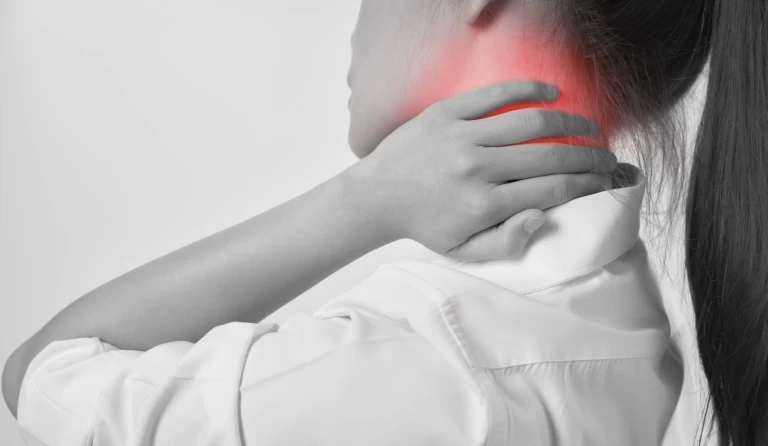
If the atlas shifts out of position, the suboccipital muscles never get to fully relax. They're working constantly to hold your head level on a base that isn't centered. That steady guarding is what turns a passing ache into a pressure you can almost predict. Many people also notice it's worse on one side, which fits a misalignment that has a direction.
What Makes It Worse?
A few everyday habits load this area heavily:
- Looking down at a phone or laptop for long stretches
- Long drives on I-75 with your chin pushed forward
- A pillow that's too high, bending your neck all night
- Clenching your jaw when you're focused or stressed
These don't usually cause the problem on their own, but they reliably turn it up.
When Should Skull-Base Pressure Send You to the ER Instead?
Related article

Get emergency care for a sudden, severe headache that peaks within a minute, pressure with fever and a stiff neck, or pressure after a fall or car accident. The same applies if it comes with confusion, weakness, numbness, trouble speaking, or vision loss.
Also see a medical doctor promptly if the pressure gets worse when you cough, sneeze, or strain, or if it's worse lying down and comes with blurred or double vision. Those patterns can point to problems inside the skull that need imaging.
How Does the Blair Technique Address Pressure That Starts in the Neck?
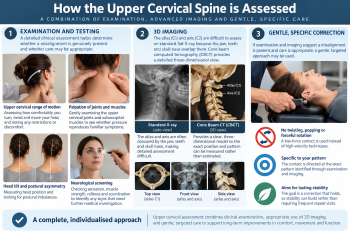
The Blair technique is a measurement-first discipline. Cone beam computed tomography measures the three-dimensional position of the atlas and axis against your own anatomy, so a correction is calculated rather than estimated. The correction involves no twisting, no popping, no cracking, and no pulling of the neck.
It's gentle enough that many patients from Siesta Key and Venice are surprised the visit is already finished. When the atlas holds its correction, the suboccipital muscles no longer have a reason to guard, and the pressure often eases over the following weeks.
What Can You Do This Week?
Raise your screens so your eyes land near the top third without tipping your head down. Every hour, do five slow chin nods: a small "yes" motion from the top of the neck, with no strain. Then keep a simple log of when the pressure starts, which side it favors, and what you were doing. A pattern that shows up at the same spot and on the same side is worth bringing to an evaluation.

Frequently Asked Questions
1. Is pressure at the base of the skull serious?
Usually it's muscular and mechanical, not dangerous. Seek emergency care if it's sudden and severe, comes with fever and a stiff neck, follows an injury, or comes with neurological symptoms like weakness, numbness, confusion, or vision loss.
2. Can stress cause pressure at the base of the skull?
Yes. Stress tightens the suboccipital muscles. If the pressure returns most days, though, a structural cause like an atlas misalignment is often keeping those muscles tight.
3. Why is the pressure worse on one side?
One-sided pressure often reflects a misalignment that has a direction, so the muscles on one side work harder than the other. An exam with imaging can confirm whether that's the case.
4. Does massage help pressure at the base of the skull?
Massage can ease it for hours or a day. If the pressure keeps returning to the same spot, the muscles are likely responding to something underneath them, and that's what an upper cervical exam looks for.
5. Can upper cervical chiropractic help with skull-base pressure?
When the pressure comes from the upper neck, correcting the atlas addresses the reason the suboccipital muscles stay tight. Dr. Hall and Dr. O'Rourke use CBCT imaging to determine whether that's the source.
Schedule a free consultation with Hall Upper Cervical Chiropractic. Call 941-259-1891 or visit us at 3920 Bee Ridge Rd, Bldg D, Suite 101, Sarasota, FL 34233.


Leave a comment