

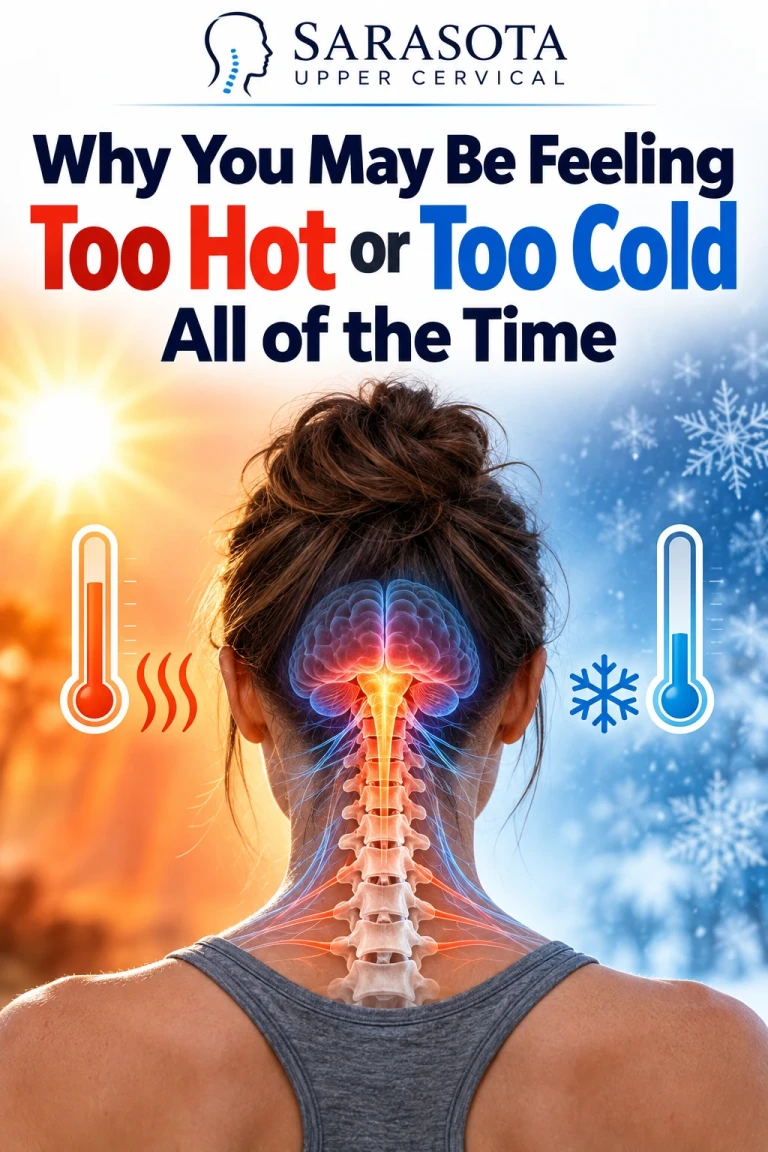
Feel too hot or too cold and don’t know why? Our Sarasota upper cervical office explains how your brainstem and upper neck help regulate body temperature.
By Dr. Drew Hall, Sarasota Upper Cervical
Schedule Your Appointment
Schedule appointmentMaybe you are the person reaching for a sweater in a room everyone else finds comfortable. Maybe your hands and feet stay icy no matter the season, or you flush and sweat at random times while the people around you feel fine. Patients in Sarasota, Bradenton, and Lakewood Ranch describe this to us often, usually after hearing that their blood work looks normal. This article explains how your nervous system controls temperature, where the upper neck sits along that pathway, and what the research can and cannot tell us about the connection.
Throughout this article, we label each claim as one of three things: established anatomy and physiology (well documented in the scientific literature), reasoned hypothesis (a plausible mechanism that has not been directly proven), or clinical observation. We think you deserve to know which is which.
First, Rule Out the Common Medical Causes
Before looking at the neck, it is important to say plainly that feeling persistently hot or cold has many medical causes, and several of them need a medical doctor. An underactive or overactive thyroid, iron deficiency or anemia, perimenopause and menopause, low body weight, diabetes and the nerve damage it can cause, Raynaud’s phenomenon, infections, and the side effects of many common medications can all change how warm or cold you feel. If you have not had a medical workup for this symptom, start there. If you have a fever, confusion, fainting, or signs of heat illness, seek medical care right away.
Upper cervical care is not a treatment for thyroid disease, anemia, hormonal change, or infection. Where it may become relevant is for people whose medical workup has come back unremarkable and who also have a history of neck injury, head trauma, or upper neck symptoms.
How Your Body Controls Temperature: The Neurology
Your body keeps its core temperature within a narrow range through a chain of nerve signals that runs from your skin, up through your spinal cord and brainstem, into the brain, and back down again. Understanding this chain is the key to understanding why the upper neck matters.
Step One: Sensing Temperature
Established physiology. Specialized nerve endings in the skin detect warmth and cold. Those signals enter the spinal cord, where they connect with neurons in the dorsal horn. From there, the signal climbs toward the brain. A key relay station on this route is the lateral parabrachial nucleus, a cluster of neurons in the pons, which is part of the brainstem. Researchers Shaun Morrison and Kazuhiro Nakamura, whose work forms much of the modern map of temperature control, describe this ascending route running from skin receptors to dorsal horn neurons to the lateral parabrachial nucleus and then up to the brain’s temperature integrator.
This means that every temperature signal from your body below the head must travel up through the cervical spinal cord and through the brainstem before your brain can act on it.
Step Two: The Thermostat
Related article

Vestibular Disorder Treatment Sarasota | Upper Cervical Chiropractic Guide
May 31, 2026Established physiology. The main integrating center for body temperature is the preoptic area of the hypothalamus, a small region deep in the brain. Morrison’s 2016 review states that the hypothalamus contains the primary integrative components of these circuits. The preoptic area compares incoming signals against your body’s set point and decides whether you need to conserve heat, make heat, or shed heat.
It is worth correcting a common oversimplification here, including one we have seen in chiropractic content. The thermostat itself sits in the hypothalamus, not the brainstem. The brainstem’s role is different, and in some ways more relevant to the upper neck, as the next step shows.
Step Three: The Brainstem Command Relay
Established physiology. The hypothalamus does not send its orders directly to your blood vessels, fat, and muscles. It sends them down to a group of premotor neurons in the lower brainstem, in a region called the rostral ventromedial medulla, which includes the rostral raphe pallidus. These medullary neurons are the final command relay for temperature control. Morrison and Nakamura’s research shows that this region drives both heat production, through brown fat and shivering, and heat conservation, through constriction of blood vessels in the skin.
The medulla is the lowest part of the brainstem. It sits just above the foramen magnum, the opening at the base of the skull, where the brainstem becomes the spinal cord. The atlas, your top neck bone, surrounds this transition zone. In other words, the brainstem’s temperature command relay sits within an inch or two of the most mobile joint in your spine.
Step Four: The Descending Highway Through the Neck
Established anatomy. From the medulla, the temperature commands travel down the spinal cord to the sympathetic preganglionic neurons, which are located in the intermediolateral cell column of the thoracic and upper lumbar cord, roughly from T1 to L2. These neurons control blood flow to the skin, sweating, and heat production in brown fat. Every one of those descending signals must pass through the entire cervical spinal cord, beginning at the level of the atlas and axis.
So the upper neck is not the thermostat, but it is the narrow passageway that both the incoming temperature information and the outgoing temperature commands must travel through.
What Happens When the Pathway Is Disrupted
Established clinical evidence, with an important limit. We know this pathway matters because of what happens when it is badly damaged. People with spinal cord injuries above the sixth thoracic level, especially cervical injuries, commonly lose much of their ability to regulate temperature. A Mayo Clinic Proceedings review explains that thermoregulation is substantially impaired in these patients because the neuronal pathways to and from the hypothalamus are interrupted. The American Academy of Physical Medicine and Rehabilitation lists spinal cord injury, traumatic brain injury, stroke, and brainstem lesions among the major neurological causes of impaired temperature regulation, and notes that these patients can develop a state where body temperature drifts with the environment.
This evidence proves that the cervical cord and brainstem are essential to temperature control. What it does not prove is that a subtle misalignment of the atlas produces the same effect. A spinal cord injury is a severe structural disruption, and it would be inaccurate to claim that a mild upper neck problem is equivalent. The spinal cord injury research establishes that the route matters. It does not establish that a misaligned atlas interferes with it.
The Myodural Bridge: A Physical Link From Neck Muscles to the Spinal Cord’s Covering
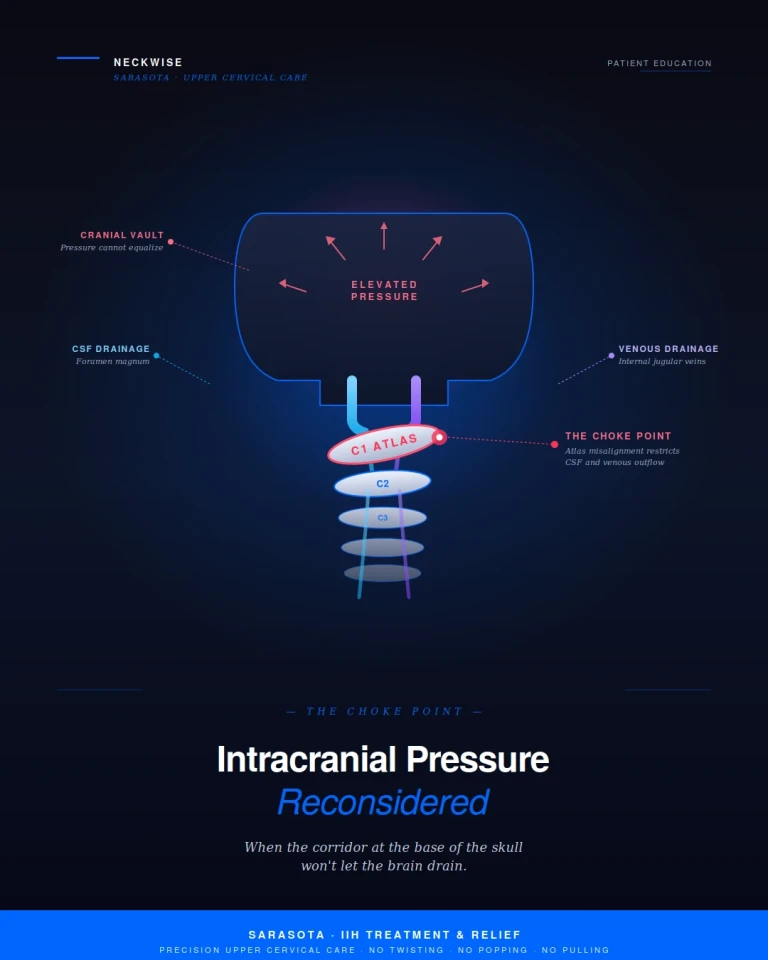
Established anatomy. In 1995, Gary Hack and colleagues published a cadaver study in the journal Spine describing a connective tissue bridge between a small suboccipital muscle, the rectus capitis posterior minor, and the dura mater, the tough outer membrane that wraps the brainstem and spinal cord. This connection is now called the myodural bridge. The fibers run roughly perpendicular to the dura and pass through the space between the skull and the atlas.
Later research expanded the picture. In 2011, Frank Scali and colleagues reported in Spine that the rectus capitis posterior major and the obliquus capitis inferior, two more suboccipital muscles, also attached to the dura in most of the 13 cadavers they examined. In that study, manually pulling on the rectus capitis posterior major moved the dural sheath, with movement reported from the C2 level down toward T1. Other anatomical studies have confirmed collagen connections between these muscles, the nuchal ligament, and the dura.
Two caveats matter here. These are cadaver studies, and the movement was produced by manual traction on dissected tissue, which is not the same as measuring force in a living person. The original proposed purpose of the bridge was protective, to keep the dura from folding during neck extension.
How an Upper Neck Misalignment Could Affect Temperature Control
Reasoned hypothesis. This is where we move from what is proven to what is plausible, and we want to be clear about the difference. No published study has directly shown that an atlas misalignment changes body temperature regulation. What follows is a mechanism built from the established pieces above.
When the atlas shifts out of its normal position, often after a fall, car accident, sports injury, or concussion, the suboccipital muscles that attach to it tend to tighten and guard the joint. Because several of those muscles connect to the dura through the myodural bridge, sustained muscle tension may transmit sustained mechanical tension to the dura at the craniocervical junction. The authors of a 2020 anatomical study in PeerJ made a similar point, noting that increased suboccipital muscle tone would be expected to pull the dura backward. That dura surrounds the lower medulla, the same region that holds the brainstem’s temperature command neurons, and the upper cervical cord, which carries both ascending temperature information and descending sympathetic commands.
The hypothesis is that chronic mechanical tension and irritation in this region could add noise to the signals passing through it. On the incoming side, that could distort the temperature information reaching the hypothalamus. On the outgoing side, it could disturb the sympathetic commands that tighten or open skin blood vessels and trigger sweating. In practical terms, that might look like cold hands and feet, sudden flushing, sweating that does not match the room, or a feeling that your internal thermostat is unreliable.
Several pieces of this chain are well supported, including the anatomy of the temperature pathway, its route through the brainstem and cervical cord, and the existence of the myodural bridge. The weakest links, and the ones that have not been tested, are whether a misaligned atlas produces enough dural tension to matter, and whether that tension measurably alters temperature regulation in a living person. We present it as a hypothesis worth investigating, not as a settled fact.
What Upper Cervical Care Looks Like in Our Sarasota Office
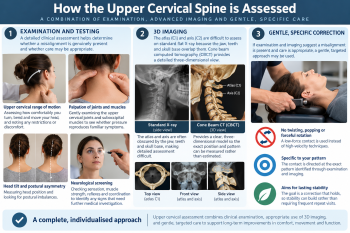
Upper cervical chiropractic focuses on the alignment of the atlas and axis and their relationship to the skull. In our office, that starts with a detailed history and examination, including questions about past head and neck trauma. We use advanced imaging to measure the precise position of the upper cervical vertebrae for each patient.
The correction itself is gentle, low force, and image guided. There is no twisting, popping, or pulling of the neck. The goal is to restore normal alignment at the craniocervical junction and reduce the mechanical irritation in that region, then allow the body time to adapt. Follow-up measurements help us track how the upper neck is holding.
We cannot promise that correcting the upper neck will change how warm or cold you feel, and we will tell you honestly if your history and exam suggest the neck is unlikely to be the issue. Some patients have reported that their temperature sensitivity improved after their neck was stabilized, but individual experiences vary, and those reports are not the same as controlled research.
Who Might Consider an Upper Cervical Evaluation
Related article
An upper cervical evaluation may be worth considering if your temperature symptoms have been checked by a medical doctor without a clear cause, if they began or worsened after a head or neck injury, or if they come with other upper neck signs such as neck pain, headaches at the base of the skull, dizziness, or a limited range of motion when turning your head. Contraindications are taken seriously. People with signs of upper cervical instability, recent fractures, or certain vascular or inflammatory conditions need appropriate medical evaluation and imaging before any upper cervical care is considered.
Schedule a Consultation in Sarasota
If you are tired of never feeling comfortable in your own body and want to know whether your upper neck may be part of the picture, our team is here to help. We serve patients from Sarasota, Bradenton, and Lakewood Ranch. Schedule a consultation by calling 941-259-1891. We will review your history, examine your upper neck, and give you an honest assessment of whether upper cervical care makes sense for you.
References
Hack GD, Koritzer RT, Robinson WL, Hallgren RC, Greenman PE. Anatomic relation between the rectus capitis posterior minor muscle and the dura mater. Spine. 1995;20(23):2484-2486. Cadaver dissection study; describes anatomy and cannot establish clinical effects.
Scali F, Marsili ES, Pontell ME. Anatomical connection between the rectus capitis posterior major and the dura mater. Spine. 2011;36(25):E1612-E1614. Cadaver study of 13 specimens; dural movement was produced by manual traction on dissected tissue.
Anatomy and clinical relevance of sub occipital soft tissue connections with the dura mater in the upper cervical spine. PeerJ. 2020;8:e9716. Cadaver dissection with histology; the clinical relevance discussed by the authors is interpretive.
Morrison SF, Nakamura K. Central neural pathways for thermoregulation. Frontiers in Bioscience. 2011;16:74-104. Review summarizing largely animal research on the neural circuitry of temperature control.
Morrison SF. Central control of body temperature. F1000Research. 2016;5:880. Review of the central nervous system circuits controlling heat loss and heat production.
Schmidt KD, Chan CW. Thermoregulation and fever in normal persons and in those with spinal cord injuries. Mayo Clinic Proceedings. 1992;67(5):469-475. Review of thermoregulatory impairment after high-level spinal cord injury.
American Academy of Physical Medicine and Rehabilitation. Impaired thermoregulation. PM&R KnowledgeNow. Clinical reference on neurological causes of impaired temperature regulation.
Medical Disclaimer
This article is for general educational purposes only and is not a substitute for professional medical advice, diagnosis, or treatment. Chiropractic care does not replace evaluation by a medical physician. Persistent changes in body temperature can signal medical conditions that require diagnosis and treatment by a medical doctor. If you have a fever, confusion, fainting, chest pain, or symptoms of heat illness, seek emergency medical care. Individual results vary, and no outcome is guaranteed. Always consult a qualified health care provider about your specific condition before beginning any new treatment.

Leave a comment