

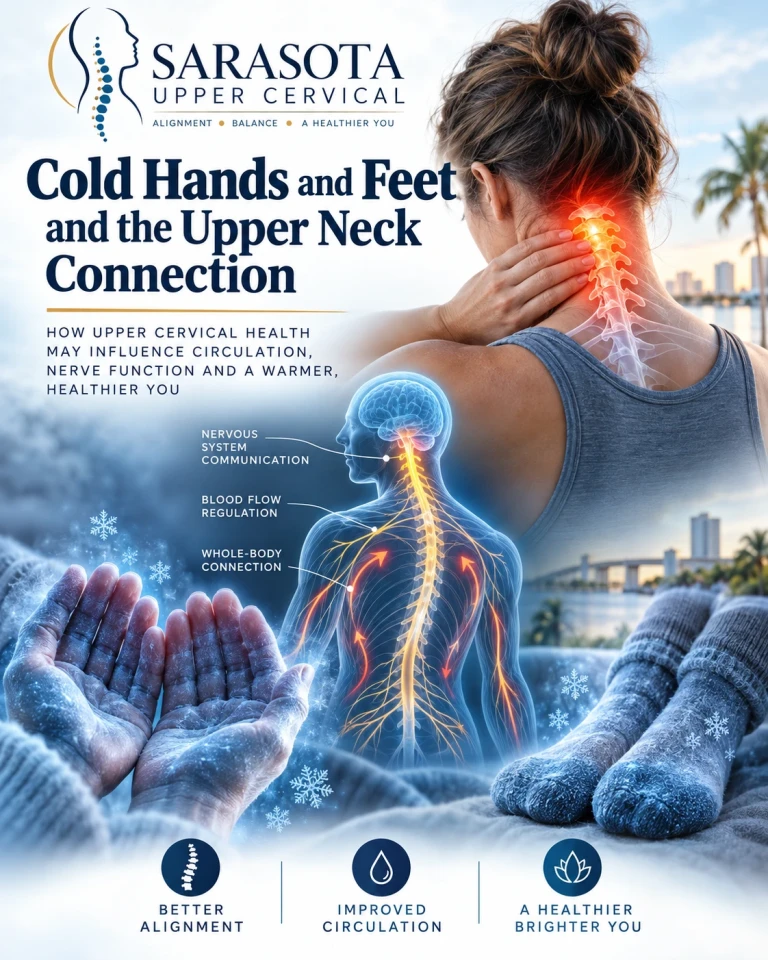
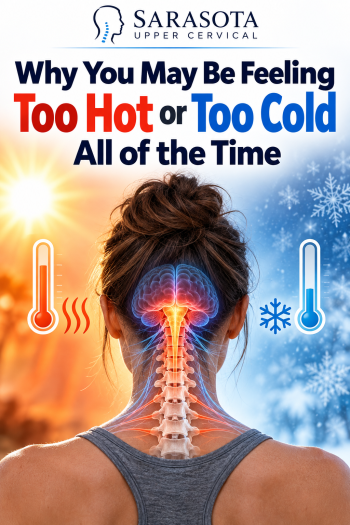
Cold hands and feet, even in a warm Sarasota home, are governed by the brainstem's sympathetic control of skin blood flow, and the upper neck may play a part. For many people in Sarasota, Bradenton, and Lakewood Ranch, the problem is easy to dismiss as "just how I am," and for some people that is exactly right. But when cold extremities show up alongside neck stiffness, headaches, dizziness, or a general sense of being wound up, it is worth understanding how the upper neck, the brainstem, and the sympathetic nervous system fit together.
This article walks through that chain one link at a time. Some of it is textbook physiology. Some of it is a reasoned hypothesis that has not been tested in clinical trials. We label each step so you can tell the difference, because a medically literate reader deserves to know which parts are settled and which are not.
Schedule Your Appointment
Schedule appointmentWhy the Hands and Feet Go Cold First
Established physiology. Your hands and feet are not just far from the heart. They are built differently from the rest of your skin. The palms, the soles, and the nail beds of the fingers and toes contain large numbers of arteriovenous anastomoses, short vessel segments that connect small arteries directly to small veins and bypass the capillary bed. In his 2015 review in the journal Temperature, the Norwegian physiologist Lars Walløe describes these vessels as having an unusually thick muscular wall and a dense supply of adrenergic nerve fibers, meaning they are wired directly to the sympathetic nervous system.
That wiring is the whole story of why cold hands happen. When these shunts are open, warm blood pours through the skin of the hands and feet and heat radiates away. When sympathetic nerves signal them to clamp down, flow to the fingers and toes drops sharply and those areas cool within minutes. Earlier work from the same research group estimated that spontaneous opening and closing of these shunts can swing flow to the hands and feet by roughly 5 to 10 percent of total cardiac output in a resting person, which gives a sense of how much blood these small vessels control.
This is a deliberate design. In a review of hand and foot responses to cold, Stephen Cheung of Brock University explains that sympathetically driven vasoconstriction reduces flow to the periphery in favor of a central pooling of blood in the torso. In plain terms, when the body decides it needs to conserve heat or prepare for a threat, it pulls blood inward toward the heart, lungs, brain, and abdominal organs, and the first place it takes that blood from is the skin of the hands and feet. They are the body's most adjustable radiators, so they are the first to be turned down.
The Brainstem Is Where That Decision Gets Made
Established physiology, largely from animal research. The sympathetic nerves that clamp down the vessels in your hands and feet do not act on their own. Their signals originate in the spinal cord, in sympathetic neurons of the thoracic and upper lumbar segments, and those spinal neurons are driven from above by a small group of "premotor" neurons in the lower brainstem.
A 2015 review by Youichirou Ootsuka and Mutsumi Tanaka summarizes two decades of research on this circuit. The key relay is a region of the medulla oblongata called the medullary raphé, along with input from a neighboring region called the rostral ventrolateral medulla. When researchers silence the medullary raphé in rats and rabbits, skin vasoconstriction in response to cold, to fever, and to frightening stimuli is abolished. The authors describe this region as a common final pathway for sympathetic control of skin blood flow, receiving instructions from the hypothalamus, the amygdala, and other higher centers and passing them down to the spinal cord.
Related article
Brachioradial Pruritus Relief in Sarasota and Bradenton | Why Is My Arm Itching?
Mar 04, 2026Two details matter for our purposes. First, this is not only a temperature circuit. The same brainstem neurons drive skin vasoconstriction during alarm and psychological stress, which is why people "go pale with fright" and why many people notice their hands go cold before a stressful meeting. Second, the human evidence is consistent with the animal work: a 2006 functional MRI study by McAllen and colleagues found activity in the human medulla during skin cooling and rewarming. The fine-grained circuit mapping, however, comes from rats and rabbits, and that caveat should travel with every claim in this section.
Put together, the established picture is this. The lower brainstem sets the level of sympathetic tone sent to the skin. When that tone rises, the shunt vessels in the hands and feet constrict, blood is redistributed toward the core, and the fingers and toes cool. Anything that persistently raises sympathetic drive to the skin can, in principle, leave someone with chronically cold extremities.
Where the Upper Neck Enters the Picture
Established anatomy, with limited human data. The top two vertebrae of the neck, the atlas (C1) and axis (C2), sit directly beneath the skull and surround the junction where the brainstem becomes the spinal cord. The small muscles and joints of this region are among the most densely supplied with position-sensing nerve endings anywhere in the body. Those sensory signals do not stay local. Many of them travel to the vestibular nuclei in the brainstem, the same centers that help coordinate balance with blood flow during changes in posture.
Researchers have shown that this input can influence sympathetic output. In a 1998 study in Brain Research Bulletin, Bolton, Kerman, Woodring, and Yates electrically stimulated the C2 nerve root and the nerves supplying the dorsal neck muscles in animals and recorded changes in sympathetic nerve activity, often at very low stimulation intensities. In 2014, Bolton, Hammam, and Macefield tested the same idea in ten healthy adults using direct recordings from sympathetic nerves in the leg. Rhythmic stretching of the neck muscles, with the head held still, measurably modulated sympathetic activity going to the leg muscles.
That same human study also contains a finding we want to state plainly, because it cuts against an oversimplified version of the upper cervical argument. When the researchers held the neck in a sustained, static stretch to one side, sympathetic activity did not change significantly compared with a neutral position. The study also measured sympathetic outflow to muscle, not to skin. So the evidence establishes that upper neck sensory input is plugged into the brainstem's sympathetic machinery. It does not yet establish that a fixed misalignment raises sympathetic tone to the hands and feet.
The Hypothesis: How Upper Neck Misalignment Could Lead to Cold Hands and Feet
Reasoned hypothesis, not demonstrated. Here is the proposed chain in full. An atlas or axis misalignment changes the mechanics of the craniocervical junction. The joints, ligaments, and small suboccipital muscles in that region are placed under persistent strain, and that strain alters the stream of sensory signals flowing from the upper neck into the brainstem. Because those signals feed the same brainstem regions that set sympathetic tone, the altered input is proposed to nudge the system toward a higher baseline level of sympathetic activity. With sympathetic drive to the skin turned up, the shunt vessels in the palms, soles, fingers, and toes stay constricted more of the time, blood is held centrally, and the hands and feet run cold.
Each individual link in that chain is grounded in established physiology. The chain as a whole has not been tested. There is no published study we are aware of that measures hand or foot skin temperature or skin blood flow before and after upper cervical care in a controlled design. Until that work exists, this mechanism should be read as a plausible explanation that deserves investigation, not as a proven cause.
The closest relevant clinical study is a 2007 pilot trial led by hypertension specialist George Bakris, published in the Journal of Human Hypertension. Fifty people with early-stage hypertension and evidence of atlas misalignment received either a specific atlas correction or a sham procedure, and the corrected group showed significantly better hypertension readings at eight weeks. That result is often cited as evidence that the atlas influences the autonomic nervous system. It deserves several caveats. It was a small pilot, all corrections were performed by a single practitioner, it measured hypertension rather than hand or foot temperature, and the authors themselves wrote that the mechanism was unknown and could not be determined by their study. A larger multi-practitioner trial was planned at the time, and to our knowledge a replication of the original result has not been published.
Rule Out the Common Medical Causes First
Most cold hands and feet have nothing to do with the neck. Before considering an upper cervical explanation, the medical causes deserve a proper look, and several of them are important not to miss. Raynaud's phenomenon causes episodes in which fingers or toes turn white or blue and then red, and in some people it is linked to autoimmune conditions such as scleroderma or lupus. An underactive thyroid, iron-deficiency anemia, and vitamin B12 deficiency are all common and treatable causes of feeling cold. Diabetes and peripheral artery disease reduce blood flow to the feet. Certain medications, including beta-blockers and some migraine and stimulant medications, can cause cold extremities as a side effect. Low body weight, smoking, and simply living in heavily air-conditioned spaces play a role as well.
Some signs call for prompt medical evaluation rather than a chiropractic visit. These include coldness affecting only one hand or one foot, color changes to white or blue, sores or ulcers on the fingers or toes that heal slowly, pain in the calves when walking that eases with rest, numbness or weakness, and coldness that appeared suddenly. Your primary care physician can order simple blood work and a vascular assessment to sort these out.
How We Evaluate the Upper Neck in Our Sarasota Office
When someone with cold hands and feet comes to our office, we start by asking what else is going on. Cold extremities that appear alongside neck stiffness, a history of head or neck trauma, headaches, dizziness, poor sleep, or a constant sense of being on edge raise a reasonable question about whether the upper neck is contributing to an elevated sympathetic state. Cold extremities that appear in isolation, or with any of the warning signs above, point us toward a referral to your physician instead.
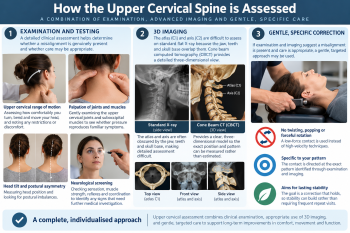
Our evaluation focuses on the craniocervical junction. It includes a detailed history, a postural and neurological examination, and precise imaging of the upper neck to measure the position of the atlas and axis relative to the skull. If a misalignment is found, correction is made with a gentle, low-force, image-guided contact. There is no forceful cracking or popping, and the procedure is designed to be comfortable for patients of all ages. Upper cervical care is not appropriate for everyone. People with ligamentous instability of the upper neck, recent fractures, certain inflammatory arthritis conditions, or some vascular conditions require medical clearance or a different approach, and high-velocity manipulation is contraindicated when frank instability is present.
We are clear with patients about what to expect. Upper cervical care is not a treatment for Raynaud's phenomenon, thyroid disease, anemia, or circulatory disease. Our goal is narrower: to identify and correct upper neck misalignment where it exists, and to see whether reducing that source of irritation to the nervous system is associated with changes in how a person feels. Some patients report warmer hands and feet over time; others do not, and individual results vary.
Schedule a Consultation
Related article
Brachioradial Pruritus: Why Sun Exposure Triggers Itchy Arms | Sarasota Upper Cervical
Jul 27, 2026
If you live in Sarasota, Bradenton, or Lakewood Ranch and have persistently cold hands and feet along with neck problems, headaches, or other signs your nervous system is running in high gear, we would be glad to talk with you. Call our office at 941-259-1891 to schedule a consultation. To learn more about the NeckWise approach to upper cervical care, visit www.neckwise.com.
References
Walløe L. Arterio-venous anastomoses in the human skin and their role in temperature control. Temperature. 2015;3(1):92-103. Narrative review of the anatomy and sympathetic control of shunt vessels in the hands and feet. PMC4861183
Cheung SS. Responses of the hands and feet to cold exposure. Temperature. 2015;2(1):105-120. Narrative review; describes sympathetically mediated peripheral vasoconstriction and central pooling of blood in the torso.
Ootsuka Y, Tanaka M. Control of cutaneous blood flow by central nervous system. Temperature. 2015;2(3):392-405. Review of brainstem circuits controlling skin blood flow; the underlying circuit data come primarily from rat and rabbit studies. PMC4843916
McAllen RM, Farrell M, Johnson JM, et al. Human medullary responses to cooling and rewarming the skin: a functional MRI study. Proceedings of the National Academy of Sciences. 2006;103:809-813. Small imaging study; shows brainstem activity associated with skin temperature change in humans but does not map individual circuits.
Bolton PS, Kerman IA, Woodring SF, Yates BJ. Influences of neck afferents on sympathetic and respiratory nerve activity. Brain Research Bulletin. 1998. Animal study; establishes that upper cervical sensory input can alter sympathetic nerve activity but does not test misalignment.
Bolton PS, Hammam E, Macefield VG. Neck proprioceptors contribute to the modulation of muscle sympathetic nerve activity to the lower limbs of humans. Experimental Brain Research. 2014;232(7):2263-2271. Ten healthy adults; dynamic neck stretch modulated sympathetic activity to muscle, while static stretch did not. Skin sympathetic activity was not measured.
Bakris G, Dickholtz M Sr, Meyer PM, et al. Atlas vertebra realignment and achievement of arterial pressure goal in hypertensive patients: a pilot study. Journal of Human Hypertension. 2007;21(5):347-352. Pilot randomized sham-controlled trial of 50 participants with a single treating practitioner; outcome was hypertension, not extremity temperature, and the authors stated the mechanism could not be determined.
Medical Disclaimer
This article is provided for general educational purposes only and does not constitute medical advice, diagnosis, or treatment, and does not establish a doctor-patient relationship. Persistently cold hands and feet can be a sign of medical conditions, including Raynaud's phenomenon, thyroid disease, anemia, diabetes, and peripheral artery disease, that require evaluation and management by a qualified physician. Upper cervical chiropractic care is not a treatment or cure for any of these conditions or any other named disease, and no guarantee of any particular result is made or implied. Do not discontinue or alter any prescribed medication or treatment without consulting the prescribing physician. Individual results vary, and the mechanisms described in this article include both established physiology and hypotheses that have not been demonstrated in clinical trials, as explicitly indicated throughout the text. In accordance with Florida Administrative Code Rule 64B2-15.001, this content is offered without any claim of superiority of one method of treatment over another and without any promise of cure or guaranteed outcome.
Written by Dr. Drew Hall, upper cervical chiropractor, Sarasota Upper Cervical / Hall Upper Cervical Chiropractic PC, serving Sarasota, Bradenton, and Lakewood Ranch, Florida.
Leave a comment