

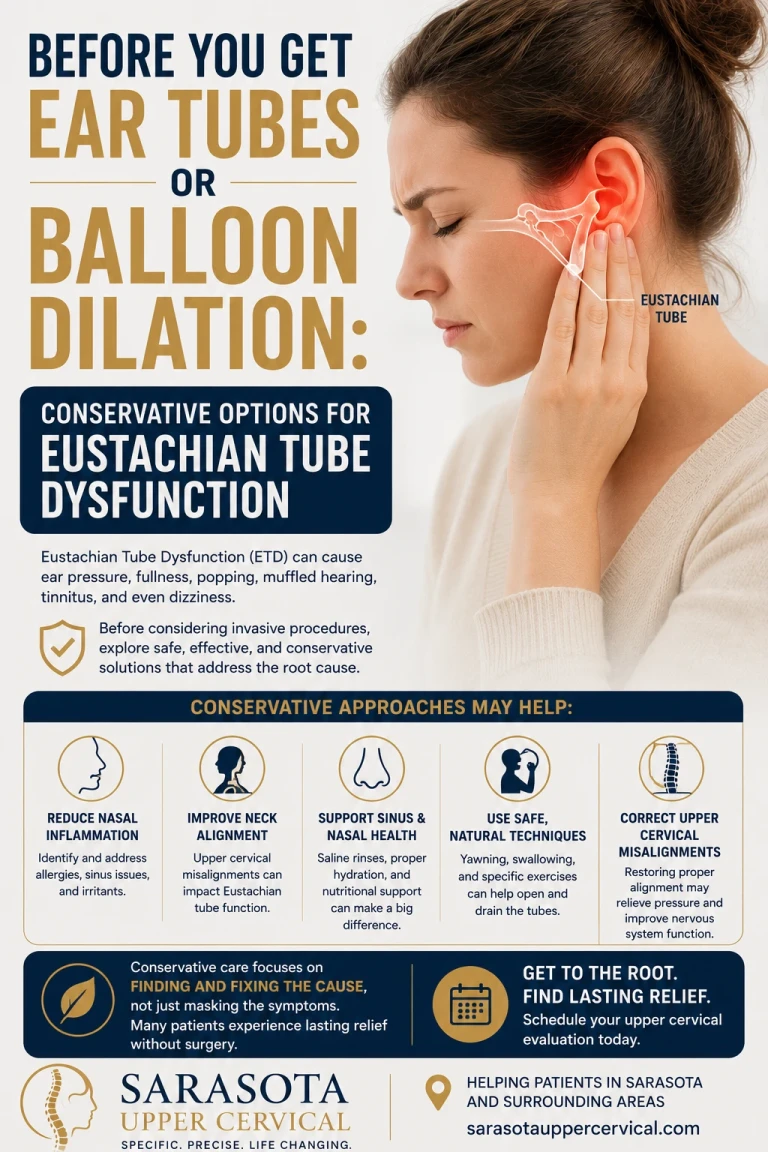
If you've had months of ear fullness, pressure, popping, or muffled hearing that won't resolve, you may have reached the point where an ENT is discussing a procedure — ear tubes or eustachian tube balloon dilation. Those are real, often appropriate options. But before you schedule one, it's worth understanding exactly what they do, who they're genuinely for, and what conservative steps are reasonable to try first or alongside them — including whether a mechanical contributor in your neck and posture has ever been evaluated.
This article is not anti-procedure. For the right candidate, these interventions help. The goal here is to help you be an informed patient: to know the candidacy criteria, the evidence, and the full menu of conservative options — so whatever you decide, you decide it with the whole picture in front of you.
Schedule Your Appointment
Schedule appointmentFirst, what the two procedures actually do
Ear tubes (tympanostomy tubes). A surgeon makes a tiny opening in the eardrum and places a small tube that ventilates the middle ear and lets trapped fluid drain. Tubes bypass the eustachian tube rather than fixing it — they manage the consequence (fluid and negative pressure) while the tube itself remains dysfunctional. They're a long-established, effective tool, especially where there's persistent middle-ear fluid.
Balloon dilation (balloon eustachian tuboplasty, or BDET). A small balloon catheter is passed through the nose into the eustachian tube and inflated to widen the portion that tends to collapse. The procedure uses a tiny inflated balloon to treat obstructive eustachian tube dysfunction, and it can be done in an operating room or, increasingly, in-office under local anesthesia. Unlike tubes, it aims at the tube itself.
What the evidence actually says about balloon dilation
Balloon dilation is genuinely promising for the right patient, and being clear-eyed about the evidence helps you ask better questions. A 2025 systematic review found that balloon dilation improved exam findings, Valsalva (ear-clearing) ability, and middle-ear pressure measurements — particularly within the first six weeks — and that symptom questionnaire scores generally improved, while measured hearing on pure-tone testing showed no significant change, with complications reported as rare. Other analyses have found improvement that stayed stable up to twelve months, and lasting benefit in some persistent cases at more than two years of follow-up, especially when symptoms had resisted medical treatment.
In plain terms: for chronic obstructive ETD that hasn't responded to medical management, balloon dilation is a low-risk procedure that helps many people — but it's not a guaranteed cure, the strongest effects are early, and it doesn't reliably change measured hearing. That's a reasonable thing to weigh, not a reason to avoid it.
Related article
Who the procedures are genuinely for — the candidacy criteria
This is the part most people don't realize: there are formal candidacy criteria, and not everyone with ear symptoms meets them. The otolaryngology clinical consensus statement defines the balloon-dilation target population as adults 18 or older with obstructive ETD in one or both ears for three months or longer that significantly affects quality of life. Insurance medical-policy criteria are often stricter, requiring symptoms for twelve months or longer, confirmed aural fullness and pressure, and a full diagnostic workup including tympanometry, nasal endoscopy, and audiometry.
Two things follow from that. First, the workup matters — these criteria exist to confirm the problem is truly an obstructive eustachian tube, not something that mimics it. Second, the three-to-twelve-month thresholds are, in effect, a built-in conservative-care window. The medical system itself expects time and non-surgical measures before a procedure. That window is exactly where the options below belong.
The key point: The candidacy criteria are also a green light to explore conservative care. If you need three to twelve months of persistent, documented symptoms before a procedure is even on the table, that's months in which it's reasonable to address every contributor — including mechanical and postural ones that a standard ENT workup doesn't typically assess.
The conservative options worth trying first or alongside
1. Standard medical management
The usual first line targets inflammation and congestion: nasal steroid sprays, antihistamines or decongestants when allergy or a cold is driving it, treating underlying sinusitis or reflux, and ear-clearing maneuvers (gentle Valsalva, Toynbee, chewing, yawning). This is appropriate and often effective — and notably, the published caution is that decongestants and antihistamines sometimes make symptoms worse rather than better, so it's worth tracking whether they actually help you.
2. Addressing the mechanical and postural contributors
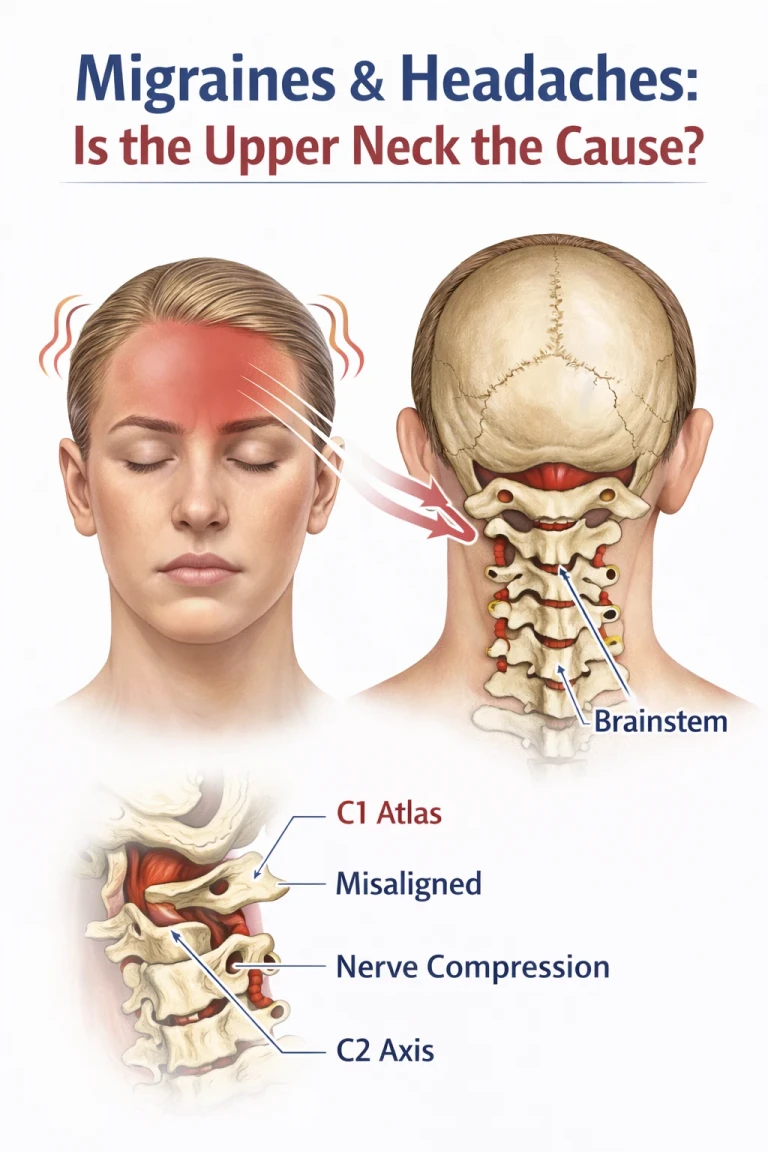
Here's the piece that's routinely missed. The eustachian tube doesn't open by itself — it's pulled open by small muscles (chiefly the tensor veli palatini) anchored in a region with direct fascial and muscular relationships to the upper cervical spine and jaw. Head position, posture, and upper cervical alignment can influence the mechanics of how — and how well — that tube opens and drains. We've covered this in depth across our work on how posture and head position influence ETD, the direct fascial and muscular relationships of upper cervical misalignment, and the craniocervical connection in obstructive ETD.
This is where upper cervical care focuses on a contributor the surgical pathway doesn't address: not the eardrum, not the tube's lumen, but the muscular and postural environment around the tube's opening. For someone whose ETD is driven or worsened by a mechanical/postural component — particularly after whiplash, head injury, or with chronic forward-head posture — restoring normal upper cervical mechanics is a reasonable, low-risk conservative avenue to evaluate before committing to a procedure that targets only the tube or the eardrum.
3. Time and the underlying trigger
A meaningful share of ETD resolves as the true driver — a lingering cold, an allergy season, a sinus infection — settles. The clinical guidance is consistent that most ETD improves within a couple of weeks, and that persistence beyond that is the signal to investigate further rather than the signal to immediately operate.
How to think about the decision
A sensible sequence for most people with persistent, non-emergency ETD looks like this: confirm the diagnosis and rule out red flags with a proper ENT workup; treat the obvious medical drivers (allergy, sinus, reflux); evaluate and address mechanical/postural contributors during the conservative window; and reserve tubes or balloon dilation for symptoms that are genuinely chronic, obstructive, documented, and quality-of-life-limiting — which is precisely the population the procedures are designed for. Done this way, you're not avoiding a procedure; you're making sure that if you have one, it's the right one for the right reason — and that you didn't skip a simpler contributor on the way there.
When to stop researching and see someone promptly
Some symptoms shouldn't wait. Seek timely medical evaluation for sudden hearing loss, severe or worsening ear pain, drainage of fluid or blood from the ear, persistent dizziness or vertigo, or symptoms following significant trauma. Untreated ETD can, in some cases, lead to ongoing middle-ear problems — so persistent symptoms beyond two to three weeks warrant a provider visit rather than indefinite self-management.
Questions and Answers:
Do I have to get ear tubes or balloon dilation for eustachian tube dysfunction?
Not in most cases. These procedures are designed for chronic, obstructive ETD that has persisted for months and significantly affects quality of life. Many people improve with conservative measures — treating the underlying allergy, sinus, or reflux driver, addressing mechanical and postural contributors, and allowing time. Procedures are best reserved for symptoms that remain genuinely chronic and obstructive after conservative care.
What's the difference between ear tubes and balloon dilation?
Ear tubes are placed through the eardrum to ventilate the middle ear and drain fluid — they bypass the eustachian tube rather than repairing it. Balloon dilation passes a small balloon through the nose into the eustachian tube and widens it, targeting the tube itself. Tubes manage the consequence; dilation aims at the cause of obstruction.
Does balloon dilation cure eustachian tube dysfunction?
It helps many people with chronic obstructive ETD, with improvements in ear-clearing ability, middle-ear pressure, and symptom scores — strongest in the first several weeks and stable up to a year or more in many cases. It is low-risk, but it is not a guaranteed cure, and studies generally don't show a significant change in measured hearing. It's a reasonable option for the right candidate, weighed against conservative alternatives.
Can my neck or posture really affect my ears?
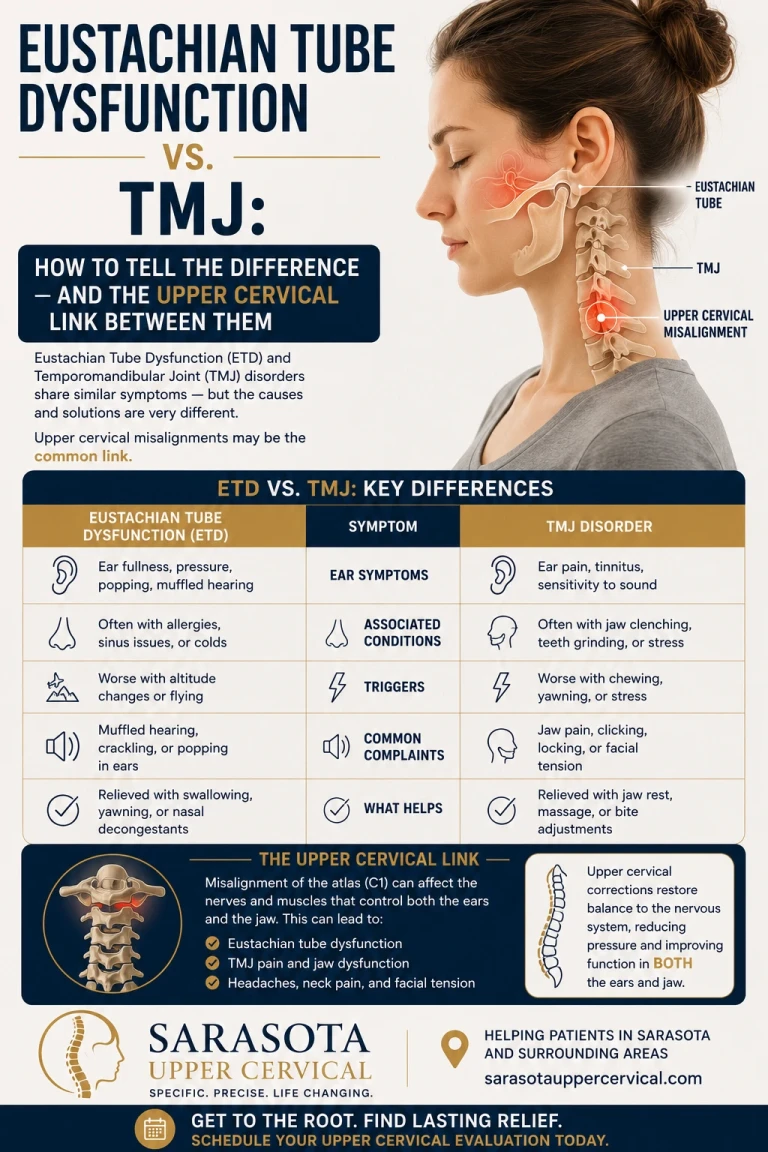
The muscles that open the eustachian tube sit in a region with direct fascial and muscular relationships to the upper cervical spine and jaw, and head position and posture can influence how the tube opens and drains. For ETD with a mechanical or postural component — common after whiplash, head injury, or with chronic forward-head posture — addressing upper cervical mechanics is a reasonable conservative avenue to evaluate. It doesn't replace an ENT workup; it addresses a contributor the surgical pathway doesn't.
How long should I try conservative care before considering a procedure?
The candidacy criteria themselves point to a window: balloon dilation is generally considered for obstructive ETD lasting three months or longer (often twelve months under insurance policies), with a full diagnostic workup. That timeframe is a reasonable period to address medical drivers and mechanical/postural contributors. Symptoms that remain chronic, documented, and quality-of-life-limiting after that are exactly what the procedures are designed for.
When should I see a doctor right away instead of waiting?
Seek prompt evaluation for sudden hearing loss, severe or worsening ear pain, fluid or blood draining from the ear, persistent dizziness or vertigo, or symptoms after a significant head or neck injury. Persistent ETD symptoms beyond two to three weeks also warrant a provider visit rather than continued self-management.
Eustachian tube dysfunction relief in Sarasota
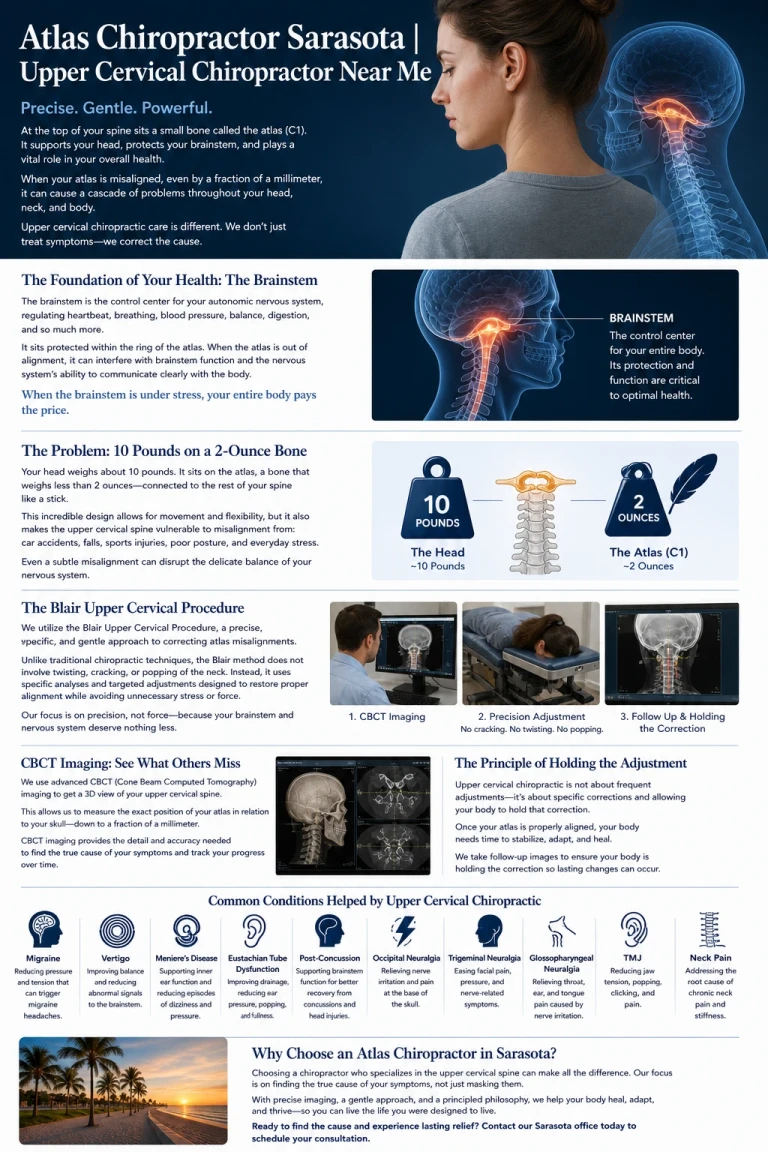
If your ear fullness, pressure, or muffled hearing hasn't resolved — and especially if a mechanical or postural contributor has never been evaluated — a focused upper cervical assessment can help determine whether your neck is part of the picture, working alongside your ENT care.
Request a Consultation call 9412 259-1891
This article is for general educational purposes only and is not medical advice, a diagnosis, or a treatment recommendation for any individual, and it is not a recommendation for or against any surgical procedure. Decisions about ear tubes, balloon dilation, or other medical treatment should be made with a qualified ENT/medical provider based on your individual evaluation. Upper cervical chiropractic is an area of focus within chiropractic; it is not a board-recognized specialty, no claim of specialization or superiority is made or implied, and it addresses mechanical and postural contributors as a complement to appropriate medical care rather than a replacement for it. Individual results vary, and no specific outcome is guaranteed. Seek prompt medical attention for sudden hearing loss, severe ear pain, ear drainage, persistent dizziness, or symptoms following trauma. Always consult a qualified healthcare provider regarding diagnosis and treatment of eustachian tube dysfunction.



Leave a comment