

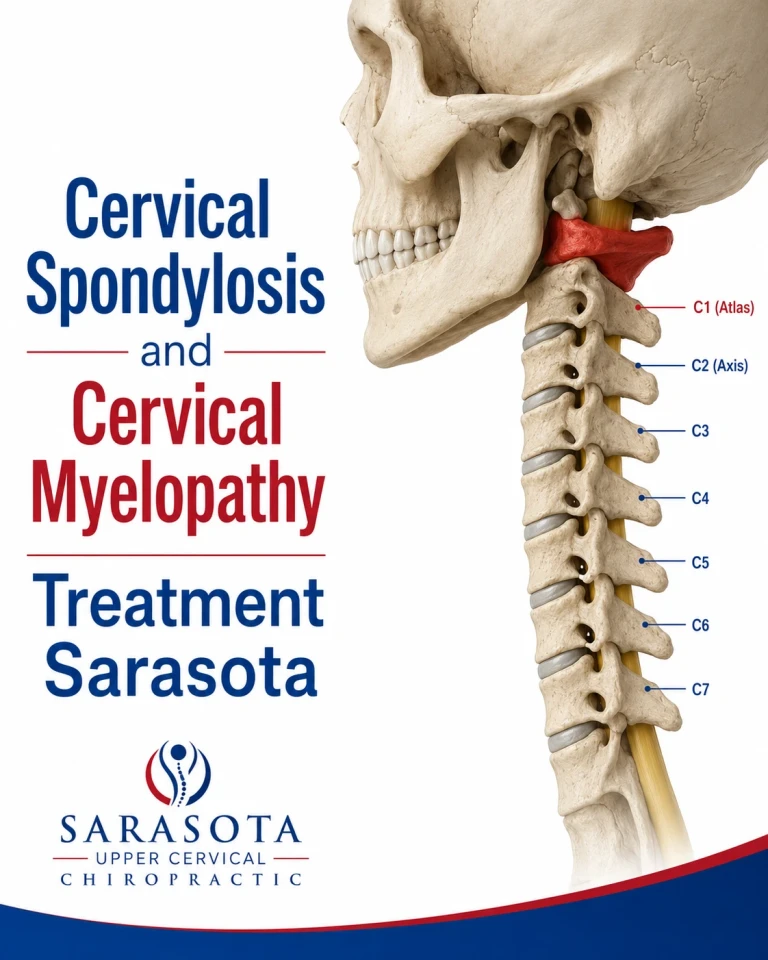
Cervical spondylosis and cervical myelopathy are two very different problems in Sarasota, Bradenton, and Lakewood Ranch, and confusing them is one of the more consequential mistakes in neck care. Spondylosis is age-related wear of the cervical spine, it is nearly universal past middle age, and in most people it causes nothing at all. Myelopathy is compression of the spinal cord itself. It is progressive, it can cause permanent loss of function, and it changes what care is appropriate — including whether any manual treatment of the neck should be given.
This article is written to help you tell them apart, and I want to be clear at the outset that a meaningful part of its purpose is to identify people who should not be treated in my office.
Schedule Your Appointment
Schedule appointmentSpondylosis: common, and usually not the problem
Cervical spondylosis describes degenerative change — disc height loss, osteophyte formation, facet joint arthrosis, ligament thickening. It is the spine's equivalent of grey hair. Radiographic evidence of it is present in a very large proportion of the population over forty, and the majority of those people have no symptoms whatsoever.
This is the single most important thing to understand about imaging of the neck. A report describing degenerative change, disc bulging, or foraminal narrowing does not establish that those findings explain your symptoms. Studies of asymptomatic volunteers consistently find these changes in people with no pain at all. An image finding becomes meaningful only when it corresponds to your clinical picture.
Symptomatic spondylosis typically produces axial neck pain, stiffness, reduced rotation, and sometimes cervicogenic headache. Where an osteophyte or disc narrows a nerve root exit, it produces radiculopathy: pain, numbness, or weakness following a single nerve root's distribution down one arm. Neither of these is myelopathy.
Myelopathy: what actually changes
Related article
Lakewood Ranch Neck Pain Specialist | Natural Upper Cervical Alignment Solutions
Mar 19, 2026
Degenerative cervical myelopathy is the most common cause of age-related spinal cord dysfunction worldwide. When the canal narrows enough to compress the cord, the symptoms are not primarily painful — and that is precisely why they get missed.
The symptoms that matter are these. Clumsiness of the hands, most often noticed as difficulty with buttons, coins, keys, or handwriting. Numbness affecting both hands rather than following one nerve's territory. Difficulty walking, particularly a sense of unsteadiness or a wider, more cautious gait. Bilateral arm tingling. An electric-shock sensation running down the spine or into the limbs when the neck is bent forward, known as Lhermitte's phenomenon. Weakness. Later, changes in bladder urgency or control.
On examination, the findings include exaggerated reflexes, a positive Hoffmann sign, upgoing plantar responses, clonus, lower limb spasticity, wasting of the small muscles of the hand, and an unstable broad-based gait.
The Hoffmann sign deserves a note, because it is frequently over-interpreted. In one surgical series of 225 patients treated for myelopathy, a Hoffmann sign was present in 68 per cent, hyperreflexia in 60 per cent, and a Babinski sign in 33 per cent. Severity tracked with the findings: in patients with milder disability, Hoffmann appeared in 46 per cent and Babinski in 10 per cent, whereas in those with severe myelopathy Hoffmann was present in 81 per cent and Babinski in 83 per cent. But a Hoffmann sign also occurs in neurologically normal people, and a related finding, the inverted radial reflex, has been reported in around a quarter of asymptomatic individuals. A positive Hoffmann sign is a reason to look further. It is not a diagnosis on its own.
Why this is a referral, not a treatment plan
Severity in myelopathy is graded using the modified Japanese Orthopaedic Association scale. Current recommendations from the World Federation of Neurosurgical Societies Spine Committee are that surgical intervention is recommended for moderate and severe myelopathy, and that either surgery or rehabilitation may be offered for mild myelopathy in the mJOA 15 to 17 range.
That is the appropriate care pathway, and it is not a chiropractic one. The reason is straightforward: compression of the spinal cord is a mechanical problem inside the spinal canal, and no adjustment enlarges a canal narrowed by osteophyte and thickened ligament. Neurological deficit from prolonged cord compression frequently does not fully recover after decompression, which makes delay costly in a way that delay in treating ordinary neck pain is not.

There is a further and more direct concern. Manipulation of a spine with significant cord compression carries risk of neurological worsening. However, because upper cervical chiropractic uses precise three d imaging and does not employ twisting or cracking of the neck the intervention is still safe and pateints often find relief.
What upper cervical care can legitimately offer
With that stated, there are two genuine contributions.
The first is screening. A great many people carry undiagnosed early myelopathy, attributing hand clumsiness to age and unsteadiness to inner ear trouble. Anyone presenting with neck complaints should be examined for upper motor neuron signs before any treatment is given. That examination — reflexes, Hoffmann, plantar responses, clonus, gait, tandem walking, hand intrinsic bulk — takes a few minutes and is the reason some patients leave my office with an imaging referral instead of an adjustment.
The second applies to the far larger group who have spondylosis without myelopathy. In that population, upper cervical dysfunction can contribute to altered head position and abnormal load distribution through the segments below, and addressing it is reasonable. It is worth being honest that this is management of mechanics and symptoms rather than reversal of degeneration. Nothing regrows a disc.
Precision and knowing when not to adjust
Where care is appropriate, it involves no twisting, no popping, no cracking, and no pulling of the neck. Cone beam computed tomography measures the three-dimensional relationship between skull, atlas, and axis against your own anatomy, and also demonstrates the degenerative changes present, so that decisions are made on your structure rather than an average. Where the clinical picture suggests cord involvement, cone beam imaging is not the right test — MRI is, because it images the cord and soft tissue that CT cannot.

Objective measures are taken at every visit: leg length assessment, cervical range of motion, postural and balance measurement, and thermographic pattern tracking. When those show the correction is holding, no adjustment is given. In a spine with significant degenerative change, restraint matters more, not less.
Red flags requiring prompt medical evaluation
Progressive hand clumsiness or difficulty with fine motor tasks. Numbness in both hands. Increasing unsteadiness or falls. Electric shock sensations with neck flexion. Weakness in the arms or legs. Any change in bladder or bowel control, which requires urgent assessment. Symptoms affecting both arms and both legs. Neck pain with fever, unexplained weight loss, or a history of cancer. Neck pain following significant trauma, particularly in anyone with osteoporosis or rheumatoid arthritis.
Rheumatoid arthritis and Down syndrome both warrant specific mention, because both are associated with instability at the atlantoaxial joint, and both require imaging assessment before any cervical treatment.
An evaluation in Sarasota
If you have neck pain and want to know whether the degenerative changes on your report are actually the source, or if you have noticed clumsiness in your hands or unsteadiness on your feet and no one has examined you for it, an evaluation that includes a proper neurological screen is a reasonable step. Where the findings point to cord involvement, you will leave with a referral rather than a treatment plan. To arrange a consultation caqll 941 259-1891.
Dr. Drew Hall, Upper Cervical Chiropractor
Serving Sarasota, Bradenton, and Lakewood Ranch, Florida
This article is for general educational purposes only and is not medical advice, a diagnosis, or a treatment recommendation for any individual. Degenerative cervical myelopathy is a progressive condition requiring diagnosis and management by qualified medical providers, typically with MRI and specialist referral, and current guidance recommends surgical intervention for moderate and severe disease. Established cervical myelopathy and atlantoaxial instability are contraindications to cervical manipulation. Upper cervical chiropractic is an area of focus within chiropractic; it is not a board-recognized specialty, and no claim of specialization or superiority is made or implied. Chiropractic care does not reverse degenerative change, enlarge a narrowed spinal canal, or treat spinal cord compression, and no such claim is made here. Cone beam computed tomography is used as a precision measurement and analysis tool, not as a stand-alone diagnostic device, and does not image the spinal cord; MRI is the appropriate study where cord involvement is suspected. Individual results vary and no specific outcome is guaranteed. Seek prompt medical attention for progressive hand clumsiness, numbness in both hands, unsteadiness or falls, limb weakness, electric shock sensations with neck movement, or any change in bladder or bowel control. Always consult a qualified healthcare provider regarding diagnosis and treatment.


Leave a comment