

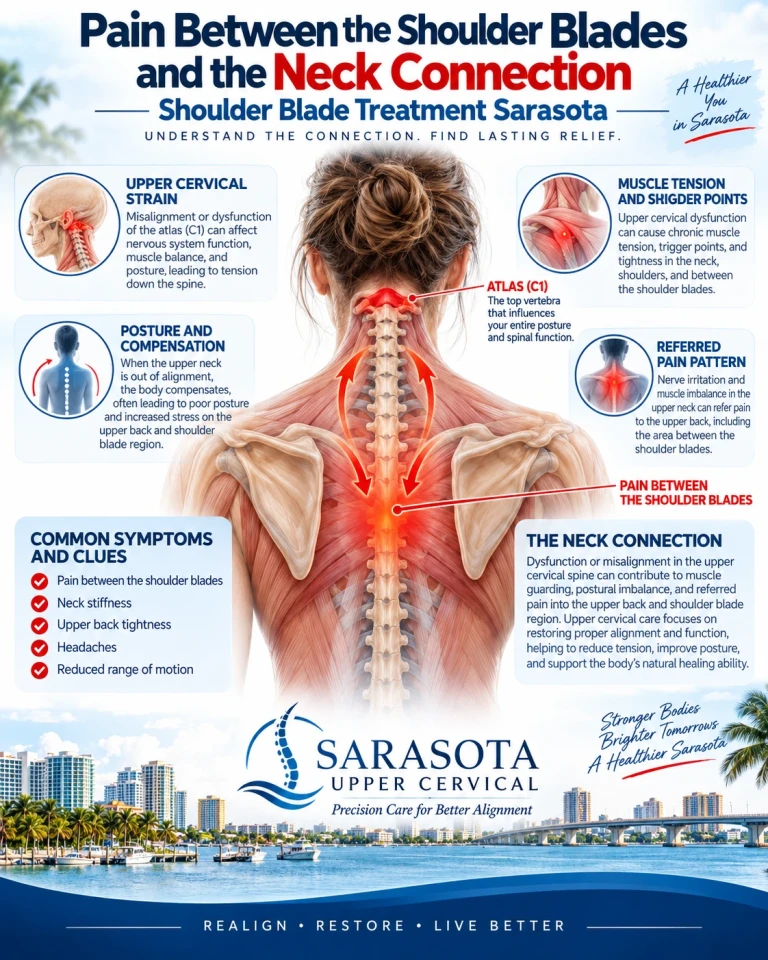
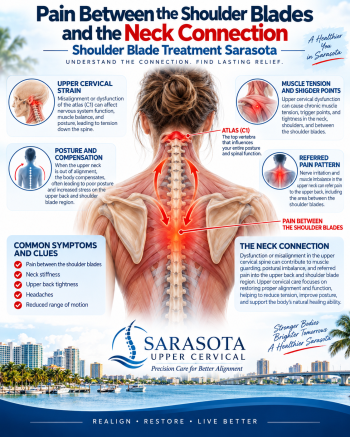
Pain between the shoulder blades is one of the most common complaints in Sarasota, Bradenton, and Lakewood Ranch, and one of the most consistently mislocated. People point to the spot, press on it, roll a ball into it, and get relief that lasts an hour. Then it returns to exactly the same place. That pattern — reliable location, temporary response to local treatment, reliable return — usually means the pain is being referred there rather than generated there.
This article covers where interscapular pain actually comes from, including the causes that are not musculoskeletal at all.
Schedule Your Appointment
Schedule appointmentStart with what must be excluded
The area between the shoulder blades is a referral site for several serious conditions, and any article that goes straight to posture without saying so is doing readers a disservice.
Cardiac ischaemia can present as interscapular or upper back pain, particularly in women, in people with diabetes, and in older adults, sometimes without classic chest pain. Aortic dissection classically produces sudden severe tearing pain between the shoulder blades and is a surgical emergency. Pulmonary embolism can produce upper back pain with breathlessness. Gallbladder disease refers to the right scapular region, and pancreatic disease to the mid-back, often worse lying flat and better leaning forward. Peptic ulcer and oesophageal disease refer to the same territory.
The features that separate these from mechanical pain are worth knowing. Mechanical pain changes with position and movement, is reproducible by palpation or specific motion, and does not come with systemic symptoms. Visceral referral is typically unchanged by position, poorly localised, often described as deep or boring, and may come with nausea, sweating, breathlessness, or a relationship to meals or exertion.
If your pain between the shoulder blades comes on with exertion and eases with rest, that is an exertional pattern and it needs cardiac evaluation before anything else.
The mechanical sources
Referral from the cervical spine
This is the single most under-recognised cause, and it is why local treatment so reliably fails.
The lower cervical segments refer pain into the interscapular region in well-mapped patterns. Provocation studies of the cervical zygapophyseal joints have established that C5-6 and C6-7 refer into the area over and around the scapula, and cervical disc provocation produces similar patterns. Someone with a lower cervical facet or disc problem may have minimal neck pain and prominent pain between the shoulder blades.
Cervical radiculopathy, particularly at C7 and C8, frequently produces medial scapular pain, often before or without arm symptoms. Interscapular pain that came on with a neck problem, that changes with neck position, or that comes with any arm symptoms should be worked up at the neck rather than at the site of pain.
Thoracic joints and ribs
Each thoracic vertebra articulates with its neighbours and with the ribs through costovertebral and costotransverse joints. These are genuine pain generators, produce well-localised pain often described as sharp or catching, and typically vary with breathing, twisting, or specific movements. Rib dysfunction commonly presents as pain reproducible by direct pressure over a specific rib angle.
Muscular and scapular
The rhomboids, middle and lower trapezius, and levator scapulae are frequently tender, but tenderness is not the same as causation. In most cases the muscular findings are secondary — the muscles are working overtime because the joints they attach to are not doing their share, or because scapular mechanics have altered.
Related article
Scapular dyskinesis, where the shoulder blade does not move normally on the ribcage, contributes substantially. So does a prolonged sitting posture with a protracted scapula and forward head position, which loads the interscapular muscles eccentrically for hours at a time.
Where the upper cervical spine fits
The connection here is real but indirect, and I want to describe it accurately rather than assert it.
The head weighs roughly ten to twelve pounds and sits on a mobile column. Its position over that column determines the load distribution through everything below. Where the head is carried forward of the body's centre of gravity, the posterior cervical and upper thoracic musculature must generate continuous counterbalancing tension, and the interscapular region is precisely where that tension is borne.
Upper cervical alignment influences head position directly, because the atlas is the structure the skull sits on. Where an upper cervical problem produces a compensatory head position, the postural cascade runs downward through the lower cervical segments, the cervicothoracic junction, and the scapular stabilisers.
There is also a proprioceptive argument. The suboccipital muscles carry one of the highest muscle spindle densities in the body — an estimate derived substantially from anatomical specimen studies including fetal material, which is worth stating since the figure is often quoted without it. These structures inform postural tone throughout the body, and distorted input from them plausibly affects the resting tone of the muscles maintaining upright posture.
I would label the postural cascade as well-reasoned biomechanics and the proprioceptive tone argument as a hypothesis. There is no trial evidence that upper cervical correction resolves interscapular pain, and I am not going to claim there is. What is defensible is that where the pain has resisted local treatment and a cervical contribution is identified on examination, treating the neck is more likely to help than continuing to treat the site.
Why local treatment keeps failing
Related article
Massage, dry needling, foam rolling, and stretching all reduce interscapular muscle tension temporarily. If the muscle is contracting because of referred input from the cervical spine, or because it is compensating for altered scapular mechanics, reducing its tension does not remove the reason it was contracting.
The diagnostic value of that observation is high. Reliable but short-lived relief from local work suggests you have found where the pain is felt but not where it is coming from.
Precision and knowing when not to adjust
Upper cervical correction involves no twisting, no popping, no cracking, and no pulling of the neck. Cone beam computed tomography measures the three-dimensional position of the atlas and axis against your own anatomy so a correction is calculated rather than estimated. Objective measures — leg length assessment, cervical range of motion, postural and balance measurement, and thermographic pattern tracking — determine whether a correction is indicated and whether it is holding. When it is holding, no adjustment is given.
Where the interscapular pain is arising from a local thoracic or rib source, or from scapular mechanics, that is what needs addressing, and postural and scapular retraining does more of the work than any passive treatment.
An evaluation in Sarasota
If pain between your shoulder blades has resisted massage, stretching, and local treatment, and cardiac and other medical causes have been excluded, an evaluation that examines the cervical spine and postural mechanics rather than only the painful area may identify why it keeps returning. This works alongside your physician rather than in place of medical assessment. To arrange a consultation, call 941 259-1891.
Dr. Drew Hall, Upper Cervical Chiropractor
Serving Sarasota, Bradenton, and Lakewood Ranch, Florida
This article is for general educational purposes only and is not medical advice, a diagnosis, or a treatment recommendation for any individual. Pain between the shoulder blades can be referred from cardiac, vascular, pulmonary, and abdominal sources, and requires medical evaluation to exclude these before being managed as a musculoskeletal problem. Upper cervical chiropractic is an area of focus within chiropractic; it is not a board-recognized specialty, and no claim of specialization or superiority is made or implied. No trial evidence exists for upper cervical chiropractic care in interscapular pain, and none is claimed here; the postural cascade described is reasoned biomechanics and the proprioceptive contribution is a hypothesis rather than a demonstrated mechanism. Suboccipital muscle spindle density figures derive substantially from anatomical specimen studies including fetal material. Cone beam computed tomography is used as a precision measurement and analysis tool, not as a stand-alone diagnostic device. Individual results vary and no specific outcome is guaranteed. Seek emergency care for sudden severe tearing upper back pain, pain with chest tightness, breathlessness, sweating or nausea, pain brought on by exertion, or any leg weakness, numbness, or change in bladder or bowel control. Always consult a qualified healthcare provider regarding diagnosis and treatment.
Leave a comment