


Central sensitization is the reason a great many people in Sarasota, Bradenton, and Lakewood Ranch are told their imaging is clean and their pain is nonetheless real. Scans find no torn tissue. Blood work is normal. The pain is widespread, disproportionate to any identifiable damage, and worsening. The conclusion drawn is often that nothing is wrong. What is actually wrong is that the system reporting the pain has changed its settings.
What the term means
Schedule Your Appointment
Schedule appointment
Pain is not a direct readout of tissue damage. It is a signal that gets processed, amplified, or suppressed at multiple points between the periphery and the brain. Central sensitization describes an increase in the responsiveness of neurons in the central nervous system, so that the same peripheral input produces a larger pain output than it should.
Clifford Woolf demonstrated the phenomenon experimentally in the early 1980s, showing that sustained noxious input produced lasting increases in spinal cord excitability rather than simply passing through. That work reframed persistent pain from a purely peripheral problem to one involving the nervous system's own processing.
The International Association for the Study of Pain has since introduced nociplastic pain as a third mechanistic category alongside nociceptive pain, which arises from tissue damage, and neuropathic pain, which arises from nerve lesion. Nociplastic pain arises from altered nociception without clear evidence of either. Fibromyalgia is the archetype, but the mechanism appears across a wide range of persistent pain conditions.
What changes
Several things happen together, and each maps onto something patients describe.
Wind-up, or temporal summation, means repeated stimuli of identical intensity produce progressively larger responses. This is why a repetitive task that was fine for ten minutes becomes intolerable at thirty.
Receptive field expansion means dorsal horn neurons begin responding to input from a wider area than they originally covered. This is why pain spreads beyond its starting point.
Related article

Allodynia means non-painful input is experienced as painful — clothing, a light touch, a breeze. Hyperalgesia means painful input is amplified.
Loss of descending inhibition may be the most important element. The brainstem, principally the periaqueductal grey and rostral ventromedial medulla, sends descending pathways that continuously suppress incoming nociceptive traffic. When that suppression weakens, more signal reaches consciousness. This can be measured as impaired conditioned pain modulation, and it is reduced in many chronic pain populations.
These are measurable phenomena, not descriptions of attitude.
Evidence it is real, and one study worth knowing
A finding that illustrates the concept unusually well comes from César Fernández-de-las-Peñas and colleagues, published in Brain in 2009. They studied patients with carpal tunnel syndrome — a compression of one nerve in one wrist — and found bilateral, widespread mechanical pain hypersensitivity, including on the unaffected side and at sites well away from the hand.
A nerve trapped in one wrist should not alter pain thresholds in the other arm or the shoulders. That it does demonstrates that a local, entirely explicable peripheral problem can produce system-wide changes in pain processing. It also explains something clinically important: why some people do not improve after a technically successful surgery. If the processing has changed, releasing the ligament does not automatically reset it.
Where the upper cervical spine fits
Two threads connect this to the neck, and they differ in strength.
The first is straightforward and applies to any input source. Central sensitization is driven and maintained by sustained nociceptive input. Where the upper cervical spine is a source of that input — after whiplash, after head injury, in the presence of persistent suboccipital dysfunction — it contributes to the total load the system is processing. Reducing a maintaining source is a coherent aim in a sensitised state, and it is the same logic that underlies treating any ongoing peripheral pain generator in a chronic pain patient.

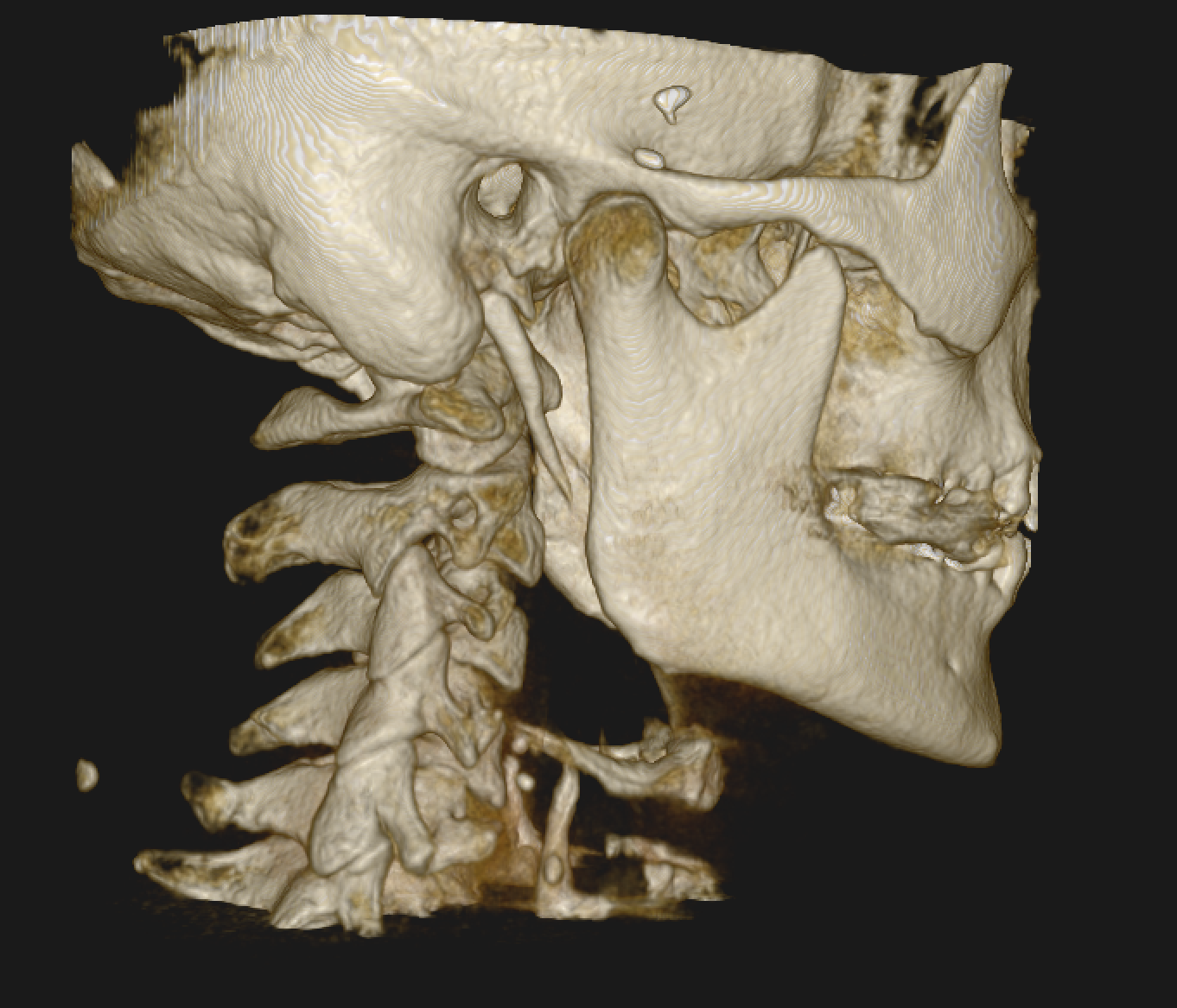
The second is more specific and concerns the head and neck. The trigeminal nucleus caudalis extends downward into the upper cervical spinal cord to roughly the C2 and C3 level, where trigeminal afferents from the face, jaw, dura, and cranial vessels share second-order neurons with afferents from the upper cervical roots. This is the trigeminocervical complex. Convergence at this level means upper cervical input can influence the excitability of neurons that also process facial and cranial sensation — the established explanation for cervicogenic headache and for why neck problems refer into the head and face.
Beyond that anatomy, the brainstem structures generating descending pain inhibition sit immediately above the craniocervical junction, and cervical afferents have documented access to brainstem circuitry. Whether upper cervical dysfunction meaningfully alters descending inhibition in humans is not established, and I am labelling that as a hypothesis rather than a mechanism. What is established is the convergence anatomy.
There is no clinical trial of upper cervical chiropractic for central sensitization, and it would be a strange thing to trial, since central sensitization is a mechanism rather than a diagnosis. The honest claim is that where the neck is one maintaining input among several, addressing it is reasonable — not that it resolves a sensitised state.
What actually reduces central sensitization
This is worth stating plainly, because manual care is a small part of it.
Pain neuroscience education has reasonable supporting evidence on its own. Understanding that pain does not equal damage measurably changes outcomes, largely by reducing the threat value attached to the sensation.
Graded activity and graded exposure, progressing carefully rather than avoiding movement, is central. Deconditioning and avoidance reinforce sensitisation.
Sleep matters more than most people expect. Poor sleep reliably lowers pain thresholds, and the relationship runs strongly from sleep to pain, not only the reverse. Addressing sleep is not peripheral to pain management; it is part of it.
Aerobic exercise improves descending inhibition. Stress and threat load modulate the system directly. Certain medications acting on central mechanisms, including some antidepressants and gabapentinoids, are used because they target this processing rather than tissue.
Related article
Anyone offering a single passive intervention as the answer to a centrally sensitised pain state is offering less than the condition requires.
How care is delivered here
Upper cervical correction involves no twisting, no popping, no cracking, and no pulling of the neck. In a sensitised nervous system that is not a stylistic preference — forceful handling can provoke a disproportionate response, and low-force technique is the appropriate choice.
Cone beam computed tomography measures the three-dimensional position of the atlas and axis against your own anatomy so that a correction is calculated rather than estimated. Objective measures — leg length assessment, cervical range of motion, postural and balance measurement, and thermographic pattern tracking — determine whether a correction is indicated and whether it is holding. When it is holding, no adjustment is given. Frequent adjusting of a sensitised system adds input to a system already struggling to filter it.
Red flags
Central sensitization is a diagnosis reached after other causes have been considered, not instead of considering them. Unexplained weight loss, fever, night sweats, a history of cancer, or pain that is unremitting and worse at night require medical work-up. Progressive weakness, numbness in a defined nerve distribution, changes in bladder or bowel control, or unsteady gait suggest a structural neurological problem. New widespread pain with morning stiffness lasting more than an hour, particularly with raised inflammatory markers, points toward inflammatory rheumatic disease. Widespread pain with fatigue warrants screening for thyroid disease, vitamin D deficiency, and anaemia.
Chronic pain carries a substantial psychological burden, and low mood or anxiety in this setting deserves support in its own right rather than being treated as the explanation for the pain.
An evaluation in Sarasota
If your pain has spread beyond where it started, if your imaging does not explain what you feel, or if a technically successful treatment has not helped, an evaluation that considers the upper cervical spine as one potential maintaining input may be worth including in a broader plan. It works alongside medical care, rehabilitation, and pain management rather than in place of them. To arrange a consultation- call 941 259-1891.
Dr. Drew Hall, Upper Cervical Chiropractor
Serving Sarasota, Bradenton, and Lakewood Ranch, Florida
This article is for general educational purposes only and is not medical advice, a diagnosis, or a treatment recommendation for any individual. Central sensitization is a pain mechanism rather than a stand-alone diagnosis, and persistent pain should be evaluated by qualified medical providers with other causes appropriately excluded. Upper cervical chiropractic is an area of focus within chiropractic; it is not a board-recognized specialty, and no claim of specialization or superiority is made or implied. No clinical trial evidence exists for upper cervical chiropractic care in central sensitization, and none is claimed here; the role described is limited to addressing one potential maintaining input among several. Education, graded activity, sleep, and exercise-based approaches are central to management and should not be delayed or replaced by manual care. Cone beam computed tomography is used as a precision measurement and analysis tool, not as a stand-alone diagnostic device. Individual results vary and no specific outcome is guaranteed. Seek prompt medical attention for unexplained weight loss, fever, night sweats, progressive weakness, numbness, changes in bladder or bowel control, or unsteady gait. Always consult a qualified healthcare provider regarding diagnosis and treatment.

Leave a comment