


Something is wrong with your digestion and nobody can tell you why. The endoscopy was clean. The colonoscopy was normal. Your blood work came back fine. You have tried elimination diets, probiotics, enzyme supplements, and more antacids than you care to count. The bloating, the reflux, the cramping, the unpredictable bowels, they persist. And the best answer anyone can offer is "irritable bowel syndrome," which is essentially a label that says your gut is malfunctioning but we cannot find a structural reason for it.
There may be a structural reason. It just is not in the gut. It is at the top of the neck.
Schedule Your Appointment
Schedule appointmentHow the Brainstem Runs Your Digestive System
The vagus nerve is the longest cranial nerve in the body. It originates in the brainstem and travels down through the neck, chest, and abdomen, branching into the esophagus, stomach, liver, pancreas, gallbladder, small intestine, and the first two-thirds of the large intestine. It carries approximately 75% of all parasympathetic signals in the body, making it the primary nerve responsible for "rest and digest" function.
But here is what most articles about the vagus nerve and digestion leave out: the vagus nerve is not a one-way street. Roughly 80% of its fibers are afferent, meaning they carry information from the gut up to the brainstem, not the other way around. The brainstem is constantly receiving data from the digestive tract about pH levels, nutrient content, distension, motility, and microbial activity. It processes that data and sends motor signals back down to adjust gastric acid secretion, enzyme release, sphincter tone, bile output, and the rhythmic contractions that move food through the system.
The control center for this entire operation is the dorsal motor nucleus (DMN), a cluster of vagal neurons located in the medulla oblongata of the brainstem. The medulla sits directly above the atlas vertebra (C1). When the atlas is misaligned, the DMN can be placed under mechanical stress that degrades its ability to regulate the digestive organs below the diaphragm. The gut does not stop working. It stops working correctly.
The Migrating Motor Complex: The Housekeeper Your Gut Depends On
Between meals, the small intestine performs a cleaning cycle called the migrating motor complex (MMC). This is a series of strong, sweeping contractions that move residual food particles, bacteria, and cellular debris from the upper small intestine down into the large intestine. The MMC operates on a roughly 90-minute cycle during fasting states and is entirely dependent on vagal signaling.
When vagal tone is impaired, the MMC slows or stops. Residual material accumulates in the small intestine. Bacteria that should have been swept downstream begin to colonize the upper small bowel. This is the mechanism behind small intestinal bacterial overgrowth, or SIBO, one of the most rapidly increasing gastrointestinal diagnoses in the United States.
SIBO produces bloating, gas, abdominal pain, diarrhea, constipation, or an alternating pattern of both. These are the same symptoms that define IBS. In fact, a growing body of gastroenterological research suggests that SIBO may account for a significant portion of what gets diagnosed as IBS. The connection to the vagus nerve is direct, and the vagus nerve's connection to the atlas is anatomical.
No other article on upper cervical care and digestive health mentions the migrating motor complex. But for patients whose bloating and gut disturbance appear between meals or worsen with fasting, the MMC mechanism is often the missing explanation.
GERD, Gastroparesis, and the Lower Esophageal Sphincter
Gastroesophageal reflux disease (GERD) affects roughly 20% of adults in the United States. The conventional explanation focuses on the lower esophageal sphincter (LES), the valve between the esophagus and the stomach that is supposed to prevent acid from traveling upward. When the LES loses tone, acid refluxes.
What controls LES tone? The vagus nerve. Specifically, the motor fibers descending from the dorsal motor nucleus regulate the contraction and relaxation of the LES alongside gastric motility. When vagal output is diminished due to brainstem irritation from an atlas misalignment, LES tone drops. Acid rises. The patient is prescribed a proton pump inhibitor (PPI), which suppresses acid production but does not address the reason the sphincter lost its tone.
Similarly, gastroparesis, or delayed stomach emptying, occurs when the stomach's motility slows. Food sits in the stomach longer than it should, producing nausea, early satiety, bloating, and sometimes vomiting. The vagus nerve controls gastric motility through the same DMN pathway. Atlas displacement does not sever the nerve. It reduces the quality of the signal, which is enough to slow the stomach without creating a finding on a standard imaging study.

Why the Gastroenterologist's Tests Come Back Normal
Endoscopy looks at the lining of the esophagus and stomach. Colonoscopy examines the large intestine. Blood panels measure markers of inflammation, infection, and organ function. These tests are designed to detect structural pathology within the digestive tract itself: ulcers, tumors, inflammatory bowel disease, celiac damage.
When the problem is not in the gut's structure but in its neurological control, these tests will be normal. The organs look fine because they are fine. What is not fine is the signal telling them how to function. That signal originates in the brainstem, travels through the vagus nerve, and can be disrupted by a structural issue at the craniocervical junction that no gastroenterologist is trained to evaluate.
This is not a criticism of gastroenterology. It is a recognition that digestive function is a neurological event, and the neurology of digestion begins at the brainstem.
Dr. Drew Hall's Personal Experience
Dr. Drew Hall, the lead doctor at Sarasota Upper Cervical, knows what it feels like when the atlas disrupts digestion. After a wrestling injury in his early twenties, he developed chronic nausea alongside headaches, insomnia, dizziness, cognitive fog, depression, anxiety, and fatigue. For two years he went from doctor to doctor. Every test came back negative. He was told it was all in his head. It turned out to be about a quarter inch below his head: a misaligned atlas.
After receiving an upper cervical correction, his symptoms resolved. That experience became the foundation of a 20-year career and the treatment of more than 10,000 patients across practices in Los Angeles, Carson, and now Sarasota.
When a patient walks into the Bee Ridge Road office describing bloating that nobody can explain, or reflux that PPIs are not controlling, or a gut that has simply stopped cooperating, Dr. Hall does not need to imagine what that experience is like. He has lived it.
Blair Upper Cervical Care for Digestive Disorders at Sarasota Upper Cervical
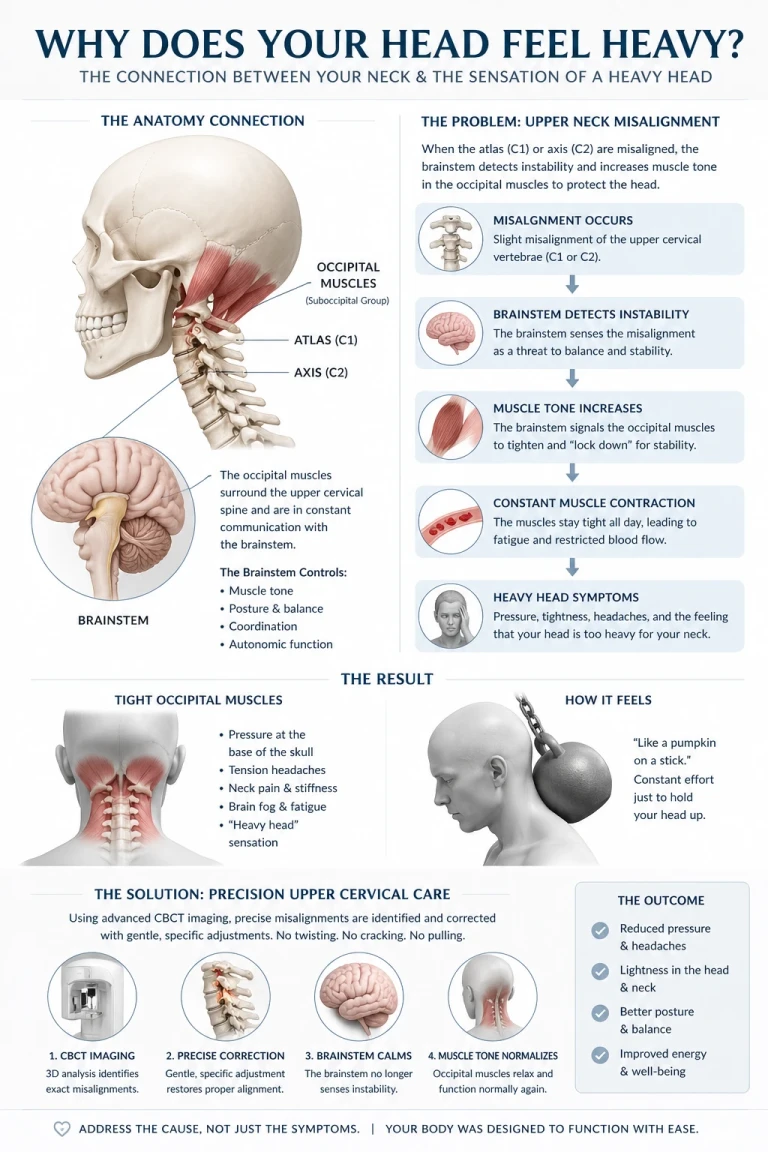
Dr. Hall and Dr. Beth O'Rourke use the Blair Upper Cervical technique, which begins with CBCT (cone beam computed tomography) imaging of the craniocervical junction. CBCT produces a three-dimensional volumetric scan that reveals the exact positional relationships between the atlas, the axis, and the base of the skull. No two misalignment patterns are the same, and the correction must match the individual anatomy.
The Blair adjustment is gentle. There is no pulling, popping, or twisting of the neck. The input is precise and controlled, using only the amount of pressure you would use to check a pulse. Thermography and leg length checks monitor nervous system function at each visit. If the atlas is holding its corrected position, no adjustment is performed. The objective is a stable correction that allows the brainstem, and specifically the dorsal motor nucleus, to regulate the digestive system without structural interference.
For a deeper understanding of how the vagus nerve functions and how atlas misalignment affects it broadly, the practice's comprehensive guide to vagus nerve dysfunction provides additional context.
What Digestive Patients Typically Notice
Many patients report changes in digestive function within the first few weeks of care. Bloating decreases. Bowel regularity improves. Reflux episodes become less frequent or less severe. Some patients notice changes they were not expecting: reduced post-meal fatigue, better appetite regulation, less abdominal cramping after eating.
These changes are not isolated to the gut. They tend to arrive alongside improvements in sleep, energy, neck tension, and mental clarity. This is because the vagus nerve and the brainstem do not regulate just one system. They regulate many systems simultaneously. When the interference is removed, the benefits extend beyond the original complaint.
Who Should Consider Evaluation in Sarasota
If you live in Sarasota, Bee Ridge, Gulf Gate, Lakewood Ranch, Siesta Key, Venice, Bradenton, Osprey, Palmer Ranch, or North Port and you have been living with digestive problems that dietary changes, supplements, and medication have not resolved, the upper cervical spine may hold the answer nobody has looked for. This is especially worth pursuing if your digestive symptoms began after a head or neck injury, if you also experience neck stiffness or headaches, or if your GI workup came back normal and you were given a functional diagnosis like IBS without a clear cause.
Sarasota Upper Cervical offers a Free Consultation for new patients. The office is at 3920 Bee Ridge Rd, Bldg D, Suite 101, Sarasota, FL 34233. Call (941) 259-1891.

Leave a comment