

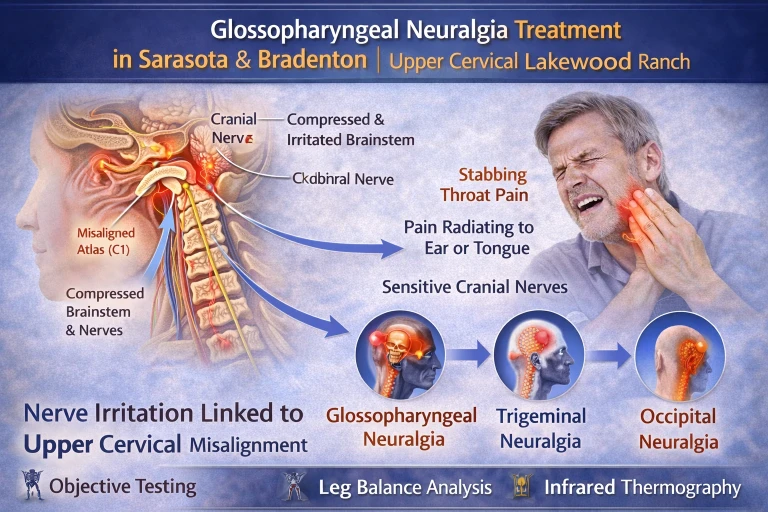
Glossopharyngeal Neuralgia Treatment in Sarasota & Bradenton | Upper Cervical Lakewood Ranch
Sharp, stabbing pain in the throat, ear, or back of the tongue can be frightening and incredibly disruptive. Many people who experience this type of pain are eventually diagnosed with Glossopharyngeal Neuralgia (GPN)—a rare but extremely painful nerve condition.
Schedule Your Appointment
Schedule appointmentIf you are searching for Glossopharyngeal Neuralgia treatment in Sarasota, Bradenton, or Lakewood Ranch, it’s important to understand that nerve pain in the head and neck is often connected to the upper cervical spine and the brainstem.
Many patients suffering from nerve-related facial or throat pain also experience conditions such as:
• Trigeminal neuralgia
• Occipital neuralgia
• Chronic headaches
• Ear pain
• Jaw pain (TMD)
• Neck stiffness
These conditions are often treated separately, but they may share a common neurological connection at the upper cervical spine.
Upper cervical chiropractic focuses on restoring proper alignment of the top bones of the spine to help reduce irritation to the brainstem and cranial nerves.
👉 Schedule a FREE consultation by calling 941-259-1891 or click here to book online.
Understanding Glossopharyngeal Neuralgia
Glossopharyngeal Neuralgia involves irritation of the glossopharyngeal nerve (cranial nerve IX). This nerve originates in the brainstem and travels through the neck to supply sensation to the throat, ear, tonsils, and back of the tongue.
When the nerve becomes irritated, it can produce sudden, severe pain.
Common symptoms include:
• Sharp, electric-like pain in the throat
• Pain in the ear canal
• Pain at the base of the tongue
• Pain triggered by swallowing, talking, or chewing
• Episodes that come and go suddenly
• Pain lasting seconds to minutes
Because the nerve travels through tight anatomical spaces near the skull base and upper neck, structural tension in this region can play a role in nerve irritation.
The Brainstem: The Source of Cranial Nerves
The glossopharyngeal nerve begins in the brainstem, specifically within the medulla.
The brainstem is one of the most important neurological structures in the body. It regulates:
• Cranial nerve function
• Autonomic nervous system balance
• Sensory processing
• Muscle tone
• Cardiovascular regulation
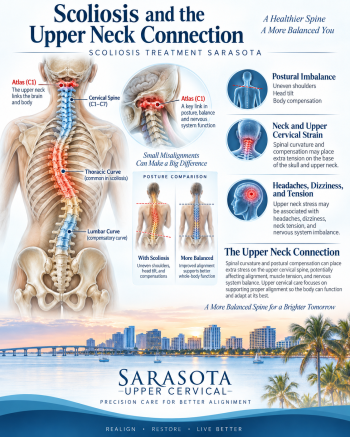
The atlas (C1) vertebra sits directly beneath the skull and surrounds the lower portion of the brainstem.
Because of this close anatomical relationship, misalignment in the upper cervical spine can influence the environment around these nerves.
Related article
Cluster Headache Treatment in Sarasota & Bradenton | Upper Cervical Chiropractor Near Me
Mar 02, 2026
Atlas Misalignment and Brainstem Stress
The atlas is the top bone of the spine and supports the skull. It is uniquely designed for mobility, which unfortunately also makes it vulnerable to injury.
Common causes of atlas misalignment include:
• Car accidents
• Whiplash injuries
• Slip and falls
• Sports impacts
• Concussions
• Poor posture over time
When the joint capsule surrounding the atlas becomes injured, the body often responds with muscle tension and protective spasm. This can alter alignment and create mechanical stress near the base of the skull.
Even small misalignments in this region may influence:
• Blood flow around the brainstem
• Cerebrospinal fluid circulation
• Cranial nerve signaling
• Muscle tone in the head and neck
For individuals with nerve-related pain conditions like glossopharyngeal neuralgia, reducing structural stress in this area may help restore better neurological balance.
The Connection to Trigeminal Neuralgia
Glossopharyngeal neuralgia is closely related to another well-known facial nerve disorder: trigeminal neuralgia.
The trigeminal nerve (cranial nerve V) controls sensation in the face and also originates in the brainstem.
Trigeminal neuralgia symptoms often include:
• Electric shock–like facial pain
• Jaw pain
• Tooth pain without dental cause
• Pain triggered by chewing or touching the face
The trigeminal nerve nucleus lies within the brainstem near the upper cervical spine.
When the atlas is misaligned, abnormal mechanical tension in the neck can influence the brainstem environment where this nerve originates.
This may contribute to hypersensitivity of the nerve pathways.
The Link to Occipital Neuralgia
Another nerve condition frequently connected to upper cervical dysfunction is occipital neuralgia.
Occipital neuralgia involves irritation of the greater and lesser occipital nerves, which travel from the upper cervical spine into the scalp.
Symptoms often include:

• Sharp pain at the base of the skull
• Burning scalp pain
• Pain radiating toward the eye
• Tenderness along the back of the head
Atlas misalignment can lead to chronic tightening of the suboccipital muscles, the small muscles that stabilize the head.
When these muscles become tight or inflamed, they may compress or irritate the occipital nerves.
This explains why many patients with occipital neuralgia also experience:
• Neck stiffness
• Headaches
• Jaw tension
The upper cervical spine acts as a central hub where many of these nerve pathways converge.
Why Structural Alignment Matters
Many treatments for nerve pain focus on symptom suppression, including:
• Pain medications
• Anti-seizure medications
• Nerve blocks
• Surgical procedures
While these approaches may reduce symptoms, they may not address underlying structural issues affecting the nervous system.
Upper cervical chiropractic takes a different approach.
Instead of treating symptoms directly, the goal is to restore proper alignment of the upper cervical spine so the nervous system can function more normally.
When the atlas alignment improves, it may help reduce:
• Mechanical stress on the brainstem
• Abnormal nerve signaling
• Muscle tension in the neck
• Irritation of cranial nerves
The Importance of 3D CBCT Imaging
Every patient’s anatomy is different, which is why precision is critical when working near the brainstem.
Upper cervical chiropractic uses 3D Cone Beam CT (CBCT) imaging to precisely measure:
• The exact direction of atlas misalignment
• Rotational displacement
• Lateral shift
• Skull-to-atlas relationship
• Structural asymmetry
This imaging allows the doctor to develop a customized correction specific to the patient’s anatomy.
Without imaging, adjustments are generalized.
Related article

Natural Treatment For Migraine Headache - Sarasota Upper Cervical Chiropractor
Sep 28, 2021With imaging, care becomes extremely precise.
Gentle Corrections Without Twisting or Cracking
Many people hesitate to seek chiropractic care because they fear aggressive neck manipulation.
Upper cervical care is very different.
Adjustments are:
• Gentle
• Highly precise
• Low force
• Based on imaging measurements
There is no twisting, popping, or pulling of the neck.
The goal is simply to restore proper joint alignment so the nervous system can function more efficiently.
Objective Testing to Guide Care
Upper cervical offices also use objective neurological testing to determine when an adjustment is needed.
These tests may include:
Leg Balance Analysis
Subtle neurological imbalance can appear as asymmetry in leg length patterns.
Infrared Thermography
Thermal scanning detects differences in heat patterns along the spine that may indicate nervous system irritation.
These tests help determine when a patient is out of alignment and when the correction is holding.
Glossopharyngeal Neuralgia Treatment in Sarasota & Bradenton
Living with nerve pain in the throat, face, or head can be overwhelming. Conditions like glossopharyngeal neuralgia, trigeminal neuralgia, and occipital neuralgia often involve complex neurological pathways that originate near the brainstem and upper cervical spine.
If structural misalignment is contributing to irritation of these nerves, correcting the alignment of the atlas may help restore better neurological balance.
If you are searching for Glossopharyngeal Neuralgia treatment in Sarasota, Bradenton, or Lakewood Ranch, upper cervical chiropractic offers a gentle, precise approach focused on the nervous system.
👉 Schedule your FREE consultation by calling 941-259-1891 or click here to book online.
Understanding the connection between the upper cervical spine, the brainstem, and cranial nerves may provide the missing piece in finding relief from chronic nerve pain.
Our office serves Sarasota, Lakewood Ranch, Longboat Key, Venice, Englewood, Bradenton, Punta Gorda, Port Charlotte, Ruskin, Apollo Beach, and Arcadia.
Leave a comment