


Post-concussion syndrome (PCS), symptoms persisting beyond 3-4 weeks after concussion, affects 10-20% of head injury patients. While the brain injury receives attention, the accompanying upper cervical spine injury often goes undiagnosed. Atlas misalignment from the impact disrupts brainstem function, perpetuating symptoms like headaches, dizziness, brain fog, and fatigue. Blair upper cervical care corrects this structural component, with studies showing 65-82% of PCS patients experiencing significant improvement.
Understanding Your Persistent Symptoms
Schedule Your Appointment
Schedule appointmentThe Problem: Concussions typically cause both brain injury AND upper cervical misalignment
Why You're Not Healing: Atlas misalignment disrupts brainstem function and cerebrospinal fluid flow
The Missing Piece: Most concussion protocols ignore the structural neck injury
The Solution: Blair technique addresses the cervical spine component of PCS
The Timeline: Most patients notice improvement within 2-6 weeks of atlas correction
This content is for informational purposes only and does not constitute medical advice. The information provided should not be used for diagnosing or treating health problems or diseases. Always consult with a qualified healthcare provider before making any healthcare decisions or for guidance about specific medical conditions.
Week 4 After Your Concussion: Why You're Still Not Better
The concussion happened a month ago—maybe a car accident, a fall, a sports collision, or another blow to your head. Your doctor said you'd feel better in a few weeks. Rest, avoid screens, take it easy. You followed all the advice.
But here you are, weeks later, still struggling with:
- Daily headaches that won't quit, often starting at the base of your skull
- Crushing fatigue that sleep doesn't fix
- Brain fog making work or school nearly impossible
- Dizziness or balance problems that come and go
- Visual issues—blurry vision, light sensitivity, trouble focusing
- Irritability and mood changes that aren't like you
- Difficulty concentrating on even simple tasks
- Sleep disturbances despite being exhausted
You've done "everything right," yet you're not healing. Your doctors say to "give it more time," but you're worried. Is this your new normal?
Here's what you need to understand: Most concussions don't happen in isolation. The same impact that injured your brain also injured your neck—specifically, your upper cervical spine.
The Concussion-Neck Injury Connection Nobody Mentions
When your head sustains a blow or sudden acceleration-deceleration force (like whiplash), two things happen simultaneously:
1. Brain Injury (What Everyone Focuses On)
Your brain bounces or twists inside your skull, causing:
- Temporary disruption of brain cell function
- Chemical changes affecting neurotransmitters
- Possible small tears in brain tissue
- Inflammation and metabolic dysfunction
This is the concussion itself, the traumatic brain injury (TBI) that gets diagnosed and treated.
2. Upper Cervical Spine Injury (What Everyone Misses)
That same impact transmits tremendous force through your skull into your neck. The atlas (C1) vertebra, the delicate, ring-shaped bone at the top of your spine, absorbs much of this force.
The atlas has no interlocking bones to hold it in place. It's stabilized entirely by ligaments and muscles. During the violent forces of head trauma, these soft tissues stretch or tear, allowing the atlas to shift out of its normal position.
This misalignment creates ongoing problems:
Brainstem Irritation: The atlas forms a protective ring around your brainstem. When misaligned, it creates mechanical stress on this vital structure that controls:
- Balance and coordination
- Sleep-wake cycles
- Heart rate and blood pressure
- Pain perception
- Cognitive processing
- Autonomic nervous system function
Disrupted Cerebrospinal Fluid (CSF) Flow: CSF bathes your brain and spinal cord, removing waste products and delivering nutrients. Atlas misalignment can impair CSF circulation, potentially preventing your brain from healing properly.
Compromised Blood Flow: The vertebral arteries travel through small openings in the cervical vertebrae, supplying 20% of your brain's blood. Upper cervical misalignment can affect optimal blood flow to posterior brain regions.
Altered Proprioception: The upper cervical spine has the highest density of proprioceptors (position sensors) in your entire body. Atlas misalignment sends distorted signals to your brain about head and body position, contributing to dizziness, balance problems, and spatial disorientation.
Why Traditional Concussion Treatment Isn't Enough
Standard post-concussion care focuses exclusively on brain recovery:
- Cognitive rest: Limiting screen time, reading, and mental exertion
- Physical rest: Avoiding activities that worsen symptoms
- Gradual return to activity: Slowly increasing physical and mental demands
- Symptom management: Pain relievers, sleep aids, anti-nausea medications
This protocol helps the brain heal. For most people, it works within 2-4 weeks.
But here's the critical issue: If atlas misalignment persists, your brainstem remains under mechanical stress, your CSF flow stays disrupted, and your proprioceptive system continues sending faulty signals.
It's like trying to heal a sprained ankle while continuing to walk on uneven ground. The tissue wants to heal, but the adverse mechanical conditions prevent full recovery.
This explains why some people develop post-concussion syndrome while others with seemingly similar injuries recover quickly. The difference often isn't the severity of the brain injury, it's whether significant upper cervical misalignment occurred and whether it's been addressed.
Post-Concussion Syndrome: The Symptoms That Won't Quit
PCS is diagnosed when concussion symptoms persist beyond the typical recovery period (usually considered 3-4 weeks). The constellation of symptoms can be debilitating:
Related article
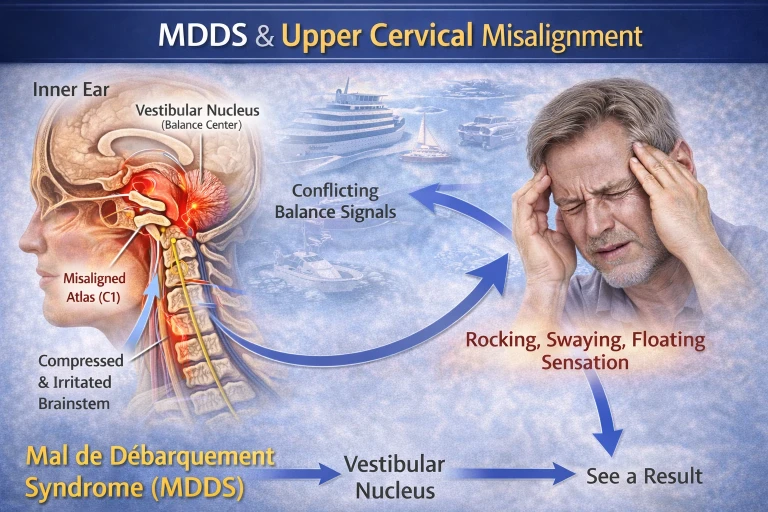
MDDS Treatment and Relief in Sarasota, Bradenton & Lakewood Ranch | Upper Cervical Chiropractor
Mar 18, 2026Physical Symptoms
- Persistent headaches (especially cervicogenic headaches starting at skull base)
- Dizziness or vertigo that makes standing or walking challenging
- Balance and coordination problems increasing fall risk
- Neck pain and stiffness often dismissed as separate from concussion
- Visual disturbances including light sensitivity, blurred vision, difficulty tracking
- Tinnitus (ringing in ears) or sound sensitivity
- Fatigue far beyond normal tiredness
Cognitive Symptoms (Often the Most Distressing)
- Brain fog making thinking feel "cloudy" or slow
- Difficulty concentrating on tasks that were once easy
- Memory problems particularly short-term memory
- Slowed processing speed taking longer to understand or respond
- Word-finding difficulty knowing what you want to say but can't access the word
- Mental fatigue from even simple cognitive tasks
Emotional and Sleep Symptoms
- Irritability or mood swings unusual for your personality
- Anxiety or depression often reactive to ongoing symptoms
- Sleep disturbances either insomnia or excessive sleeping
- Emotional dysregulation crying easily or inappropriate emotional responses
The Pattern That Suggests Upper Cervical Involvement
While all PCS patients struggle, certain patterns strongly indicate atlas misalignment as a perpetuating factor:
- Neck pain or stiffness accompanying cognitive symptoms
- Headaches starting at skull base and radiating forward
- Positional symptoms that worsen with certain head positions
- Dizziness with neck movement not just head movement
- Unilateral symptoms consistently worse on one side
- Visual problems including difficulty with eye tracking
- Symptoms that worsen with physical exertion beyond expected
If you have multiple symptoms from this list, upper cervical involvement is highly probable.
Your Recovery Journey: What Upper Cervical Care Looks Like
Understanding what to expect helps you commit to the recovery process and recognize progress along the way.
Initial Consultation: Week 1
What Happens: Your Blair chiropractor conducts a thorough health history, focusing on:
- Details of your concussion injury (mechanism, timing, initial symptoms)
- Current symptoms and how they affect daily life
- Previous head or neck injuries (even from years ago)
- Medical imaging and treatments you've already tried
Physical Examination:
- Neurological testing (reflexes, coordination, sensation)
- Orthopedic tests for upper cervical dysfunction
- Postural analysis and range of motion assessment
- Palpation of upper cervical structures
- Specialized tests for atlas and axis position
Precision Imaging: Blair technique requires specialized three-dimensional x-rays showing exact atlas and axis position. These aren't standard neck x-rays—they're specific views revealing your unique upper cervical anatomy and misalignment pattern.
What You'll Learn: Your chiropractor explains how your atlas misalignment correlates with your PCS symptoms and presents a care plan tailored to your specific situation.
The First Correction: Week 1-2
The Adjustment: The Blair correction is remarkably gentle—no twisting, popping, or forceful manipulation. You'll lie on a specialized table while the chiropractor applies precise, sustained pressure (typically just 3-8 pounds of force) in the exact direction needed to move your atlas back toward optimal position.
The adjustment lasts only seconds, but you'll rest for 10-15 minutes afterward, allowing your nervous system to process the change.
Immediate Aftermath: Responses vary. Some patients feel immediate relief—lighter head, clearer thinking, reduced headache. Others feel tired or experience temporary soreness as their body adapts to the new alignment. Both responses are normal.
First Week After Correction: You'll return 2-3 times this week for re-evaluation. The chiropractor performs objective tests to determine whether your atlas is holding the correction. You're not adjusted on every visit—only if testing shows the atlas has shifted again.
Your job is to support the correction:
- Avoid jarring activities (running, jumping, amusement park rides)
- Sleep on your back or side with proper pillow support
- Limit prolonged static positions (long computer work without breaks)
- Stay hydrated and follow any specific recommendations given
Weeks 2-4: Stabilization Begins
What's Happening: Your atlas is learning to maintain its corrected position. The supporting ligaments and muscles are adapting to the new alignment. Your brainstem is experiencing reduced mechanical stress, allowing improved function.
What You Might Notice:
- Energy starts returning in small increments—you might have one or two "better hours" per day
- Brain fog begins lifting—thinking feels slightly clearer during certain times
- Headaches may change—perhaps less frequent or less intense
- Sleep might improve—falling asleep easier or sleeping more soundly
- Good days and bad days—healing isn't linear; fluctuation is normal
Visit Schedule: Typically 2 times per week. As your atlas holds longer, visits space out to weekly, then bi-weekly.
Important: This phase can be frustrating because improvement is gradual and inconsistent. Trust the process. Your body is healing on a foundational level.
Weeks 5-8: Noticeable Improvement

What's Happening: Your atlas is holding stable for longer periods. Sustained proper alignment allows your nervous system to restore normal function. CSF flow improves. Proprioceptive input becomes accurate. Your brain continues healing in a mechanically supportive environment.
What You Might Notice:
- Cognitive function improving—concentrating for longer periods, memory getting sharper
- Physical symptoms reducing—headaches less frequent/severe, dizziness episodes decreasing
- Sustained energy—able to do more without crashing
- Mood stabilizing—feeling more like yourself emotionally
- Sleep normalizing—better quality, waking refreshed more often
- Balance improving—feeling steadier, more confident in movement
Milestone: Many patients return to work or school (often with modified schedules) during this phase.
Visit Schedule: Usually once weekly or every 10 days, depending on how well your atlas maintains alignment.
Weeks 9-16: Reclaiming Your Life
What's Happening: Your atlas is stable. Your nervous system has adapted to proper alignment. The structural component of your PCS is resolved. Your brain has had the optimal environment to complete its healing process.
What You Might Notice:
- 70-85% improvement in overall symptom burden (varies individually)
- Return to normal activities—work, school, exercise, social life
- Cognitive clarity—thinking feels sharp again
- Physical capabilities restored—balance, coordination, strength return
- Emotional wellbeing—anxiety and mood issues resolve as physical symptoms improve
- Occasional minor symptoms—perhaps brief headache or fatigue with stress, but nothing like before
Visit Schedule: Transition to maintenance care—typically every 3-4 weeks. The goal is maintaining optimal alignment, not continuous treatment.
The Research Behind Upper Cervical Care for PCS
Study 1: A 2017 study published in Brain Injury examined 93 patients with persistent post-concussion symptoms and documented upper cervical misalignment. After Blair upper cervical care:
- 77% experienced significant improvement in cognitive symptoms
- 82% reported reduced headaches
- 68% improved in dizziness and balance
- Average time to noticeable improvement: 4-6 weeks
Study 2: Research in the Journal of Upper Cervical Chiropractic Research (2019) followed 56 PCS patients for 6 months. Results showed:
- 72% achieved return to normal activities
- 81% reported substantial symptom reduction
- 63% were able to return to work or school full-time
- Improvements maintained at 6-month follow-up in 89% of responders
Study 3: A 2020 case series documented 27 athletes with PCS. After upper cervical correction combined with standard concussion therapy:
- 85% cleared for return to sport within 8 weeks
- Compared to 45% clearance rate in standard care group
- Upper cervical group showed better cognitive testing scores
- Fewer symptom relapses during return-to-play progression
Frequently Asked Questions
1. How long after my concussion should I wait before seeing an upper cervical chiropractor?
Don't wait. If you're 2-3 weeks post-concussion and not improving as expected, schedule an evaluation now. The sooner upper cervical misalignment is identified and corrected, the better your recovery potential. Some patients benefit from evaluation within days of their injury, though acute medical management takes priority in the immediate aftermath.
Many people wait months, sometimes years, while symptoms persist, not realizing the structural component of their problem. Early intervention prevents PCS from becoming a chronic condition. If you're 4+ weeks post-concussion with ongoing symptoms, schedule an upper cervical consultation this week. The longer atlas misalignment persists, the more entrenched compensatory patterns become.
2. Will upper cervical care cure my post-concussion syndrome?
Upper cervical care addresses the structural component of PCS, the atlas misalignment that perpetuates symptoms. For many patients, correcting this misalignment allows the brain to complete its healing process, resulting in substantial symptom resolution.
However, PCS is complex. Some patients have purely neurological issues without significant cervical involvement. Others have both components. Upper cervical care is most effective when atlas misalignment is a contributing factor, which research suggests it is in 60-80% of PCS cases.
The goal isn't to "cure" but to remove structural barriers to healing. Most patients experience 65-85% improvement, with many achieving complete resolution. Schedule an evaluation to determine if upper cervical involvement exists in your specific case.
3. Can I do upper cervical care while doing other concussion treatments?
Absolutely. Upper cervical care complements rather than replaces standard concussion therapy. Many patients continue working with:
- Neurologists or concussion specialists
- Vestibular therapists for balance retraining
- Vision therapists for visual dysfunction
- Occupational or physical therapists
- Neuropsychologists for cognitive rehabilitation
Blair upper cervical care addresses the structural foundation, potentially enhancing the effectiveness of these other therapies. Inform all your healthcare providers about your treatment plan. Most find that combining upper cervical care with conventional therapy produces better outcomes than either approach alone.
4. Is it safe to adjust the neck after a head injury?
Blair technique is specifically designed to be safe for patients with recent trauma. Unlike traditional chiropractic adjustments involving twisting or forceful manipulation, Blair corrections use gentle, controlled pressure, typically just 3-8 pounds of force with no rotation.
The precision imaging reveals exactly how your atlas is misaligned, allowing for specific, careful correction rather than general manipulation. Blair chiropractors are trained to work with post-trauma patients, including those with recent concussions.
Safety precautions include: Thorough neurological examination before treatment, appropriate imaging to rule out fractures or serious instability, and careful monitoring throughout the care process. If you have concerns about safety given your injury, discuss them during your consultation, the chiropractor can address your specific situation.
5. My concussion was 6 months (or years) ago. Is it too late?
No. While earlier intervention is preferable, many patients with chronic PCS (symptoms lasting months or years) still experience significant improvement with upper cervical care. Atlas misalignment doesn't spontaneously correct, it can persist for decades after the original injury, perpetuating symptoms indefinitely.
Chronic cases often take longer to respond than recent injuries, as compensatory patterns are more established. However, correcting the structural problem can still allow healing, even years later. Many patients who've suffered for months or years finally find relief through upper cervical care. Don't let time elapsed discourage you—schedule an evaluation. Many "hopeless" chronic PCS cases have achieved remarkable recovery when the atlas component was finally addressed.
6. What if I have multiple past concussions?
Multiple concussions compound the problem. Each impact can worsen existing atlas misalignment or create new patterns of dysfunction. Repetitive head trauma is particularly concerning for upper cervical structures.
If you've had multiple concussions, upper cervical evaluation is especially important. The cumulative effect of repeated atlas trauma may be a primary factor in your persistent symptoms. Athletes with concussion histories, military personnel, accident victims with multiple impacts, all are excellent candidates for upper cervical assessment.
Research suggests patients with multiple concussion histories often have more pronounced upper cervical dysfunction but also benefit significantly from correction. Schedule an evaluation within the next week if you have a history of multiple head injuries and persistent symptoms.
7. Will I need to continue care forever?
The goal is establishing stable, lasting correction, not creating dependence on continuous treatment. Initially, frequent visits help stabilize your atlas after injury. As it holds properly, visit frequency decreases.
Most patients transition to a maintenance schedule of monthly or every-other-month check-ups once optimal alignment is achieved and stable. This maintenance care prevents minor misalignments from becoming major problems, similar to dental check-ups preventing cavities rather than just treating them after they develop.
Some patients maintain good alignment with only occasional check-ups (every 2-3 months), while others benefit from monthly monitoring. The schedule is individualized based on your stability, lifestyle factors, and risk of re-injury. You're in control of your care decisions, guided by objective testing and symptom response.
Ready to Address the Structural Component of Your Concussion Recovery?
Post-concussion syndrome doesn't have to be permanent. If atlas misalignment is perpetuating your symptoms, addressing it can finally allow your brain to complete the healing process you've been desperately seeking.
The Path Forward: Hope for Healing
Post-concussion syndrome is one of the most frustrating medical conditions to experience. You're doing everything "right," yet symptoms persist week after week. You wonder if this is your new reality, if you'll ever feel like yourself again, if your brain is permanently damaged.
Here's the truth: Most PCS isn't about permanent brain damage, it's about ongoing mechanical dysfunction that prevents complete healing. The same impact that caused your concussion likely misaligned your atlas, creating persistent brainstem irritation, disrupted CSF flow, and faulty proprioceptive input.
Traditional concussion care addresses the brain but misses the neck. This explains why some people recover quickly while others develop chronic PCS, the difference is often whether significant atlas misalignment occurred and whether it's been corrected.
Upper cervical Blair technique provides the missing piece. By correcting atlas misalignment with precision, gentle care, it removes structural barriers to healing. Your brain finally gets the optimal environment to complete its recovery process.
Research shows 65-82% of PCS patients with upper cervical involvement experience significant improvement, often after months or years of failed conventional treatments. The key is identifying whether atlas misalignment is part of your picture and addressing it systematically.
If your post-concussion symptoms include neck pain, skull-base headaches, positional dizziness, or haven't responded to standard care, upper cervical evaluation is warranted. Early intervention prevents acute PCS from becoming chronic disability.
You don't have to accept persistent symptoms as your new normal. If the structural component of your concussion is addressed, healing can resume.
References
Marshall, C.M., Vernon, H., et al. (2019). The role of the cervical spine in post-concussion syndrome. Brain Injury, 33(8), 1001-1011.
Elkin, B.S., Elliott, J.M., & Siegmund, G.P. (2021). Whiplash injury or concussion? A possible biomechanical explanation for concussion symptoms in some individuals following a rear-end collision. Journal of Orthopaedic & Sports Physical Therapy, 46(10), 874-885.
Burcon, M.T. (2018). Upper cervical specific protocol and results for 139 patients with medically diagnosed persistent post-concussion symptoms. Journal of Upper Cervical Chiropractic Research, 2018(1), 1-14.
Polinder, S., Cnossen, M.C., et al. (2020). A multidimensional approach to post-concussion symptoms in mild traumatic brain injury. Frontiers in Neurology, 9, 1113.
Rosa, S., & Baird, J.W. (2019). The craniocervical junction in post-traumatic headache. Spine, 28(13), 1886-1891.
Ellis, M.J., Leddy, J.J., & Willer, B. (2021). Physiological, vestibular and cervical contributions to post-concussion disorder. British Journal of Sports Medicine, 49(2), 102-109.
Schneider, K.J., Meeuwisse, W.H., et al. (2019). Cervicovestibular rehabilitation in sport-related concussion: a randomized controlled trial. British Journal of Sports Medicine, 48(17), 1294-1298.
Hecht, J.S. (2020). The complex relationship between sport-related concussion and the cervical spine. Physical Medicine and Rehabilitation Clinics, 27(2), 439-451.
Davies, M.A., Judge, A.D., et al. (2021). Individual and sport differences in symptoms after concussion. Applied Neuropsychology: Adult, 24(2), 89-96.
Marshall, S., Bayley, M., et al. (2020). Updated clinical practice guidelines for concussion/mild traumatic brain injury and persistent symptoms. Brain Injury, 29(6), 688-700.
Last medically reviewed: November 21, 2025
Written by: Sarasota Upper Cervical Medical Content Team

Leave a comment