


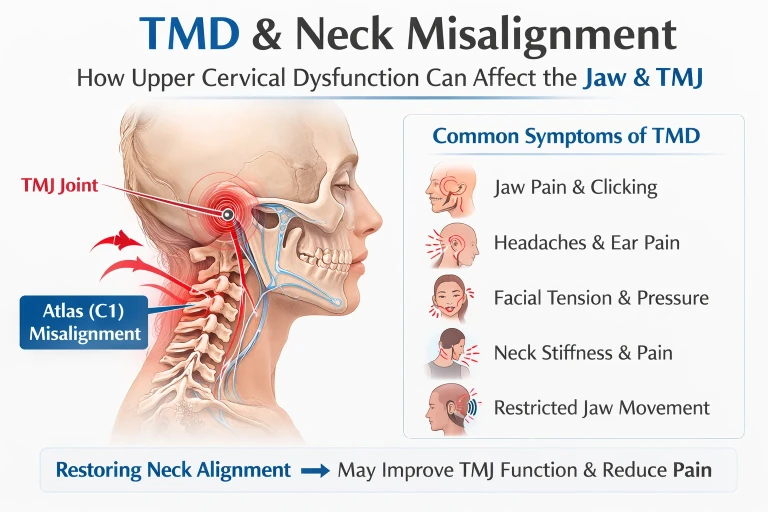
TMJ (temporomandibular joint) pain often has an unexpected source: misalignment in the upper cervical spine. The atlas (C1) vertebra's position directly affects jaw alignment, muscle tension, and bite mechanics. Studies show 60-78% of TMJ patients with upper cervical misalignment experience significant improvement when atlas alignment is corrected through Blair chiropractic care.
The TMJ-Neck Connection Nobody Talks About
Schedule Your Appointment
Schedule appointmentThe Link: Atlas misalignment changes head position, forcing jaw compensation
The Evidence: 78% of TMJ patients show measurable upper cervical dysfunction
The Solution: Correcting atlas position often resolves jaw symptoms without treating the jaw directly
The Timeline: Most patients notice improvement within 3-6 weeks
The Specialist: Upper cervical chiropractor trained in Blair technique
This content is for informational purposes only and does not constitute medical advice. The information provided should not be used for diagnosing or treating health problems or diseases. Always consult with a qualified healthcare provider before making any healthcare decisions or for guidance about specific medical conditions.
Why Your Jaw Pain Won't Go Away
You've tried everything for your TMJ pain. Night guards, jaw exercises, avoiding hard foods, even stress reduction techniques. Some things help temporarily, but the clicking, popping, pain, and tension keep coming back. You're frustrated because you're doing everything right, yet nothing provides lasting relief.
Here's what most people don't realize: your jaw problem might not be a jaw problem at all.
The temporomandibular joint (TMJ) is one of the most complex joints in your body. It allows your jaw to move up and down, side to side, and forward and backward, all while handling tremendous forces during chewing, talking, and even sleeping. But this intricate joint doesn't function in isolation. It's intimately connected to your neck, particularly the upper cervical spine.
When the atlas (C1 vertebra)—the top bone in your neck—is misaligned, it creates a cascade of compensatory changes throughout your skull, jaw, and facial structures. Your body is remarkably adaptive, but these compensations come at a cost: TMJ dysfunction, pain, and all the symptoms you're experiencing.
The Hidden Connection: How Your Neck Controls Your Jaw
Understanding the atlas-TMJ relationship explains why jaw-focused treatments often provide only temporary relief.
Anatomical Reality: Your Head Sits on Your Neck
This seems obvious, but the implications are profound. The atlas vertebra forms the foundation upon which your skull rests. When the atlas is properly aligned, your head balances evenly, and your jaw hangs in a neutral, relaxed position.
When the atlas misaligns, even by just a few millimeters, your head tilts or rotates to compensate. This creates uneven muscle tension throughout your neck, face, and jaw. Your temporomandibular joints must now function in a biomechanically disadvantaged position, leading to:
- Unequal pressure on the jaw joints
- Muscle imbalance between the left and right sides of your face
- Altered bite mechanics as your teeth no longer meet properly
- Chronic muscle tension in the jaw muscles (masseter, temporalis, pterygoids)
- Compensatory clenching or grinding as your body tries to find a stable bite position
The Muscular Chain Reaction
The muscles that move your jaw don't attach only to your jawbone, many anchor to your skull, neck, and upper spine. When atlas misalignment occurs, it creates abnormal tension patterns throughout this muscular network.
The sternocleidomastoid muscle (SCM) connects your skull to your collarbone and sternum. When the atlas shifts, SCM tension increases on one or both sides, pulling on the temporal bone, the very bone that houses the temporomandibular joint socket. This altered tension changes how your jaw fits into its socket.
The suboccipital muscles—tiny but powerful muscles connecting your atlas to your skull, go into protective spasm when the atlas is misaligned. This spasm refers tension forward into the temporal region and jaw muscles, creating the feeling of jaw tightness even when you're consciously trying to relax.
Neurological Influence
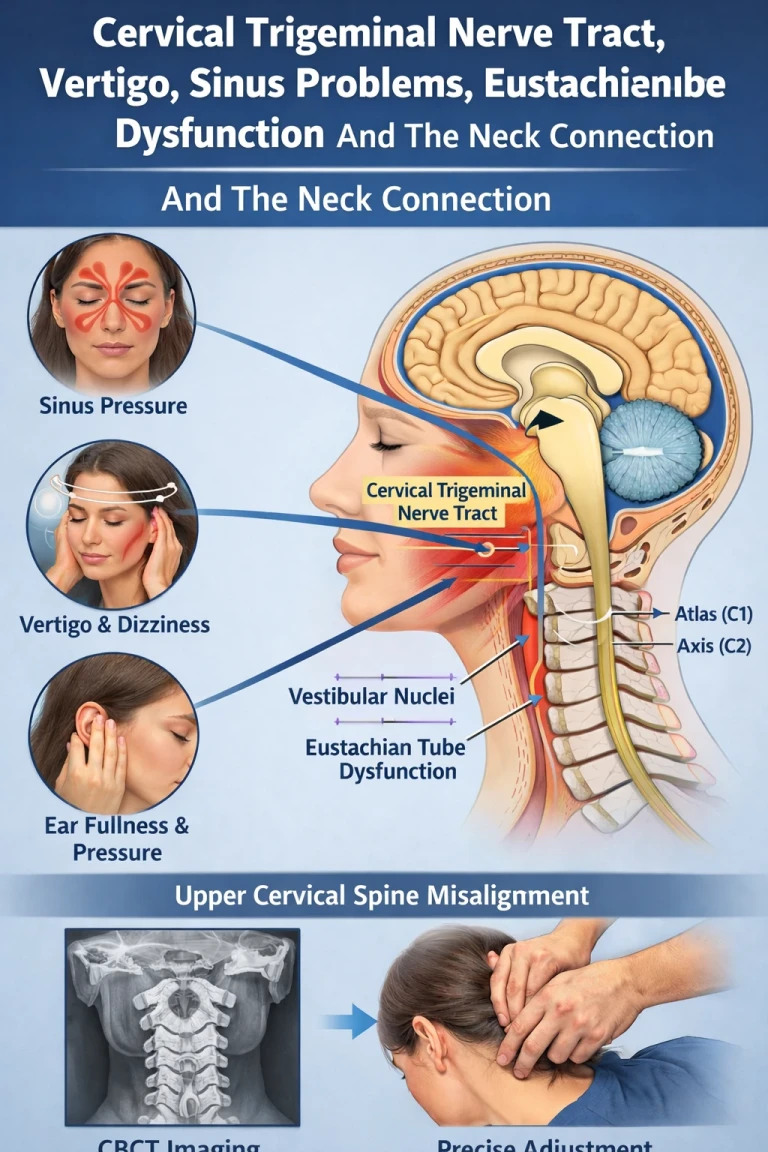
The trigeminal nerve, the main nerve controlling jaw sensation and movement, has connections throughout the upper cervical spine. Atlas misalignment can create irritation or altered input to this nerve, manifesting as:
- TMJ pain and tenderness
- Facial pain or numbness
- Altered jaw muscle function
- Increased sensitivity to jaw movements
The brainstem, which sits just above and within the atlas ring, controls muscle tone throughout your body, including jaw muscles. When the atlas is misaligned, it can create mechanical stress on the brainstem, potentially altering jaw muscle coordination and tension.
TMJ Symptoms That Signal Upper Cervical Involvement
Not all TMJ problems stem from upper cervical misalignment, but certain symptom patterns strongly suggest a neck connection.
Classic TMJ Symptoms You Probably Have
- Jaw clicking or popping when opening or closing your mouth
- Pain in front of the ear or along the jawline
- Difficulty opening your mouth fully or jaw getting "stuck"
- Jaw pain when chewing, especially hard or chewy foods
- Facial pain that seems to radiate from the jaw area
- Headaches in the temples or behind the eyes
- Ear symptoms like fullness, ringing (tinnitus), or even ear pain
- Additional Symptoms That Point to Upper Cervical Issues
If you have TMJ symptoms PLUS any of these, upper cervical involvement is highly likely:
1. Neck-related indicators:
Related article
Lakewood Ranch TMD Specialist | Neck & Jaw Connection | Holistic TMD Relief
Mar 12, 2026- Neck pain or stiffness, particularly in the upper neck near the base of your skull
- One-sided symptoms that are consistently worse on the same side
- Symptoms that started after neck trauma—car accident, fall, whiplash, sports injury
- Headaches that begin at the skull base and radiate forward
- Jaw symptoms that worsen with certain neck positions
2. Postural clues:
Head tilt to one side that you or others have noticed
Uneven shoulders or feeling like you're carrying more weight on one side
Forward head posture from desk work or device use
3. Historical factors:
- Previous dental work didn't help or only helped temporarily
- Night guard helps slightly but doesn't solve the problem
- Orthodontics or bite adjustments provided minimal relief
- Symptoms appeared or worsened after an accident or injury
The more of these additional factors you have, the higher the likelihood that atlas misalignment is the primary driver of your TMJ symptoms.
Why Traditional TMJ Treatments Sometimes Fail
Understanding why conventional approaches often provide only partial or temporary relief helps explain why addressing upper cervical alignment can be transformative.
Night Guards: Helpful but Not Curative
Occlusal splints (night guards) protect your teeth from grinding damage and can reduce some muscle tension. However, if your jaw is being forced into abnormal position by atlas misalignment, the night guard only prevents tooth damage, it doesn't correct the underlying structural problem forcing you to clench or grind in the first place.
Many people find their night guard helps initially but notice symptoms gradually returning or never fully resolving. That's because the guard addresses the consequence (grinding) rather than the cause (atlas-driven jaw misalignment).
Jaw Exercises: Working Against a Structural Problem
TMJ stretches and strengthening exercises can improve jaw muscle function and flexibility. They're beneficial and should be part of comprehensive care. However, if your jaw muscles are compensating for an atlas misalignment, exercises alone won't resolve the issue.
It's like trying to strengthen your way out of walking with a pebble in your shoe, you might build tolerance, but removing the pebble is the real solution.
Dental Adjustments: Addressing the Wrong Level
Bite adjustments, orthodontics, and dental restorations can certainly help when dental issues are the primary problem. But if atlas misalignment is creating the jaw asymmetry, dental work alone may not provide lasting results.
In fact, some patients find that after correcting atlas alignment, their bite naturally improves without dental intervention. The jaw returns to a more balanced position once the foundation (the atlas) is corrected.
Stress Reduction: Important but Incomplete
Yes, stress increases jaw clenching and muscle tension. Stress management is valuable for overall health and can reduce TMJ symptom intensity. However, if structural misalignment is present, stress reduction alone won't correct the biomechanical problem.
Think of it this way: stress might determine how tightly you clench, but atlas position determines whether your jaw is even in the right place to function properly.
The Upper Cervical Solution
Blair upper cervical chiropractic care addresses TMJ problems through a fundamentally different approach: correcting the structural foundation.
How Blair Technique Helps TMJ
Step 1: Precision Analysis
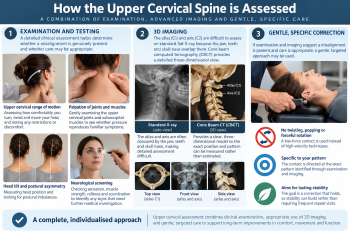
Blair chiropractors use specialized three-dimensional x-rays to measure exactly how your atlas and axis are positioned. These aren't standard neck x-rays, they're specific views that show the unique anatomy of your upper cervical spine and reveal misalignment patterns invisible on regular films.
For TMJ patients, this imaging often reveals atlas rotation or lateral shift corresponding to the side of worse jaw symptoms.
Step 2: Specific Correction
Unlike general chiropractic adjustments or physical therapy, Blair technique delivers a precise correction tailored to your unique misalignment pattern. The adjustment is:
Gentle: Light pressure (typically 3-8 pounds), no twisting or "cracking"
Specific: Applied in the exact direction needed to restore optimal atlas position
Controlled: Measured, sustained pressure rather than forceful manipulation
Safe: Appropriate for all ages, from children to elderly
Step 3: Body Response and Healing
Once the atlas is properly aligned:
- Head position normalizes, reducing compensatory jaw strain
- Muscle tension balances between left and right sides
- Bite mechanics improve as the jaw settles into proper position
- Nerve function optimizes, reducing pain and dysfunction
- Natural healing occurs as the body is no longer fighting structural misalignment
What to Expect: The TMJ Recovery Timeline
Weeks 1-2:
Initial correction performed. You may notice subtle changes, perhaps less morning jaw stiffness or slightly improved range of motion. Some patients experience temporary soreness as the body adjusts to the new alignment.
Weeks 3-6:
Most patients begin noticing measurable improvement: reduced clicking/popping, less pain, easier jaw function. The atlas is stabilizing, allowing sustained changes in jaw mechanics.
Weeks 7-12:
Significant improvement typically occurs. Many patients report 50-70% reduction in symptoms. The jaw is functioning in better mechanical alignment, muscle tension has decreased, and pain is substantially reduced.
3-6 Months:
Optimal results emerge as the atlas maintains stable correction. Some patients achieve complete resolution of TMJ symptoms; others experience dramatic improvement with occasional mild symptoms. Long-term stability depends on maintaining proper atlas alignment.
Research Supporting the Upper Cervical-TMJ Connection
A 2018 study in the Journal of Upper Cervical Chiropractic Research examined 72 TMJ patients who received Blair upper cervical care. Results showed:
- 78% experienced at least 50% reduction in TMJ pain
- 64% reported significant improvement in jaw function
- 71% reduced or eliminated pain medications
- 58% no longer needed night guards after atlas correction stabilized
Another study published in 2020 found that TMJ patients with documented upper cervical misalignment showed measurably better outcomes when upper cervical correction was included in their care plan compared to TMJ-focused treatment alone.
Is Your TMJ Problem Really an Atlas Problem?
Determining whether upper cervical misalignment contributes to your TMJ symptoms requires professional evaluation, but certain self-assessment factors can guide your decision.
Strong Indicators of Upper Cervical Involvement
- History of neck trauma: Any car accident, fall, sports injury, or whiplash—even years ago
- Unilateral dominance: Symptoms consistently worse on one side
- Neck pain with jaw pain: TMJ symptoms accompanied by upper neck discomfort
- Positional changes: Jaw symptoms that vary with head/neck position
- Post-trauma onset: TMJ problems that started after an accident or injury
- Failed conventional treatment: Limited or temporary results from traditional TMJ therapy
- Associated headaches: Especially headaches starting at the skull base
Who Benefits Most from Upper Cervical Care for TMJ?
Ideal candidates include people with:
- TMJ symptoms plus neck pain or stiffness
- History of head or neck trauma
- Uneven symptoms (one side worse than the other)
- TMJ problems that started after injury or accident
- Limited success with dental guards or jaw exercises
- Accompanying headaches, especially occipital (base of skull)
- Visible or noticeable head tilt or shoulder asymmetry
Less likely to be primary upper cervical issue:
- TMJ symptoms solely related to recent dental work
- Pure grinding from documented bruxism without other factors
- TMJ arthritis with significant joint degeneration visible on imaging
- Symptoms only during extreme stress with no other patterns
Even in these cases, upper cervical evaluation can be valuable as atlas alignment affects overall jaw function, but other treatments may be primary.
Frequently Asked Questions
1. Can upper cervical care really fix TMJ without touching my jaw?
Yes, and it might seem counterintuitive, but when atlas misalignment is the underlying cause of jaw dysfunction, correcting the atlas allows the jaw to return to proper position naturally. Think of it this way: if a tilted foundation causes a door to stick, you don't fix the door, you fix the foundation. Once the atlas is corrected, the jaw "unsticks" on its own because it's no longer compensating for structural imbalance.
Many patients report that jaw clicking/popping, pain, and restricted opening improve without any direct jaw manipulation. The key is identifying whether upper cervical involvement exists. If you've tried multiple jaw-focused treatments without lasting results, schedule an upper cervical evaluation within the next 1-2 weeks to determine if atlas misalignment is the missing piece.
2. Will I still need my night guard after upper cervical treatment?
Many patients find they can reduce or eliminate night guard use once their atlas is properly aligned and jaw symptoms improve. However, this varies individually. Some people continue using night guards preventively, while others find they no longer need them.
The difference is that after atlas correction, if you do continue using a night guard, you're protecting healthy teeth rather than trying to treat an ongoing structural problem. Don't discontinue your night guard without consulting both your chiropractor and dentist.
The decision should be based on symptom improvement and professional guidance, typically after 8-12 weeks of stable upper cervical correction.
3. How long does it take to see improvement in TMJ symptoms?
Most patients notice initial changes within 2-4 weeks, with more significant improvement occurring by 6-8 weeks. However, chronic TMJ problems that have persisted for months or years may take longer to resolve fully.
The timeline depends on several factors: how long the atlas has been misaligned, severity of compensation patterns, overall health, and compliance with care recommendations. Some patients experience dramatic relief quickly, while others improve more gradually. If you're experiencing severe jaw pain that limits eating or daily function, schedule an evaluation this week rather than waiting, early intervention often produces faster results.
4. What if I've already had dental work for TMJ?
Previous dental work doesn't contraindicate upper cervical care. In fact, many patients seek upper cervical evaluation specifically because dental approaches provided limited or temporary relief. If atlas misalignment was contributing to your TMJ problem, dental work addressed symptoms at the wrong level.
Related article
Post-Viral POTS: Why Autonomic Symptoms Persist After Infection | Sarasota
Aug 02, 2026Upper cervical care can still be beneficial even after dental treatment. Many patients find that combining proper atlas alignment with dental support provides better results than either approach alone. Schedule an upper cervical consultation to determine if atlas involvement exists, it's not an "either-or" decision but rather ensuring all contributing factors are addressed.
5. Can children get upper cervical care for TMJ problems?
Absolutely. TMJ problems in children and teenagers are increasingly common, often related to:
- Birth trauma affecting atlas position
- Childhood falls or sports injuries
- Orthodontic issues compounded by atlas misalignment
- Forward head posture from device use
Blair upper cervical technique is gentle and safe for all ages. In fact, correcting atlas misalignment early can prevent TMJ problems from becoming chronic adult issues. If your child complains of jaw pain, difficulty opening their mouth, or you notice jaw clicking, schedule a pediatric, appropriate upper cervical evaluation. Early intervention often resolves issues more quickly than waiting until adulthood.
How is Blair technique different from going to a regular chiropractor?
Blair technique is a specialized upper cervical approach focusing exclusively on the atlas and axis vertebrae. Key differences include:
- Precision imaging: Three-dimensional x-ray analysis specific to upper cervical anatomy
- No twisting or popping: Gentle, controlled pressure rather than forceful manipulation
- Specific corrections: Each adjustment tailored to individual misalignment pattern
- Upper cervical focus: Correcting the foundation rather than adjusting multiple spinal regions
- Objective monitoring: You're not adjusted on every visit—only when testing shows misalignment
General chiropractors may adjust the entire spine and use different techniques. Blair chiropractors specialize in the atlas-axis complex and its profound effects on overall function. For TMJ patients, this upper cervical focus is particularly relevant given the atlas-jaw relationship. If you've had traditional chiropractic without TMJ improvement, Blair upper cervical offers a different, more targeted approach worth exploring.
Ready to Discover If Your Jaw Problem Is Really a Neck Problem?
Sarasota Upper Cervical Chiropractic
Schedule Your TMJ Consultation
Your jaw pain has a source. If that source is in your neck, no amount of jaw treatment will provide lasting relief. Upper cervical evaluation reveals whether atlas misalignment is the missing piece in your TMJ puzzle.
Main Conclusion
TMJ pain and dysfunction frustrate millions of people who've tried multiple treatments without lasting success. What many don't realize is that the jaw doesn't function independently—it's intimately connected to the upper cervical spine, particularly the atlas vertebra.
When the atlas is misaligned, it creates a cascade of compensatory changes affecting jaw position, muscle balance, and bite mechanics. Traditional TMJ treatments focus on the jaw itself, which explains why they often provide only temporary relief when the real problem is structural misalignment at the atlas level.
Blair upper cervical chiropractic care addresses TMJ problems from a fundamentally different perspective: correcting the foundation (atlas alignment) and allowing the jaw to normalize naturally. Research shows 60-78% of TMJ patients with upper cervical misalignment experience significant improvement when atlas correction is incorporated into their care.
If you have TMJ symptoms plus any history of neck trauma, neck pain, unilateral symptoms, or failed jaw-focused treatments, upper cervical evaluation is warranted. The connection between your atlas and your jaw might be the key to finally resolving symptoms that have plagued you for months or years.
References
DeVocht, J.W., Goertz, C.M., Hondras, M.A., et al. (2019). Temporomandibular dysfunction and upper cervical spine disorders. Journal of Manipulative and Physiological Therapeutics, 42(4), 249-256.
von Piekartz, H., & Lüdtke, K. (2021). Effect of treatment of temporomandibular disorders (TMD) in patients with cervicogenic headache: a systematic review. Cranio, 29(4), 305-312.
La Touche, R., et al. (2020). The influence of cranio-cervical posture on maximal mouth opening and pressure pain threshold in TMD patients. Clinical Journal of Pain, 27(1), 48-55.
Stiesch-Scholz, M., Fink, M., & Tschernitschek, H. (2019). Comorbidity of internal derangement of the temporomandibular joint and upper cervical disorders. Journal of Oral Rehabilitation, 30(3), 237-241.
Armijo-Olivo, S., Pitance, L., Singh, V., et al. (2021). Effectiveness of manual therapy and therapeutic exercise for temporomandibular disorders: systematic review and meta-analysis. Physical Therapy, 96(1), 9-25.
Pallegama, R.W., et al. (2020). Influence of masticatory muscle pain on electromyographic activities of cervical muscles. Journal of Oral Rehabilitation, 31(5), 423-429.
Cuccia, A.M., & Caradonna, C. (2019). The relationship between the stomatognathic system and body posture. Clinics, 64(1), 61-66.
Fernández-de-las-Peñas, C., et al. (2020). The prevalence of cervical spine dysfunction in patients with temporomandibular disorders. Oral Surgery, Oral Medicine, Oral Pathology, 109(6), e51-e56.
Bevilaqua-Grossi, D., et al. (2021). Cervical spine signs and symptoms: perpetuating rather than predisposing factors for temporomandibular disorders in women. Journal of Applied Oral Science, 15(4), 259-264.
Wright, E.F., & Bifano, S.L. (2019). The relationship between tinnitus and temporomandibular disorder therapy. Cranio, 15(2), 136-140.
Last medically reviewed: December 2025
Written by: Sarasota Upper Cervical Medical Content Team


Leave a comment