

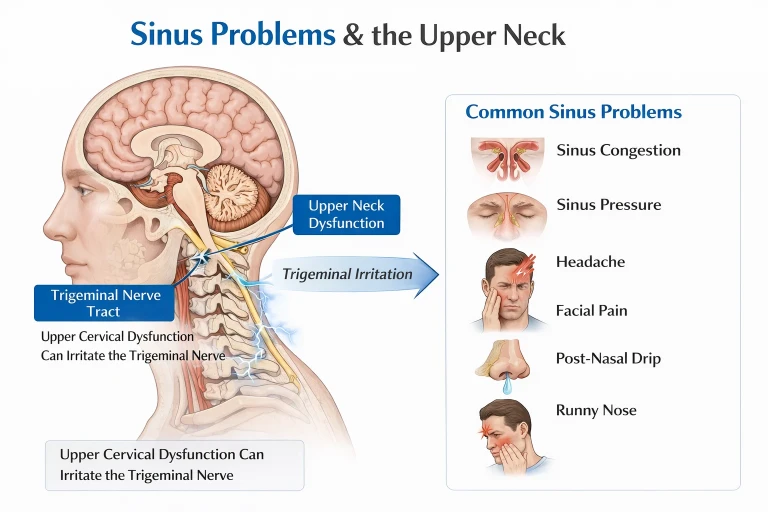
If you’re constantly dealing with sinus pressure, congestion, facial pain, or that heavy feeling behind your eyes — and you live in Sarasota or Bradenton — you may have been told it’s just allergies, weather, or chronic sinusitis.
But what if your sinus pressure isn’t primarily a sinus problem?
Schedule Your Appointment
Schedule appointmentWhat if it’s a nervous system problem?
👉 Call 941-259-1891 to schedule your FREE consultation
Or click here to schedule online.
Many chronic sinus sufferers try:
• Antihistamines
• Steroid sprays
• Antibiotics
• Decongestants
• Neti pots
• Allergy shots
Yet the pressure keeps coming back.
The missing link for many patients is the upper cervical spine.
Why Sinus Pressure Isn’t Always About Infection
Your sinuses are air-filled cavities in the skull that rely on proper drainage and pressure regulation.
That drainage depends on:
• Healthy mucosal lining
• Proper vascular tone
• Cranial nerve signaling
• Balanced autonomic nervous system control
The nervous system regulates:
• Blood vessel dilation
• Fluid production
• Inflammatory response
• Drainage pathways
When nervous system signaling is disrupted, sinus tissue can become congested — even without infection.
👉 Call 941-259-1891 to schedule your FREE consultation
Or click here to schedule online.
The Brainstem and Sinus Regulation
The upper cervical spine (C1 and C2) sits directly beneath the brainstem.
The brainstem plays a key role in:
• Autonomic nervous system function
• Cranial nerve coordination
• Vascular regulation
• Inflammatory signaling
Cranial nerves that influence facial sensation and sinus structures originate near this region.
If upper cervical misalignment creates mechanical stress on the brainstem, it may:
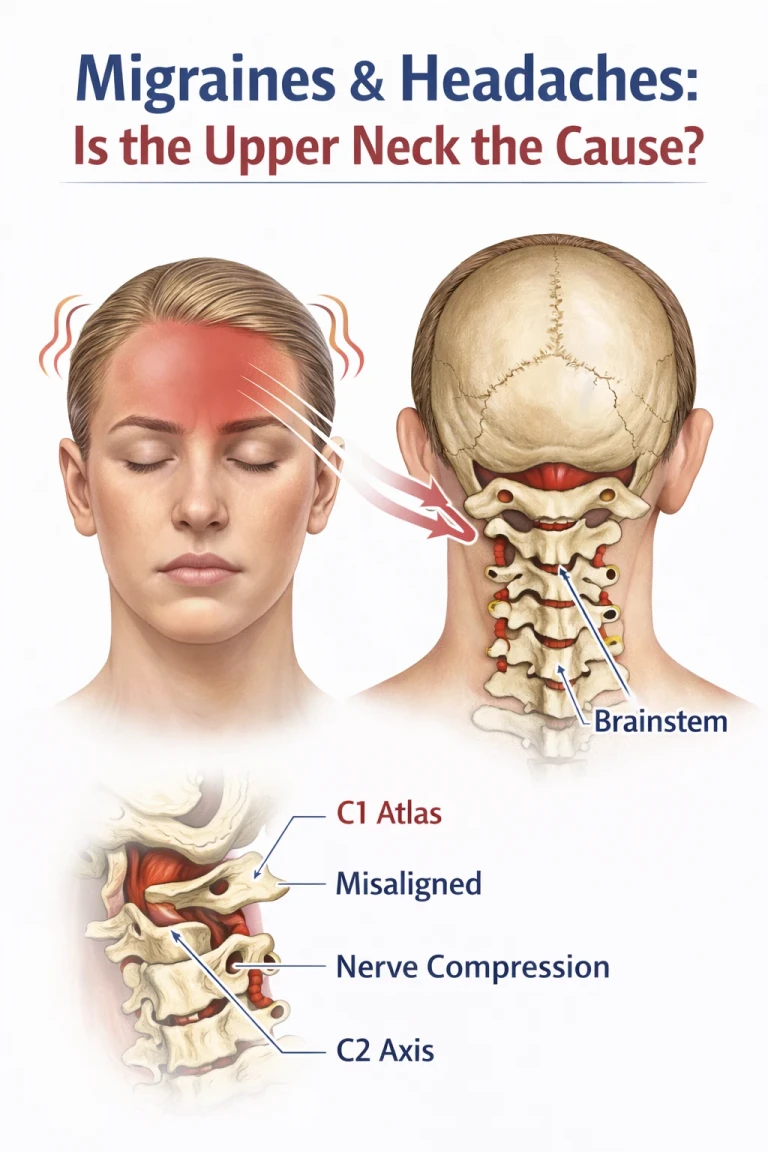
• Alter autonomic balance
• Increase vascular congestion
• Contribute to facial pressure
• Distort drainage regulation
• Increase inflammatory tone
This is why many patients with chronic sinus pressure also report:
• Neck stiffness
• Headaches
• Ear pressure
• TMJ tension
• Brain fog
The problem may not be just in the sinuses.
It may be neurological.
Trauma and Joint Capsule Injury
Most upper cervical misalignments begin with trauma.
Trauma can include:
• Car accidents
• Slip and falls
• Sports injuries
• Whiplash
• Sudden head jerking
• Repetitive strain
When trauma injures the joint capsule surrounding C1 or C2:
• Inflammation occurs
• Motion is restricted
• Joint instability develops
• Protective muscle spasm begins
When joint motion is lost, surrounding muscles tighten to protect the unstable segment.
Over time, chronic spasm and restricted motion create ongoing neurological irritation.
That irritation can influence sinus regulation through altered autonomic signaling.
Muscle Spasm Is a Reaction — Not the Root Cause
Most sinus sufferers don’t realize how much tension they carry at the base of the skull.
That tension often comes from joint instability.
When the joint capsule is injured:
• The brain senses instability
• Muscles tighten to guard the joint
• Blood flow decreases
• Neurological stress increases
Until proper joint motion is restored, the cycle continues.
The Upper Cervical Solution: Restore Motion, Restore Balance
Upper cervical chiropractic focuses specifically on correcting misalignment at C1 and C2.
When alignment is restored:
Related article
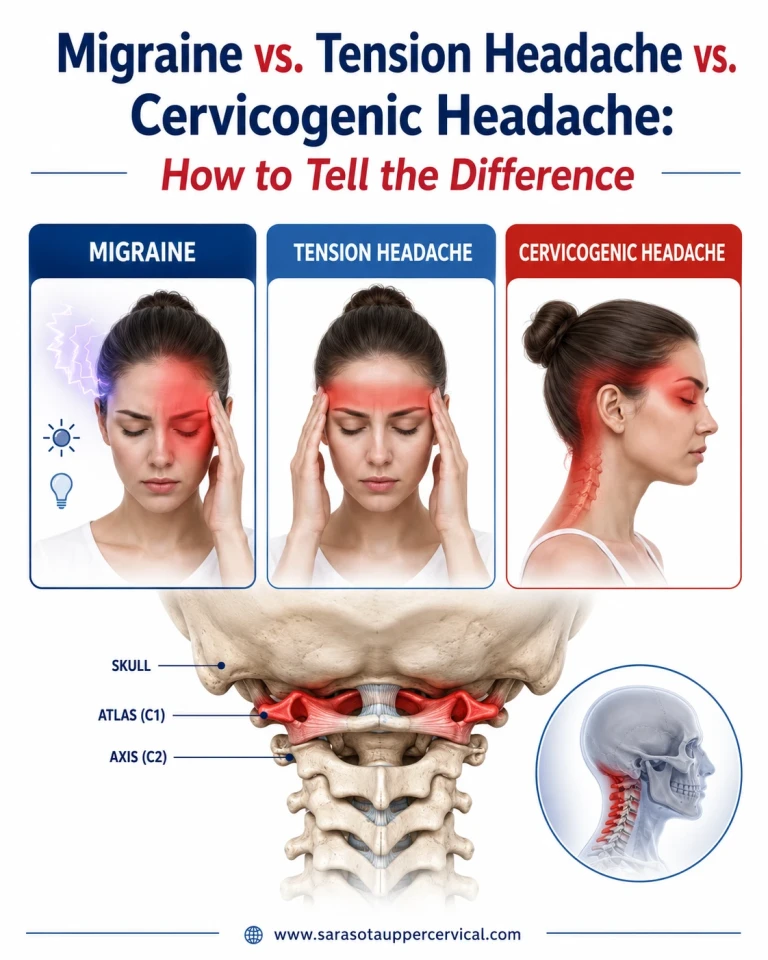
Migraine vs. Tension Headache vs. Cervicogenic Headache: How to Tell the Difference
Aug 14, 2026• Joint motion improves
• Muscle guarding decreases
• Brainstem stress reduces
• Autonomic regulation stabilizes
• Sinus congestion may improve
The goal is not to “treat sinuses.”
The goal is to remove mechanical interference affecting nervous system function.
Why Precision Matters: 3D CBCT Imaging
No two people have the same misalignment pattern.
That’s why we use advanced 3D Cone Beam CT (CBCT) imaging.
CBCT imaging allows us to measure:
• Exact rotational displacement
• Lateral deviation
• Angular misalignment
• Structural asymmetry
• Relationship between skull and atlas
Every person’s anatomy is unique.
Without imaging, adjustments are generalized.
With CBCT, corrections are precisely tailored to your specific structural pattern.
Precision is crucial when working near the brainstem.
No Twisting. No Cracking. No Pulling.
Many patients hesitate because they fear aggressive neck manipulation.
Upper cervical care is different.
There is:
• No forceful twisting
• No aggressive cracking
• No yanking or pulling
Adjustments are:
• Gentle
• Specific
• Low-force
• Measured
Especially for patients with chronic inflammation, minimal force matters.
How We Determine When (and When Not) to Adjust
We do not adjust on every visit.
Objective testing determines necessity.
Related article
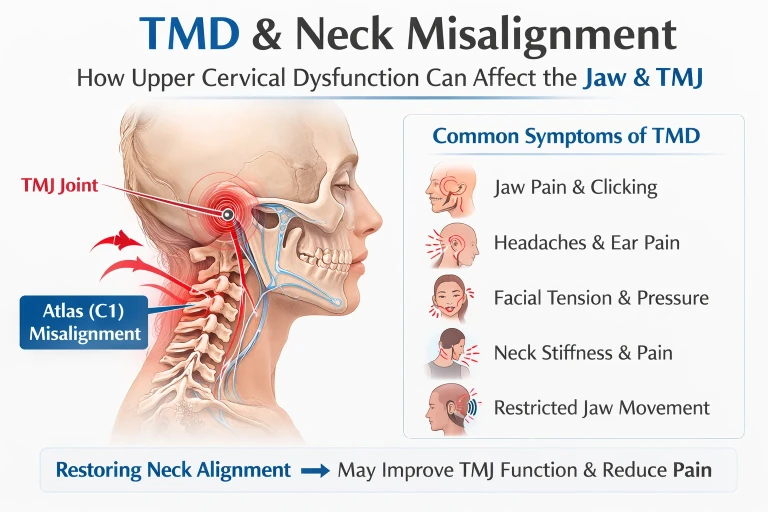
Lakewood Ranch TMD Specialist | Neck & Jaw Connection | Holistic TMD Relief
Mar 12, 2026We use:
Leg Length Analysis
Subtle changes can reflect neurological imbalance.
Infrared Thermography
Infrared scanning measures heat patterns along the spine, indicating nervous system stress.
These tools help determine:
• If misalignment is present
• If the correction is holding
• If adjustment is needed
• When stability has returned
Adjustments are data-driven — not routine.
True Healing vs Symptom Management
Most sinus treatments suppress symptoms.
Upper cervical care focuses on:
• Structural correction
• Nervous system balance
• Reducing mechanical stress
• Supporting natural drainage
True healing happens when the nervous system functions properly.
You may not need stronger medication.
You may need better alignment.
Is Upper Cervical Care Right for You?
Consider evaluation if:
• Sinus pressure is chronic
• You have frequent facial pain
• You feel ear pressure
• You wake with congestion
• You have neck stiffness
• You’ve had past trauma
Your sinuses are controlled by nerves.
Your nerves are influenced by the brainstem.
Your brainstem sits directly above C1.
Sinus Pressure & Chronic Sinus Issues in Sarasota and Bradenton
If you are ready to stop chasing temporary relief and investigate the root cause, upper cervical chiropractic may be the missing piece.
We focus on:
• Precision correction
• 3D imaging
• Gentle adjustments
• Objective testing
• Restoring motion and stability
👉 Call 941-259-1891 to schedule your FREE consultation
Or click here to schedule online.
Your sinuses were designed to drain properly.
Let’s make sure the nervous system regulating them is functioning the way it was designed to.


Leave a comment