

Balance is something most people rarely think about—until it stops working properly. When dizziness, vertigo, or instability appear, simple activities like walking, bending over, or turning your head can suddenly feel unsettling.
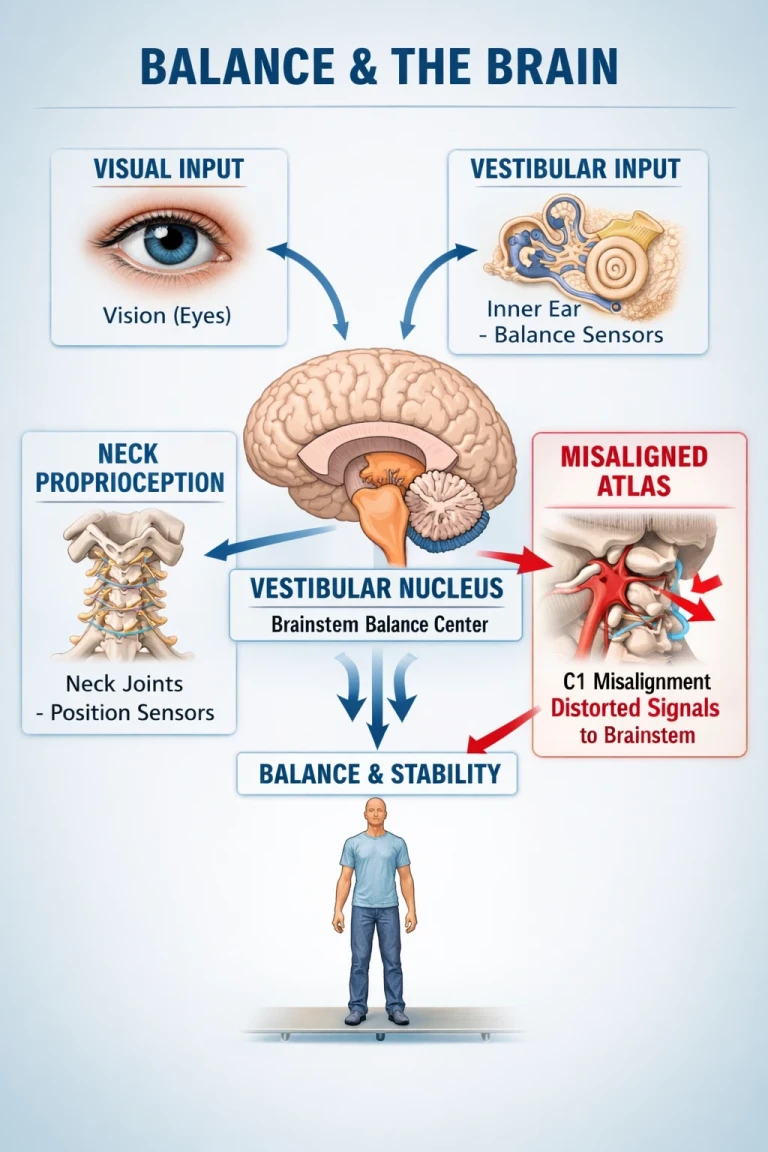
What many people don’t realize is that balance is controlled by three major sensory systems working together, all of which send information to an important coordination center in the brainstem called the vestibular nucleus. When these systems are working properly, your brain constantly knows where your body is in space and can keep you upright and stable. When one of these systems sends distorted information, however, the entire balance system can become confused.
Schedule Your Appointment
Schedule appointmentUnderstanding these three factors can help explain why some people struggle with chronic dizziness and why the upper cervical spine—the top of the neck—can often play an important role in balance disorders.
Schedule a FREE consult by clicking here.
The Three Major Systems That Control Balance
Your sense of balance depends on a constant flow of sensory information from three different parts of the body:
Visual Input from the Eyes
Vestibular Input from the Inner Ears
Proprioceptive Input from the Joints in the Neck
Your brain is constantly comparing information from these three sources to determine whether you are moving, turning, or standing still.
If all three signals match, your brain interprets your position accurately and balance remains stable. If one system sends conflicting or distorted information, the brain receives mixed signals—which can result in dizziness, vertigo, or instability.
Let’s explore each system in more detail.
Vision: The Brain’s External Reference Point
Your eyes provide a visual reference for the world around you. By observing stationary objects in your environment, your brain can determine whether your body is moving or remaining still.
For example, when you walk forward, the scenery moves across your visual field, and your brain recognizes that motion as forward movement. When you stand still and focus on a fixed object, your visual system helps reinforce stability.
This is why people who feel dizzy often say they feel more stable when they focus on a stationary object. Their brain is relying more heavily on visual information to compensate for imbalance in the other systems.
The Inner Ear: Your Motion and Gravity Sensors
The inner ear contains a complex structure known as the vestibular system, which detects head movement and orientation relative to gravity.
Tiny fluid-filled canals in the inner ear detect rotational head movements, while specialized structures called the otolith organs detect linear motion and changes in gravity.
Related article

trigeminal neuralgia and the neck connection | Trigeminal neuralgia treatment and relief sarasota
Jun 22, 2026These sensors constantly send signals to the brain about:
Head rotation
Forward and backward movement
Up and down motion
Head tilt relative to gravity
This information travels through the vestibular nerve directly to the vestibular nuclei in the brainstem, where it is integrated with visual and neck sensory input.
When the vestibular system malfunctions—as in conditions like vertigo or Ménière’s disease—the brain receives incorrect motion signals and balance can become disrupted.
Neck Joint Sensors: The Hidden Contributor to Balance
The third system that plays a major role in balance is often overlooked: proprioceptive input from the joints and muscles of the neck.
The upper cervical spine—particularly the joints between the skull, atlas (C1), and axis (C2)—contains an exceptionally high concentration of sensory receptors. These receptors detect subtle movements and positions of the head relative to the body.
These signals are extremely important because your brain must constantly determine:
Where your head is positioned
How your head is moving
How the head aligns with the rest of the body
This information is sent directly to the vestibular nuclei in the brainstem, where it is combined with visual and inner ear signals.
When these signals match, balance remains stable.
But when they don’t match, the brain receives conflicting information.
The Vestibular Nucleus: Where Balance Signals Are Coordinated
All three sensory systems—vision, inner ear, and neck joint input—converge in an area of the brainstem called the vestibular nucleus.
This region acts like a central processing hub for balance information.
The vestibular nucleus compares incoming signals from:
The eyes
The inner ear
The cervical spine joints
If the signals agree, the brain maintains stable posture and clear orientation.
But if one system sends aberrant or distorted sensory input, the brainstem can interpret this mismatch as motion—even when you are standing still.
Related article

Trigeminal Neuralgia vs. TMJ vs. Other Facial Pain: How to Tell the Difference
Jul 08, 2026This is when symptoms like vertigo, dizziness, imbalance, or disorientation can occur.
How Cervical Misalignment Can Disrupt Balance
The upper cervical spine is uniquely designed to support head movement and house critical neurological structures near the brainstem.
However, if the joints of the upper neck become misaligned due to injury, poor posture, or trauma, the sensory receptors in these joints may begin sending abnormal signals to the vestibular nucleus.
This phenomenon is sometimes referred to as cervicogenic dizziness.
When neck joint sensors send inaccurate positional information, the brain receives conflicting messages:
The inner ear may say the head is stable
The eyes may say the body is stationary
But the neck joints may falsely signal movement
The brainstem interprets this mismatch as motion, leading to symptoms such as:
Vertigo
Lightheadedness
Disequilibrium
Instability when walking
Brain fog
A Telltale Sign: Head Movement Triggers Symptoms
One common clue that the neck may be involved in balance dysfunction is when certain head movements trigger or worsen symptoms.
For example, some individuals experience increased vertigo or imbalance when:
Looking upward (neck extension)
Turning the head side to side
Tilting the head backward
Changing head position quickly
These movements can temporarily increase abnormal sensory signals coming from the cervical joints.
When the brainstem receives these distorted signals, the vestibular system becomes confused, and dizziness or imbalance may intensify.
The Precision Approach of Upper Cervical Care
Upper cervical chiropractic focuses specifically on the alignment of the atlas (C1) and axis (C2)—the two vertebrae that sit directly beneath the skull.
Because these joints play such a significant role in neurological communication and sensory signaling, even small misalignments can potentially affect how the brain interprets positional information.
Modern upper cervical care uses advanced 3-dimensional imaging(CBCT) to analyze the precise orientation of these vertebrae.
Related article
Hearing Loss Treatment in Sarasota | Understanding Eustachian Tube Dysfunction
Mar 23, 2026This imaging allows the doctor to:
Measure the exact misalignment
Understand the patient's unique anatomy
Develop a precise correction strategy
Unlike traditional spinal manipulation, upper cervical adjustments are extremely gentle and precise.
There is no twisting, popping, or pulling of the neck.
Instead, a carefully calculated correction is applied using a light and controlled force designed specifically for the patient’s anatomy.
The goal is not to treat symptoms directly, but to restore proper alignment of the upper cervical joints, allowing the nervous system—including the vestibular pathways—to function more normally.
Restoring Clear Communication to the Brainstem
When the upper cervical spine is properly aligned, the sensory input from the neck joints becomes more accurate.
This allows the vestibular nucleus to better coordinate the three balance systems:
Vision
Inner ear signals
Neck proprioception
As the brain receives clearer information, many patients report improvements in symptoms such as:
Vertigo
Chronic dizziness
Balance instability
Brain fog
Head pressure
Every patient is unique, and healing occurs at different rates, but restoring structural alignment in the neck can remove a major source of neurological interference.
Schedule a Free Consultation
If you struggle with vertigo, dizziness, imbalance, or unexplained balance problems, the upper cervical spine may be an overlooked piece of the puzzle.
A consultation can help determine whether a cervical misalignment may be contributing to your symptoms.
Schedule a free consultation today by calling
📞 941-259-1891
or click here to schedule your visit.
A precise evaluation could be the first step toward restoring stability, improving neurological function, and helping your body regain its natural balance.


Leave a comment