

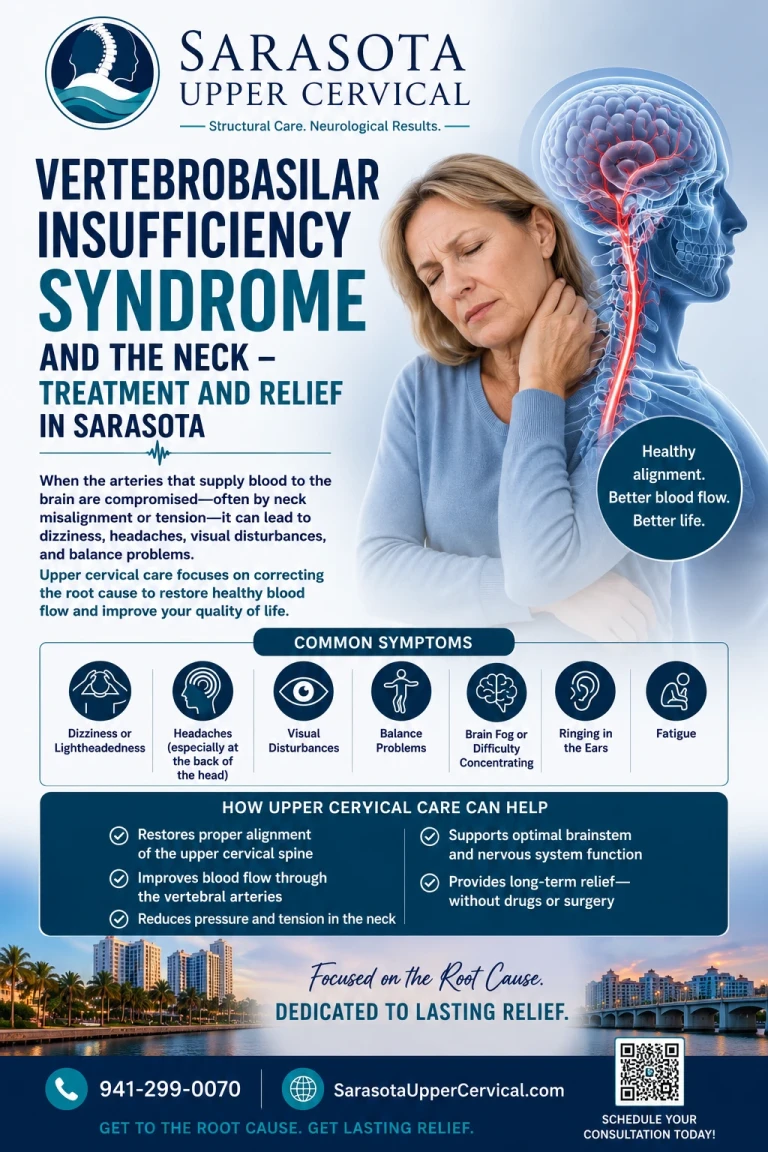
Understanding the Connection — and Why Safe, Imaging-Guided Evaluation Comes First
Few regions of the body are as critical to brain function as the upper neck. The blood vessels that supply the back of the brain — the brainstem, cerebellum, and other structures that govern balance, coordination, vision, and vital functions — travel directly through the top of the cervical spine. When blood flow through this system is reduced, the condition is called vertebrobasilar insufficiency (VBI). This guide explains what VBI is, how the alignment of the upper neck may relate to brain blood flow, what the emerging research suggests, and — importantly — why responsible, imaging-guided evaluation and medical safety always come first.
Schedule Your Appointment
Schedule appointmentImportant safety note. Vertebrobasilar insufficiency is a genuine vascular condition that requires medical evaluation. Sudden symptoms such as severe dizziness or vertigo, double vision, slurred speech, difficulty swallowing, sudden loss of coordination, drop attacks (sudden falls without warning), or weakness or numbness can signal reduced blood flow to the brain or a stroke, and are a medical emergency. If you experience these, seek emergency care immediately — call 911. Upper cervical care is not a treatment for an acute vascular event, and this information does not replace medical evaluation.
What Is Vertebrobasilar Insufficiency?
Vertebrobasilar insufficiency refers to reduced blood flow through the vertebrobasilar system — the two vertebral arteries and the basilar artery they form when they join. This system supplies the posterior (back) part of the brain, including the brainstem and cerebellum. Because these structures control balance, eye movements, coordination, swallowing, and core autonomic functions, reduced flow here can produce a distinctive set of symptoms.
Symptoms associated with vertebrobasilar insufficiency can include dizziness or vertigo, visual disturbances such as double vision, unsteadiness and poor coordination, slurred speech, difficulty swallowing, and — in more serious presentations — drop attacks. VBI is most often related to vascular factors such as atherosclerosis, and risk rises with age, high blood pressure, diabetes, and smoking. Because some of these symptoms overlap with far more benign causes of dizziness, and because some can also signal a stroke, proper medical assessment is essential to determine what is actually going on.
Why the Upper Neck Is Anatomically Involved
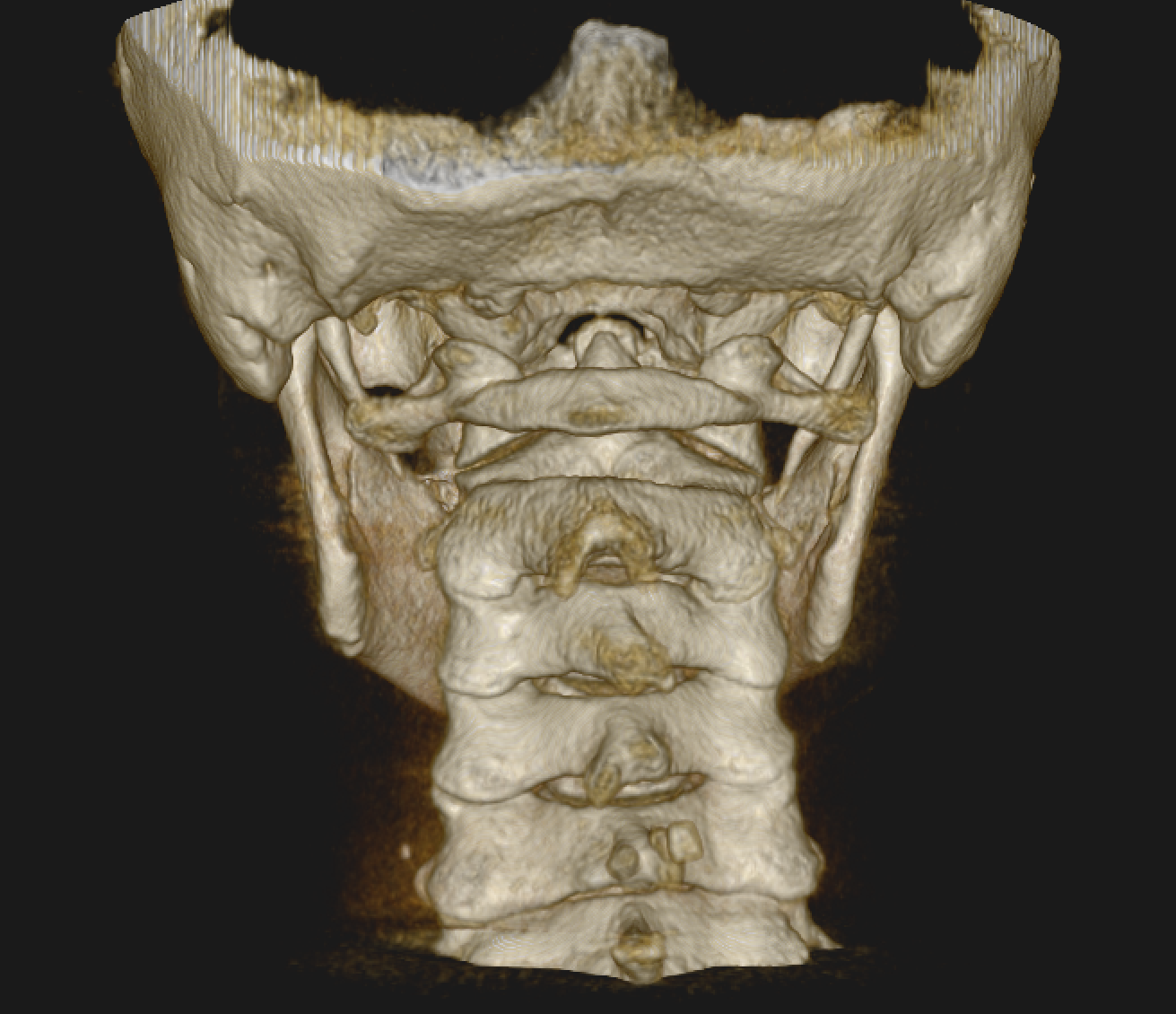
Here is the anatomical fact that connects this vascular condition to the cervical spine: the vertebral arteries do not travel a straight, protected path. They thread up through small openings in the cervical vertebrae and then make a series of turns as they pass around the atlas (C1) before entering the skull. This puts them in intimate relationship with the bones of the upper neck. The craniocervical junction — where the skull meets the atlas and axis — is the region where these arteries, along with the brainstem, spinal cord, and cerebrospinal fluid pathways, all converge in a remarkably small and complex space.
How Upper Cervical Alignment May Relate to Brain Blood Flow
Because the vertebral arteries and the cerebrospinal fluid pathways pass through the craniocervical junction, researchers have proposed that the alignment and integrity of this region may influence the flow of both blood and cerebrospinal fluid (CSF) to and from the brain. It is important to frame this carefully: these are proposed mechanisms grounded in anatomy and emerging imaging research, not settled, proven cause-and-effect. With that framing, the proposed relationships include:
Related article
Head Pressure Relief and Treatment in Sarasota | Neck Misalignment Is Commonly the Missing Link
Mar 16, 2026• Altered alignment at the craniocervical junction may affect the space and biomechanics around the vertebral arteries and venous drainage pathways as they pass through the upper neck.
• Misalignment in this region has been proposed to influence cerebrospinal fluid dynamics — the normal circulation of the fluid that surrounds and cushions the brain and spinal cord.
• Because blood inflow, venous drainage, and CSF flow are interrelated within the closed space of the skull, disturbance in one may affect the overall fluid environment of the brain.
In other words, the proposition is not that a misaligned neck simply “pinches an artery,” but that the alignment of this critical junction may be one factor among several in the broader picture of how blood and fluid move through the region. This remains an area of active investigation.
What the Research Suggests — and Its Limits
Some of the most cited work in this area comes from Dr. Scott Rosa, a chiropractor who has studied the craniocervical junction using dynamic upright MRI. His published work — including a 2018 book chapter on craniocervical junction syndrome and a peer-reviewed case-control study with Freeman and colleagues in the journal Brain Injury (2010) examining cerebellar tonsillar position and whiplash trauma — advances the hypothesis that misalignment at the C0–C1–C2 region can disrupt normal cerebrospinal fluid flow and blood flow in the vertebrobasilar system, and that these disruptions can sometimes be visualized on advanced imaging.
This work is best understood as emerging, largely observational and imaging-based research that establishes biological plausibility and generates hypotheses worth taking seriously. It is anatomically grounded and has been published, which gives it real standing. At the same time, it is important to be honest about what it is not: it does not yet constitute large-scale, replicated, randomized controlled trials proving that correcting upper cervical alignment reliably restores brain blood flow or treats vertebrobasilar insufficiency. Claims that go that far overstate the current evidence. Our position is the careful middle: the anatomy is real, the proposed mechanisms are plausible, the imaging observations are intriguing, and more rigorous research is needed before anyone should describe this as a proven treatment.
Where Upper Cervical Care Fits — and Where It Does Not
Let us be completely clear, because honesty and safety are the priority: upper cervical care is not a treatment for vertebrobasilar insufficiency. True VBI is a vascular condition that belongs in the hands of your physician, and an acute reduction in brain blood flow is a medical emergency. Anyone presenting upper cervical adjustment as a cure for VBI is overstating both the evidence and the appropriate scope of care.
Where careful upper cervical evaluation may have a role is different and more nuanced. Many people who are told they might have “poor circulation” or who experience chronic dizziness and unsteadiness actually have benign, mechanical causes — such as cervicogenic dizziness from the upper neck’s position sensors — that can mimic vascular symptoms. A responsible upper cervical office plays two roles here: first, recognizing the signs that require medical or emergency referral rather than chiropractic care; and second, for appropriately screened candidates whose vascular workup is clear, evaluating whether upper cervical alignment is contributing to their symptoms through the mechanical and proprioceptive pathways. The work always complements medical care; it never replaces it.
Related article

trigeminal neuralgia and the neck connection | Trigeminal neuralgia treatment and relief sarasota
Jun 22, 2026Safety First: Why Imaging and Screening Matter So Much Here
Nowhere in chiropractic is careful screening more important than in the upper cervical region, precisely because of the vertebral arteries. This is exactly why our approach is built around precision and caution rather than force.
Detailed 3D Imaging
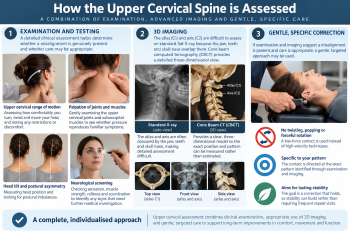
Before any care, detailed 3D imaging (CBCT) is used as a precision measurement tool to evaluate the individual anatomy of the upper neck. Understanding the real, three-dimensional structure of this region — rather than guessing — is fundamental to providing care safely and appropriately, and to recognizing anatomy that warrants caution or referral.
Gentle Corrections — No Twisting, Popping, or Yanking
This point is especially important in the context of brain blood flow. The forceful rotational and high-velocity neck manipulation that has, rarely, been associated with vertebral artery injury is not what upper cervical care of this kind involves. Blair upper cervical corrections are gentle and specific, with no twisting, popping, or yanking of the neck. The precision provided by imaging is what allows a light, exact correction — delivered along the path the analysis reveals — rather than force. For a region surrounded by critical vasculature, this gentle, individualized approach is not just more comfortable; it is fundamentally about caution.
Candidacy and Referral
A thorough evaluation determines whether upper cervical care is appropriate for you at all. Part of that responsibility is recognizing when symptoms point toward a vascular or other medical cause that requires physician evaluation or emergency care — and making that referral rather than proceeding. Candidacy-first care, in this context, is a safety practice.
Have your symptoms been medically evaluated and you want to explore the upper neck's role? Schedule a free consultation to find out whether you are a candidate for care. Call 941-259-1891.
Frequently Asked Questions
What is vertebrobasilar insufficiency?
It is reduced blood flow through the vertebrobasilar system — the vertebral and basilar arteries that supply the back of the brain, including the brainstem and cerebellum. It can cause dizziness, double vision, unsteadiness, slurred speech, difficulty swallowing, and in serious cases drop attacks. It is a vascular condition that requires medical evaluation.
Can a misalignment in my neck affect blood flow to my brain?
Related article
The vertebral arteries pass directly through the upper cervical vertebrae and around the atlas before entering the skull, so the upper neck is anatomically involved with these vessels. Researchers have proposed that alignment at the craniocervical junction may influence blood and cerebrospinal fluid flow through this region. These are plausible, anatomy-based proposed mechanisms under active study, not proven cause-and-effect.
Does upper cervical care treat vertebrobasilar insufficiency?
No. True vertebrobasilar insufficiency is a vascular condition that belongs with your physician, and acute symptoms are a medical emergency. Upper cervical care does not treat it. Careful upper cervical evaluation may have a role only for appropriately screened candidates whose medical workup is clear, in addressing mechanical or proprioceptive contributors to dizziness that can mimic vascular symptoms — always alongside, never instead of, medical care.
What does the research by Dr. Scott Rosa actually show?
Dr. Rosa’s published work, using dynamic upright MRI, proposes that misalignment at the craniocervical junction can disrupt cerebrospinal fluid and vertebrobasilar blood flow, sometimes visible on advanced imaging. It is emerging, largely observational research that establishes biological plausibility and is worth taking seriously, but it does not yet amount to large-scale randomized trials proving that correction restores brain blood flow. We present it as a promising hypothesis, not settled proof.
Is upper cervical adjustment safe given the arteries in the neck?
The forceful, high-velocity rotational manipulation rarely associated with vertebral artery injury is not what this care involves. Blair upper cervical corrections are gentle and specific, with no twisting, popping, or yanking, and are guided by detailed 3D imaging of your individual anatomy. Care begins with thorough screening, including recognizing when symptoms require medical referral instead of chiropractic care.
When should I seek emergency care instead?
Seek emergency care immediately (call 911) for sudden severe dizziness or vertigo, double vision, slurred speech, difficulty swallowing, sudden loss of coordination, drop attacks, or weakness or numbness. These can indicate reduced brain blood flow or a stroke and require urgent medical attention, not chiropractic care.
This content is for informational purposes only and does not constitute medical advice. Vertebrobasilar insufficiency is a vascular condition requiring medical evaluation, and acute symptoms are a medical emergency. Upper cervical care does not treat vertebrobasilar insufficiency; it addresses spinal alignment in appropriately screened candidates, alongside medical care. Individual results vary, and candidacy is determined by evaluation.


Leave a comment