

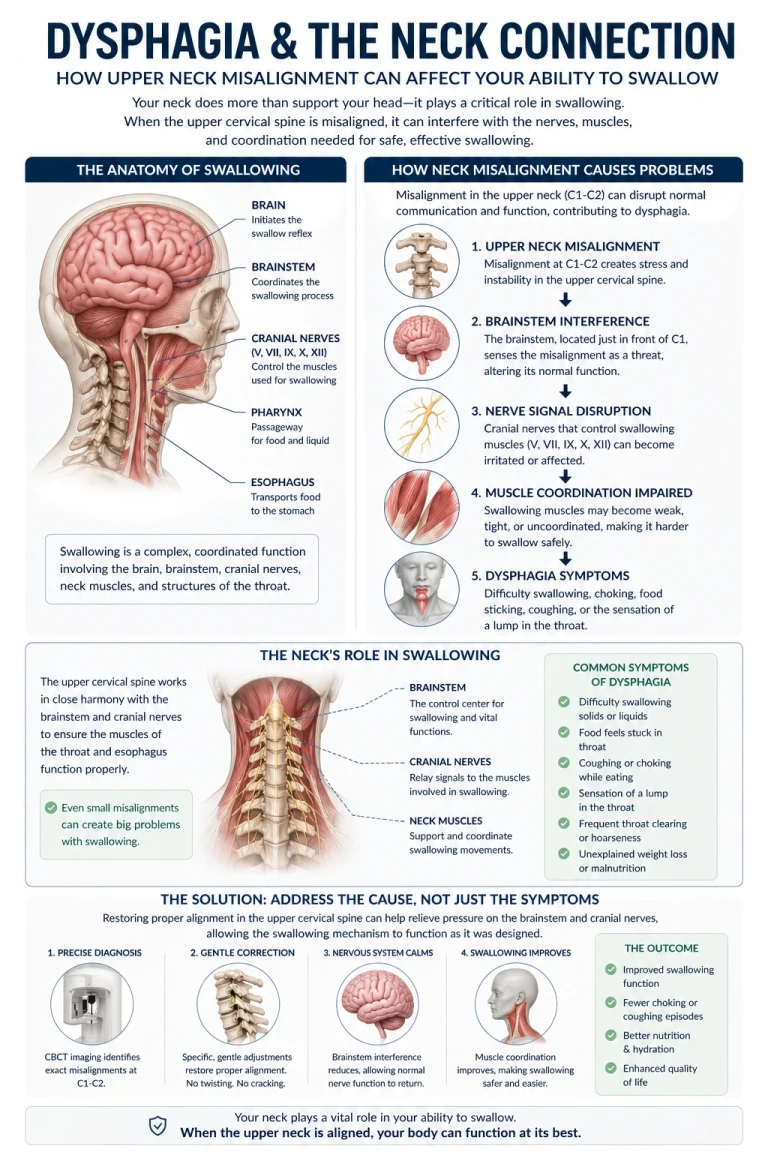
Swallowing is something most people never think about—until it becomes difficult.
If you’ve been experiencing:
Schedule Your Appointment
Schedule appointmentFood feeling like it’s getting stuck
Difficulty swallowing liquids or solids
A tight or choking sensation in your throat
Frequent throat clearing or coughing
You may be dealing with dysphagia.
For many people, this becomes frustrating and even alarming. You might be told it’s reflux, stress, or something structural. But what if the root cause isn’t just in the throat or esophagus?
What if it’s coming from the control center of swallowing itself—the brainstem—and how it’s being affected by the upper cervical spine?
What Is Dysphagia?
Dysphagia simply means difficulty swallowing, but the process of swallowing is anything but simple.
It requires:
Precise coordination of muscles in the mouth, throat, and esophagus
Proper nerve signaling
Timed, rhythmic contractions
When any part of this system is disrupted, swallowing can feel:
Uncoordinated
Weak
Delayed
Or even painful
To understand why this happens, we need to look at how swallowing actually works.
The Role of Peristalsis in Swallowing
Once food leaves your throat, it travels down the esophagus through a process called peristalsis.
Peristalsis is:
A rhythmic, wave-like contraction
Coordinated from top to bottom
Responsible for moving food smoothly into the stomach
This process must be:
Timed correctly
Strong enough to push food downward
Coordinated across multiple muscle groups
And here’s the key: Peristalsis is controlled by the nervous system, specifically the brainstem and vagus nerve.
Related article
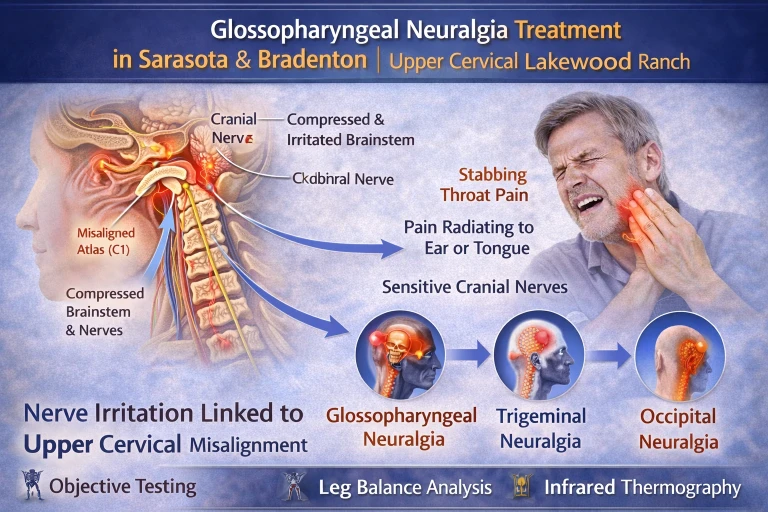
Glossopharyngeal Neuralgia Treatment in Sarasota & Bradenton | Upper Cervical Lakewood Ranch
Mar 16, 2026
The Brainstem: The Control Center for Swallowing
The brainstem, located at the base of your skull, is responsible for coordinating many automatic functions, including:
Swallowing (deglutition)
Breathing
Heart rate
Muscle tone
Autonomic regulation
When you swallow, the brainstem:
Activates the muscles of the throat
Coordinates timing with breathing
Initiates peristalsis in the esophagus
This process happens automatically—without conscious effort.
But when the brainstem becomes irritated or dysfunctional, these coordinated actions can break down.
How Upper Cervical Misalignment Can Affect Swallowing
The top two bones in your neck—C1 (atlas) and C2 (axis)—surround and protect the brainstem.
This area is one of the most neurologically sensitive regions in the body.
When there is an upper cervical misalignment, it can:
Irritate or distort brainstem signaling
Disrupt communication through the vagus nerve
Alter coordination of swallowing muscles
What Does This Lead To?
Difficulty initiating a swallow
Weak or uncoordinated peristalsis
Sensation of food “sticking”
Tightness or discomfort in the throat
In other words: dysphagia can be neurological—not just structural
Peristalsis and Brainstem Irritation
When the brainstem is functioning properly:
Peristalsis is smooth and rhythmic
Food moves effortlessly down the esophagus
But when the brainstem is irritated:
The rhythm can become disrupted
Contractions may weaken or become uncoordinated
Swallowing may feel delayed or incomplete
This is why some people experience:
Intermittent swallowing issues
Symptoms that come and go
Difficulty that doesn’t show up clearly on imaging or scopes
Because the issue is not always in the esophagus—it’s in the control system behind it
The Role of Posture and Loss of Cervical Curve
Another critical piece of this puzzle is posture and spinal alignment.
Many people today develop:
Forward head posture
Tightness in the scalene muscles
Loss of the natural cervical curve
Why Does This Matter?
Related article
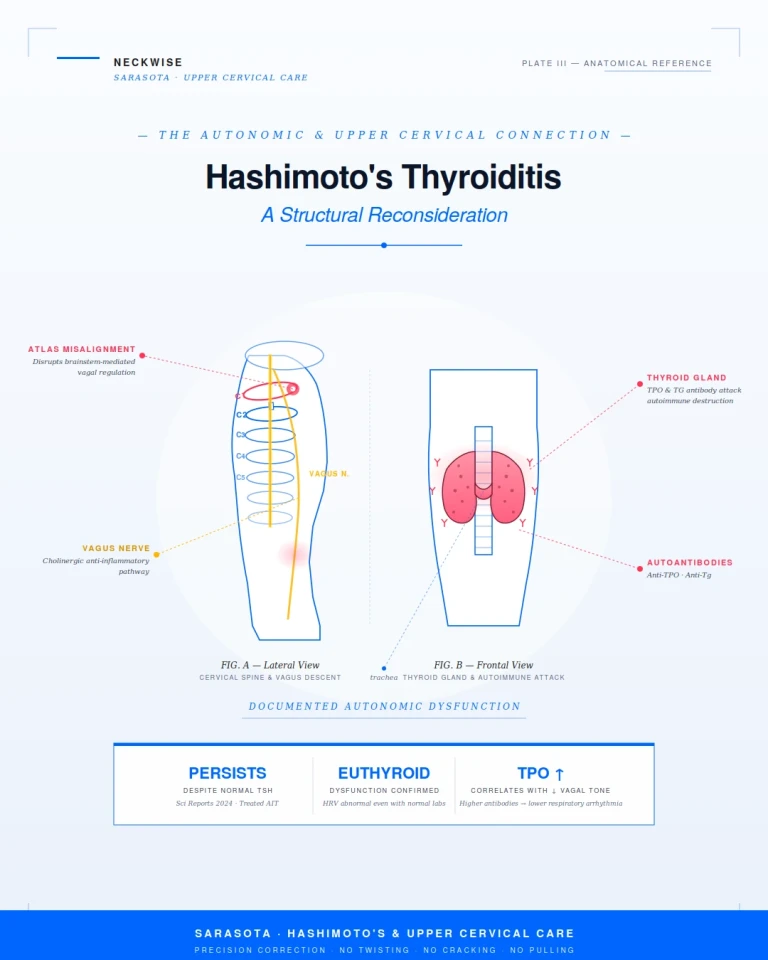
Hashimoto's Thyroiditis Treatment Support in Sarasota | The Autonomic and Upper Cervical Connection
May 14, 2026The scalene muscles, located in the front and side of the neck, can become tight due to:
Postural stress
Neurological imbalance
Compensation from upper cervical misalignment
This tightness can:
Pull the head forward
Flatten or reverse the cervical curve
How Loss of Cervical Curve Affects the Brainstem
When the natural curve of the neck is lost:
The spinal cord and brainstem can experience increased tensile stress
Mechanical tension builds in the nervous system
Brainstem function can become compromised
This can lead to:
Autonomic dysfunction
Poor coordination of swallowing
Disruption of peristalsis
The body is no longer functioning in a relaxed, balanced state
The Chain Reaction
Here’s how this often plays out:
Upper Cervical Misalignment → Brainstem Irritation → Muscle Tone Imbalance → Scalene Tightness → Loss of Cervical Curve → Tensile Stress on Brainstem → Autonomic Dysfunction → Difficulty Swallowing
This is why dysphagia can sometimes feel:
Complex
Unexplained
Resistant to traditional treatments
Common Symptoms Associated With This Pattern
In addition to difficulty swallowing, you may also experience:
Globus sensation (feeling like something is stuck in your throat)
Neck pain or tightness
Headaches
Brain fog
Fatigue
Vertigo or dizziness
Voice changes or throat irritation
These symptoms often seem unrelated—but they share a common origin:
Brainstem dysfunction and upper cervical imbalance.
Why Traditional Treatments May Miss the Mark
Many approaches to dysphagia focus on:
Acid reflux (GERD)
Structural abnormalities
Diet modifications
While these are important to rule out, they don’t always address:
Neurological coordination of swallowing.
If the brainstem is not functioning properly, the muscles involved in swallowing won’t either, no matter how healthy the esophagus looks.
The Upper Cervical Chiropractic Approach
Upper cervical care focuses on one primary goal:
Related article
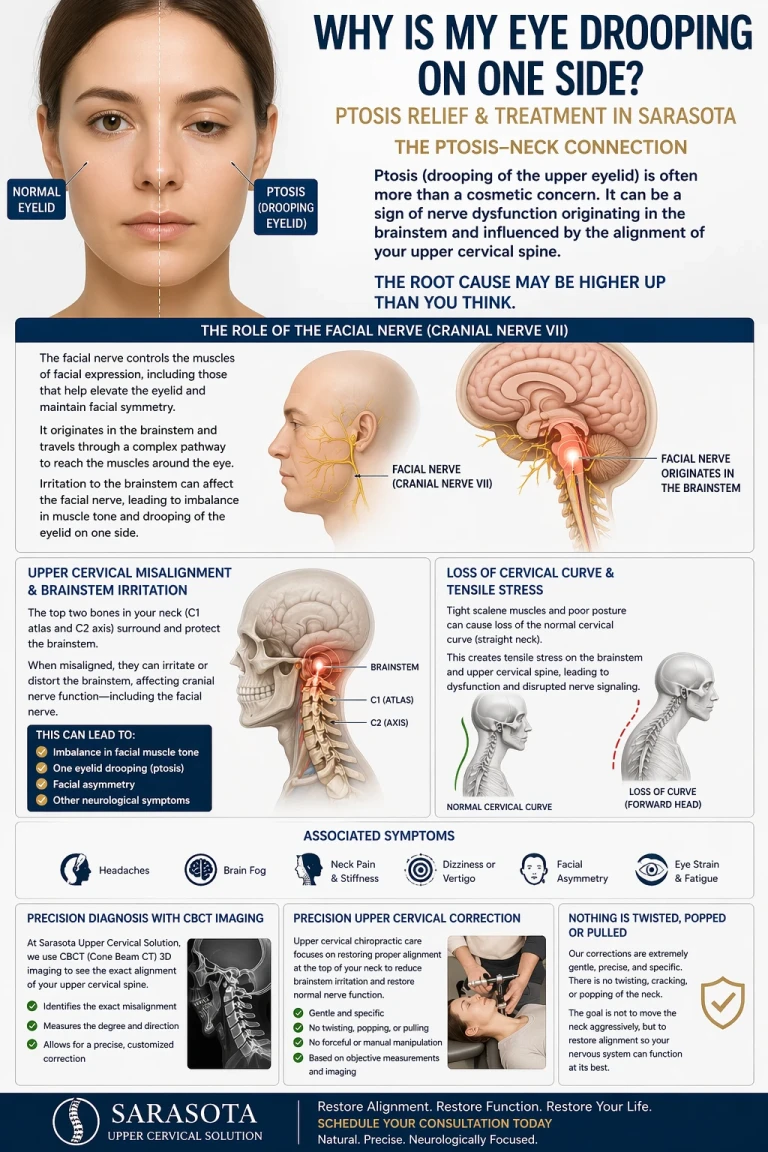
Why Is My Face Drooping on One Side? | Natural Bell’s Palsy Treatment and Relief in Sarasota
Apr 26, 2026Restoring proper alignment at the top of the neck to reduce brainstem irritation
This approach is:
Precise
Objective
Neurologically focused
And most importantly:
Adjustments are only performed when testing shows they are needed
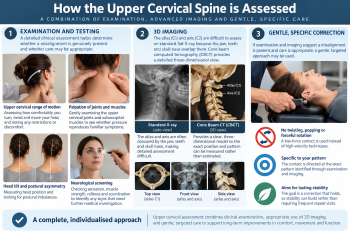
Precision Matters: CBCT Imaging
To achieve true precision, upper cervical chiropractors use CBCT (Cone Beam CT) imaging.
This allows us to:
See the upper cervical spine in 3D
Identify the exact misalignment
Measure its direction and severity
Every correction is:
Customized to your anatomy
Based on objective data
Designed for accuracy
No Twisting, Popping, or Pulling
One of the biggest misconceptions about chiropractic care is forceful adjustments.
Upper cervical care is different.
Adjustments are:
Gentle
Specific
No twisting, cracking, or popping
The goal is not to force movement…
It’s to restore alignment so the body can function properly.
Restoring Function to Swallowing
When the upper cervical spine is properly aligned:
Brainstem irritation can decrease
Nervous system communication improves
Muscle coordination begins to normalize
This can lead to:
Improved peristalsis
Easier swallowing
Reduced throat tension
Better overall function
Final Thoughts
Difficulty swallowing can be unsettling—but it’s not always just a throat issue.
For many people, the root cause lies in:
Brainstem function
Nervous system coordination
Upper cervical alignment
By addressing the problem at its source, the body can begin to restore normal function—naturally.
Looking for Dysphagia Relief in Sarasota?
If you’re dealing with:
Difficulty swallowing
Throat tightness
Brain fog, neck pain, or dizziness
It may be time to evaluate the role of your upper cervical spine and brainstem.
A proper assessment using CBCT imaging and objective testing can determine if this is contributing to your symptoms.


Leave a comment