

The human body is brilliantly designed, but there are key anatomical regions where even a small disruption can create widespread effects. One of the most important—and most overlooked—of these regions is the cranio-cervical junction, where the skull meets the upper neck.
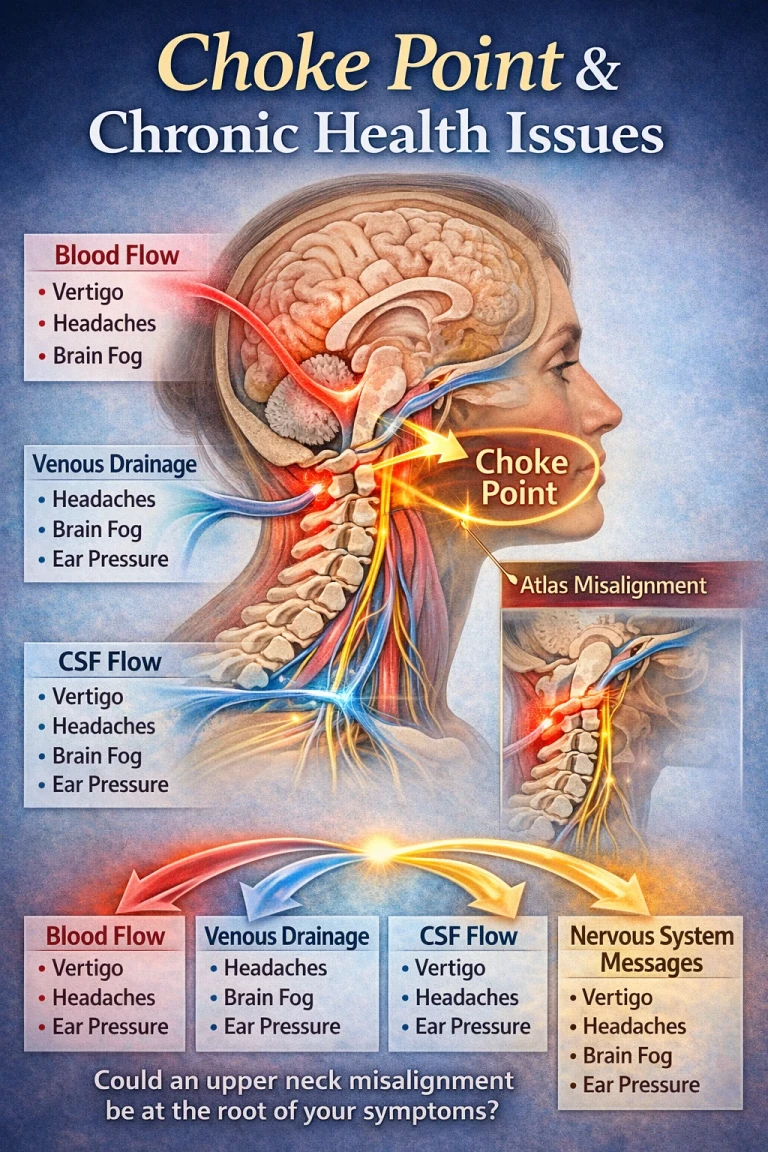
This area, centered around the atlas (C1) and axis (C2), is not just another spinal segment. It is a critical crossroads through which some of the body’s most vital systems pass. When functioning properly, it allows seamless communication and fluid movement between the brain and body. But when misaligned, it can act as a choke point, interfering with essential processes and contributing to symptoms like vertigo, headaches, brain fog, and ea.r pressure
Schedule Your Appointment
Schedule appointmentTo understand why this happens, we need to look at the four major systems that pass through this region:
Blood flow (arterial supply)
Venous drainage (blood outflow)
Cerebrospinal fluid (CSF) circulation
Nerve impulse transmission
When the atlas is misaligned, each of these systems can be disrupted—leading to a cascade of neurological and physiological dysfunction.
Click here to book a FREE consultation.
The Cranio-Cervical Junction: A Critical Gateway
The cranio-cervical junction surrounds the foramen magnum, the opening at the base of the skull where the brain transitions into the spinal cord. The atlas (C1) sits directly beneath this opening and plays a crucial role in supporting the skull and protecting the brainstem.
Unlike other vertebrae, the atlas has no disc above it and allows for a high degree of mobility. This mobility, while beneficial, also makes it vulnerable to misalignment from trauma, poor posture, or repetitive stress.
Because of its position, even a slight misalignment can influence everything passing through this region.
1. Blood Flow: Supplying the Brain
The brain relies on a constant and precise supply of oxygen-rich blood. A significant portion of this blood travels through the vertebral arteries, which ascend through the cervical spine and curve around the atlas before entering the skull.
How Misalignment Affects Blood Flow
When the atlas is misaligned, it can alter the pathway or tension surrounding these arteries. While not necessarily causing a complete blockage, even subtle changes in flow dynamics can impact:
Oxygen delivery to the brain
Nutrient transport
Overall cerebral metabolism
Connection to Symptoms
Reduced or altered blood flow can contribute to:

Vertigo and dizziness (due to impaired circulation to balance centers)
Brain fog (reduced oxygenation and metabolic efficiency)
Headaches (vascular tension and dysregulation)
The brain is highly sensitive to even minor changes in circulation, making this a critical factor.
2. Venous Drainage: Removing Waste from the Brain
Just as important as blood entering the brain is blood leaving it. The venous system, including the jugular veins, is responsible for draining deoxygenated blood and metabolic waste from the brain.
How Misalignment Affects Venous Outflow
The veins in the upper neck are more easily influenced by mechanical factors than arteries. A misaligned atlas can create subtle compression or altered tension in surrounding tissues, leading to:
Sluggish venous drainage
Increased intracranial pressure
Accumulation of metabolic byproducts
Connection to Symptoms
Poor venous drainage is strongly associated with:
Headaches, particularly pressure-type headaches
Brain fog, due to inefficient waste clearance
A sense of fullness or pressure in the head and ears
When the brain cannot effectively drain, it creates a “backed-up” system—much like a clogged sink.
3. Cerebrospinal Fluid (CSF): The Brain’s Hydraulic System
Cerebrospinal fluid (CSF) surrounds and cushions the brain and spinal cord. It also plays a vital role in:
Nutrient delivery
Waste removal
Maintaining pressure balance within the skull
CSF flows rhythmically through the cranio-cervical junction, particularly at the level of the foramen magnum.
How Misalignment Affects CSF Flow
A misaligned atlas can disrupt the normal hydrodynamic flow of CSF by:
Altering the shape or space of the foramen magnum region
Creating mechanical tension on surrounding membranes
Interfering with the natural pulsation of fluid
Connection to Symptoms
Disrupted CSF flow can lead to:
Vertigo, due to pressure imbalances affecting vestibular centers
Headaches, especially those related to intracranial pressure
Brain fog, from impaired nutrient delivery and waste clearance
Ear pressure, as fluid dynamics influence inner ear function
CSF flow is one of the most underappreciated factors in neurological health.
Related article
Migraine vs. Tension Headache vs. Cervicogenic Headache: How to Tell the Difference
Aug 14, 2026
4. Nerve Impulse Transmission: Communication Between Brain and Body
At the center of the cranio-cervical junction lies the brainstem, one of the most vital structures in the body. It acts as a relay station for nerve signals traveling between the brain and body.
How Misalignment Affects Nerve Function
When the atlas is misaligned, it can create irritation or altered input to the brainstem and surrounding neural structures. This can result in:
Distorted sensory information
Altered motor control
Dysregulation of autonomic functions
Connection to Symptoms
Because the brainstem houses nuclei related to balance, sensation, and autonomic control, dysfunction here can manifest as:
Vertigo and dizziness (vestibular nucleus involvement)
Headaches (trigeminal nucleus irritation)
Brain fog (impaired neural processing)
Ear pressure and tinnitus (neurological regulation of ear structures)
This is often referred to as neurological interference, where the signal between the brain and body is no longer clear.
Connecting the Dots: Why These Symptoms Often Occur Together
Many patients experience a combination of:
Vertigo
Headaches
Brain fog
Ear pressure
This is not a coincidence.
All four symptoms can be traced back to dysfunction at the cranio-cervical junction affecting the same four systems:
Circulation (in and out)
Fluid dynamics
Neurological communication
When this region becomes a choke point, it doesn’t just affect one system—it affects them all simultaneously.
Why Traditional Approaches May Fall Short
Most conventional treatments focus on managing symptoms:
Medications for headaches
Vestibular therapy for vertigo
Decongestants for ear pressure
While these can provide temporary relief, they often fail to address the underlying cause—especially if that cause is structural and neurological at the upper neck.
Related article

Trigeminal Neuralgia vs. TMJ vs. Other Facial Pain: How to Tell the Difference
Jul 08, 2026If the choke point remains, the symptoms often persist or return.
A Precise Approach: Addressing the Root Cause
Modern upper cervical care focuses on identifying and correcting misalignment at the atlas with a high degree of precision.
CBCT Imaging
Using Cone Beam CT (CBCT), practitioners can:
Visualize the exact position of the atlas in 3D
Measure the direction and degree of misalignment
Develop a customized correction plan
Gentle, Specific Corrections
Unlike traditional methods, these corrections are:
Gentle and controlled
Based entirely on imaging data
Performed without twisting, popping, or pulling
The goal is to remove interference—not force movement.
Restoring Flow and Function
When alignment at the cranio-cervical junction is restored, the body often begins to normalize:
Blood flow improves
Venous drainage becomes more efficient
CSF circulation stabilizes
Nerve signaling becomes clearer
As these systems recover, many patients experience significant improvements in:
Vertigo
Headaches
Mental clarity
Ear pressure
Final Thoughts
The upper neck is more than just a structural support—it is a gateway for life-sustaining processes. When functioning properly, it allows the brain and body to communicate and operate seamlessly. But when it becomes a choke point, it can disrupt multiple systems at once.
If you are experiencing persistent vertigo, headaches, brain fog, or ear pressure, it may be time to look beyond isolated symptoms and consider the role of the cranio-cervical junction.
Sometimes, the key to unlocking better health lies at the very top of the spine.


Leave a comment