

If your jaw clicks, pops, or grinds when you open and close your mouth, you’re not alone. These symptoms are commonly associated with temporomandibular joint dysfunction (TMD/TMJ), a condition that affects the jaw joint, surrounding muscles, and the way your bite functions.
But here’s what most people are never told:
Schedule Your Appointment
Schedule appointment
Your jaw doesn’t just live in your face—it is neurologically controlled by your brainstem and mechanically influenced by your upper neck.
Understanding that connection is often the missing piece for people struggling with chronic jaw issues.
What Is Causing My Jaw to Crack or Grind?
The temporomandibular joint (TMJ) is one of the most complex joints in the body. It has a small disc that sits between the jawbone (mandible) and the skull. Ideally, this disc moves smoothly as you open and close your mouth.
Jaw cracking or grinding can happen when:
The disc becomes displaced
The joint mechanics are off
The muscles controlling the jaw become imbalanced
This often leads to:
Clicking or popping when opening
Grinding or crunching sensations
Jaw tension or fatigue
Headaches or facial pain
But what’s driving that imbalance?
The Brainstem: The Command Center for Your Jaw
Your jaw muscles—called the muscles of mastication—include:
Masseter
Temporalis
Medial pterygoid
Lateral pterygoid
These muscles are not acting randomly. They are tightly controlled by your nervous system—specifically through the Trigeminal Nerve.
Related article
The trigeminal nerve originates in the brainstem, which acts like a command center regulating muscle tone, coordination, and reflexes.
Inside the brainstem:
The trigeminal motor nucleus controls how strongly your jaw muscles contract
Sensory input from your teeth, jaw, and face feeds back into this system
Reflex loops constantly adjust muscle tension in real time
When everything is balanced, your jaw moves smoothly and efficiently.
When it’s not… you get dysfunction.
How the Upper Neck Influences Jaw Function
Here’s where things get interesting—and often overlooked.
The top two bones in your neck (C1 and C2), also known as the upper cervical spine, sit directly beneath the brainstem. This region plays a critical role in:
Posture
Balance
Muscle tone regulation throughout the body
If there is a misalignment or dysfunction in this area, it can:
Alter brainstem signaling
Disrupt normal muscle tone patterns
Create asymmetry in how muscles fire
This includes the muscles of mastication.
The Chain Reaction: From Neck to Jaw
When the upper cervical spine is not functioning properly, it can create a cascade effect:
1. Brainstem irritation or altered signaling
↓
2. Imbalanced trigeminal nerve output
↓
3. Uneven muscle tone in the jaw muscles
↓
4. Abnormal jaw tracking and movement
↓
5. Disc stress, clicking, grinding, and pain
This is why many people with TMJ issues also experience:
Related article
CCI, AAI, Chiari, and Tethered Cord: Telling Overlapping Conditions Apart | Sarasota
Aug 01, 2026Neck stiffness
Headaches
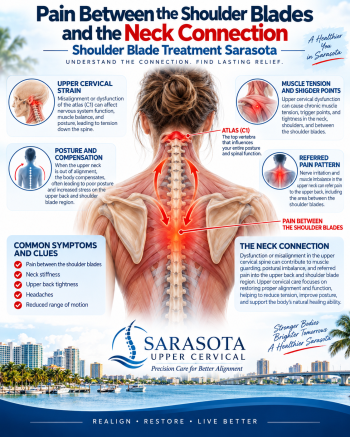
Shoulder tension
Even dizziness or ear symptoms
The jaw is not isolated—it’s part of a larger neurological system.
Why Muscles Become Tight and Overactive
When the nervous system is under stress or not communicating properly, certain jaw muscles can become:
Overactive (tight, pulling too hard)
Underactive (weak, not stabilizing properly)
For example:
The lateral pterygoid may pull the disc out of position
The masseter may over-contract, causing clenching or grinding
The temporalis may contribute to tension headaches
Over time, this imbalance leads to wear and tear on the joint.
The Role of Posture
Forward head posture—common with phone and computer use, can make everything worse.
When your head shifts forward:
The upper cervical spine compensates
The jaw position changes
The muscles of mastication must adapt
This increases strain on the TMJ and can accelerate dysfunction.
A Different Way to Look at TMJ in Sarasota
Most TMJ treatments focus on:
Related article
Tinnitus Relief: Understanding the Upper Cervical Connection to Ear Ringing
Jan 26, 2026Mouth guards
Medications
Muscle injections
Dental adjustments
While these may help symptoms, they often don’t address the neurological control system behind the problem.
A more complete approach considers:
Brainstem function
Upper cervical alignment
Objective measurements of nervous system balance
Using advanced imaging like 3D CBCT, it’s possible to analyze the precise relationship between the skull and upper neck and make highly specific corrections—without twisting or forcing the neck.
The Goal: Restore Balance, Not Just Reduce Symptoms
When the brainstem and upper cervical spine are functioning properly:
Muscle tone normalizes
Jaw movement becomes more symmetrical
Stress on the TMJ decreases
The body can begin to heal naturally
Instead of chasing symptoms, the focus becomes restoring proper communication between the brain and body.
Final Thoughts
Jaw cracking and grinding are not just mechanical problems—they are often neurological and postural problems rooted in how your brainstem is controlling your muscles.
If you’ve tried traditional TMJ treatments without lasting relief, it may be time to look at the connection between your neck, nervous system, and jaw function.
Looking for a TMJ Specialist in Sarasota?
If you’re in Sarasota and dealing with:
Jaw clicking or popping
Teeth grinding (bruxism)
Facial pain or tension
Chronic headaches
…it’s worth exploring whether your upper neck and nervous system are playing a role.
A precise, neurologically-focused approach may be the missing link in finally getting relief

Leave a comment