

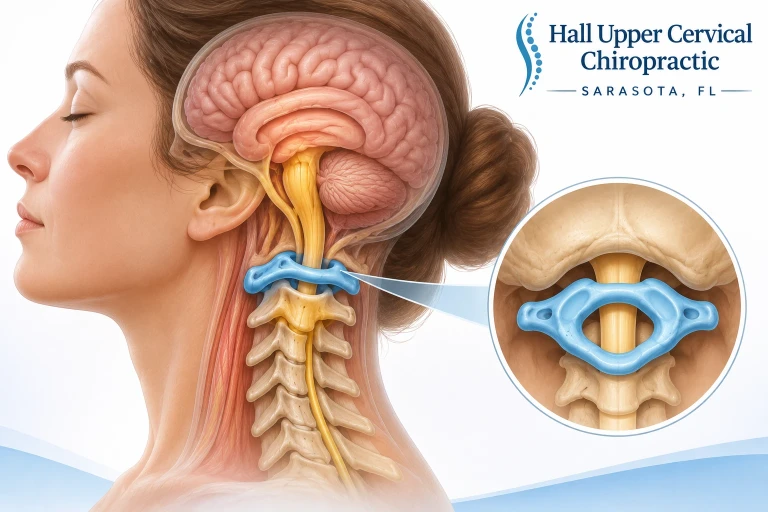
Your head weighs approximately 10–12 pounds. Supporting that weight is a remarkably small, ring-shaped vertebra called the atlas, or C1. Despite its size, the atlas performs several essential functions, including supporting the skull, facilitating head movement, and protecting important neurological structures.
Every time you turn your head, nod, walk, or adjust your posture, the upper cervical spine is involved.
Schedule Your Appointment
Schedule appointmentAt Hall Upper Cervical Chiropractic in Sarasota, Florida, Dr. Drew Hall and Dr. Beth O'Rourke focus on the unique relationship between upper cervical spinal function, biomechanics, and the central nervous system.
Understanding why the atlas matters begins with understanding its extraordinary anatomy.
What Is the Atlas Vertebra?
The atlas is the first cervical vertebra (C1), located directly beneath the skull. Named after the Greek mythological figure Atlas, who carried the heavens, this vertebra supports the weight of your head.
Unlike other spinal vertebrae, the atlas has a distinctive ring-shaped structure without a conventional vertebral body.
Its primary responsibilities include:
- Supporting the weight of the skull.
- Facilitating head movement.
- Contributing to postural stability.
- Protecting the upper spinal cord.
- Providing attachment points for muscles and ligaments.
- Participating in sensory communication related to head positioning.
The atlas works closely with the second cervical vertebra, known as the axis (C2), to provide mobility while maintaining stability.
Together, these two vertebrae form the foundation of the upper cervical spine.
Why Is Atlas Alignment So Important?
Imagine a relatively heavy structure resting on a small, highly mobile foundation. That is essentially the biomechanical relationship between your head and upper cervical spine.
The atlas must accommodate the weight of the head while allowing movement in multiple directions. Surrounding muscles, ligaments, and joints work together to distribute mechanical forces.
When upper cervical movement becomes restricted or surrounding tissues become irritated, other structures may compensate.
These compensatory changes can contribute to muscle tension, reduced neck mobility, altered movement patterns, and discomfort.
In upper cervical chiropractic, the term atlas misalignment describes certain positional or mechanical relationships involving the C1 vertebra and adjacent structures.
However, minor anatomical asymmetries do not automatically indicate dysfunction or neurological impairment. Clinical examination is necessary to determine whether an anatomical finding is relevant to a patient's symptoms.

The Atlas and Brainstem Connection
One of the most significant features of the upper cervical spine is its proximity to the brainstem.
The brainstem connects the brain to the spinal cord and consists of three major structures:
- Midbrain: Participates in movement, visual processing, and auditory responses.
- Pons: Contributes to breathing regulation, facial functions, and sleep.
- Medulla oblongata: Helps regulate essential cardiovascular and respiratory functions.
The brainstem participates in regulating numerous automatic bodily processes, including:
- Breathing and respiratory reflexes.
- Heart rate and blood pressure.
- Balance and coordination.
- Swallowing and protective reflexes.
- Eye movement.
- Sleep and wakefulness.
The lower brainstem transitions into the spinal cord near the opening at the base of the skull, immediately above the atlas.
This anatomical relationship makes the upper cervical region particularly important for protecting neurological structures.
Although significant injuries or structural abnormalities can compromise these tissues, routine atlas misalignment has not been established as a cause of impaired brainstem function.
How the Upper Cervical Spine Communicates With the Nervous System
The upper cervical spine does more than provide structural support. Its muscles and joints contain specialized sensory receptors that continuously provide information to the central nervous system.
This sensory process is known as proprioception.
Proprioception allows your brain to recognize where your head and body are positioned without relying entirely on vision.
Information from the upper cervical region contributes to:
- Head and neck positioning.
- Postural adjustments.
- Coordination of head and eye movements.
- Spatial orientation.
- Balance and movement control.
When cervical muscles become irritated or joint movement becomes restricted, sensory input from the neck may change.
These changes can influence movement patterns and pain processing, which may help explain why some individuals experience headaches, muscle tension, or movement-related discomfort alongside upper cervical dysfunction.
What Can Cause Upper Cervical Dysfunction?
Related article
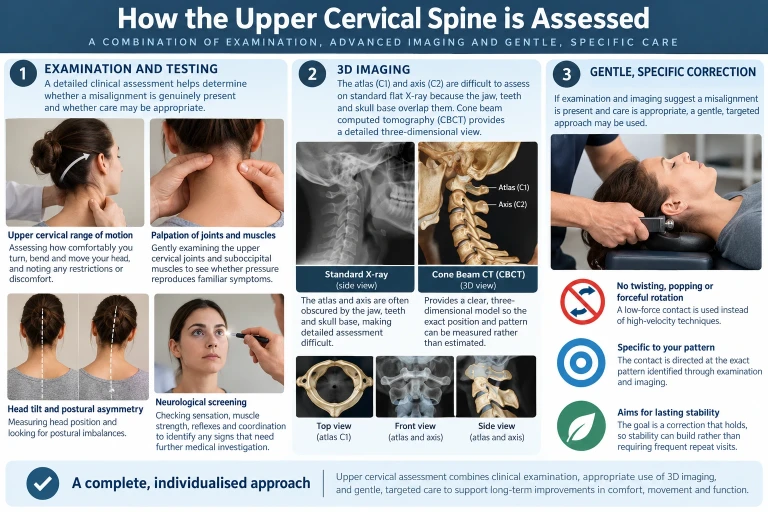
Understanding Upper Cervical Spine Evaluation: From Clinical Examination to Precise, Gentle Care
Oct 21, 2026The upper cervical spine is exposed to mechanical demands throughout everyday life.
Several factors may contribute to cervical joint dysfunction and surrounding muscle irritation, including:
- Automobile accidents and whiplash injuries.
- Sports-related impacts.
- Falls and previous head or neck trauma.
- Prolonged forward head posture.
- Repetitive physical stress.
- Extended computer and smartphone use.
- Age-related spinal changes.
Previous injuries may remain clinically relevant even after the initial discomfort has subsided.
A thorough health history and physical examination can help determine whether an earlier injury or ongoing mechanical stress contributes to current symptoms.
What Are the Symptoms of Upper Cervical Dysfunction?
Upper cervical musculoskeletal dysfunction may be associated with persistent neck stiffness, reduced mobility, headaches originating from the neck, tenderness near the skull base, and shoulder tension.
Some individuals also report dizziness or balance disturbances alongside neck discomfort.
However, these symptoms can arise from numerous medical conditions. Their presence does not necessarily establish an atlas misalignment or brainstem problem.
New or unexplained neurological symptoms require appropriate medical evaluation.
Why Precision Matters in Blair Upper Cervical Chiropractic
The upper cervical spine contains complex joint surfaces, sensitive neurological structures, and important blood vessels. Its anatomy can also vary considerably between individuals.
Blair Upper Cervical Chiropractic emphasizes individualized assessment rather than applying an identical adjustment to every patient.
At Upper Cervical Chiropractic in Sarasota, our approach focuses on understanding each patient's upper cervical anatomy and identifying relevant mechanical dysfunction.
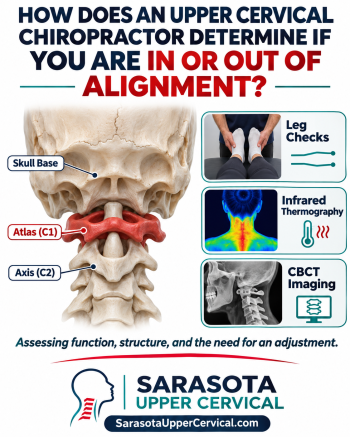
An assessment may include:
- A detailed medical and injury history.
- Upper cervical physical examination.
- Evaluation of cervical mobility.
- Diagnostic imaging when clinically justified.
- Specific, targeted upper cervical adjustments.
- Follow-up evaluations to monitor progress.
The Blair technique avoids conventional forceful neck twisting and is designed to deliver a controlled adjustment based on individual anatomical findings.
The objective is to improve relevant cervical function, address mechanical discomfort, and support comfortable movement.
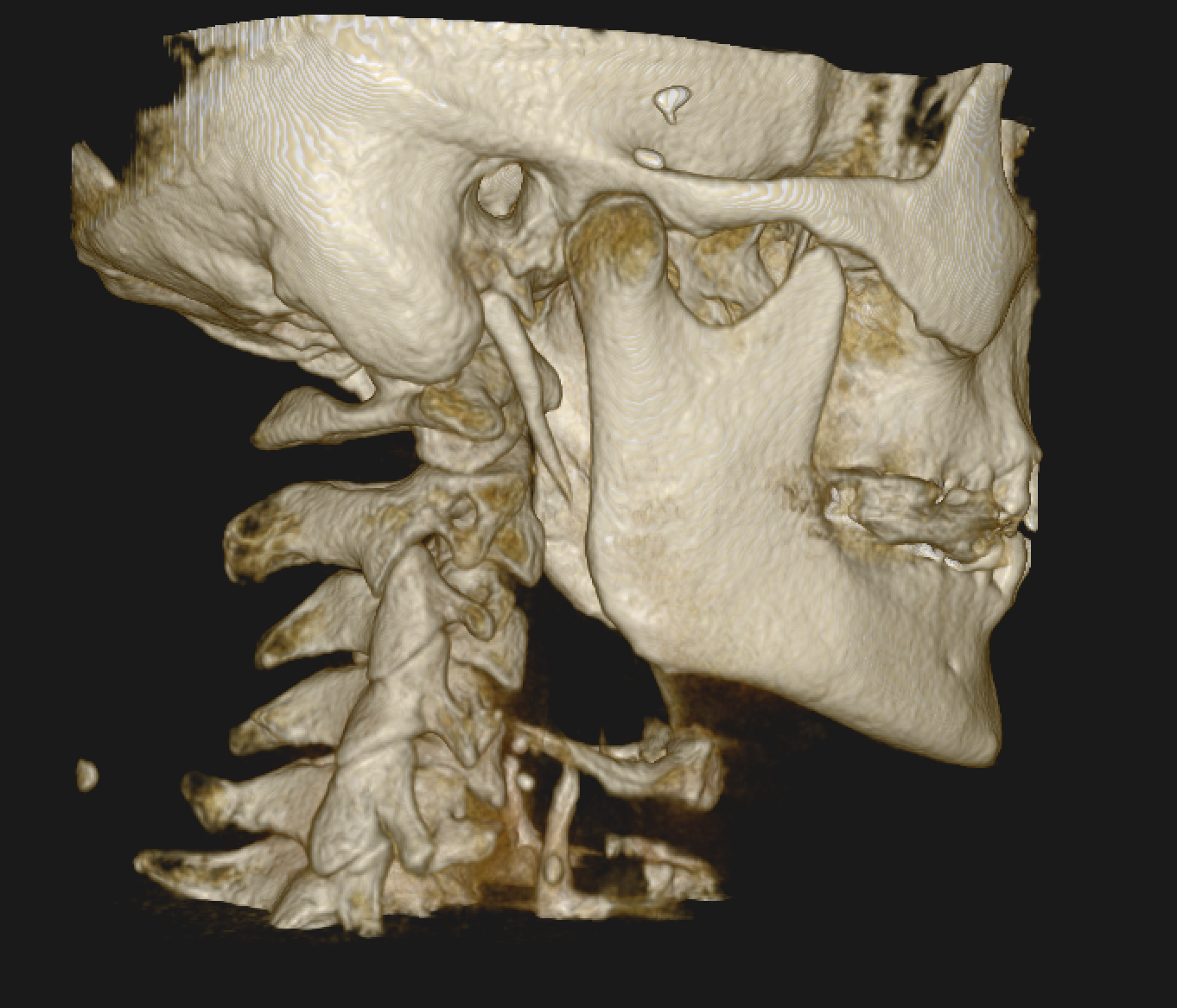
What Does Scientific Research Say?
Research suggests that certain manual therapy approaches may benefit appropriately selected patients with neck-related musculoskeletal conditions.
A 2022 systematic review published in Chiropractic & Manual Therapies found that manual and exercise therapy may improve headache intensity, frequency, and disability in patients with cervicogenic headaches.
A 2026 systematic review involving 29 randomized controlled trials also identified potential short-term benefits of manual therapy for cervicogenic headaches, although long-term effectiveness remains uncertain.
These findings support conservative care for certain cervical conditions. They do not establish that atlas adjustments restore brainstem function or improve the regulation of internal organs.
Frequently Asked Questions About the Atlas
Why is the atlas the most unique vertebra?
The atlas has a ring-shaped structure adapted to support the skull, facilitate movement, and accommodate the upper spinal cord.
Can atlas dysfunction cause headaches?
Upper cervical joints and surrounding tissues can contribute to cervicogenic headaches through shared sensory pathways involving the neck and head.
Does the atlas directly affect the brainstem?
The atlas is anatomically close to the brainstem and surrounds the upper spinal cord. Significant structural abnormalities can affect neurological tissues, but ordinary alignment variations do not necessarily impair brainstem function.
Is upper cervical chiropractic safe?
Blair adjustments are designed to be precise and controlled. Nevertheless, cervical manipulation carries potential risks, including rare serious complications. Appropriate screening and informed consent are essential.
Discover Upper Cervical Chiropractic Care in Sarasota, Florida
The atlas may be a small vertebra, but its role in supporting the head, facilitating movement, and protecting neurological structures makes it an essential part of your spinal anatomy.
If you experience persistent neck discomfort, restricted movement, or neck-related headaches, an upper cervical evaluation may help identify contributing mechanical factors.
At Upper Cervical Chiropractic, Dr. Drew Hall and Dr. Beth O'Rourke provide individualized Blair Upper Cervical Chiropractic care for patients throughout Sarasota and surrounding communities.
Schedule your free new-patient consultation and discover whether upper cervical chiropractic care is appropriate for you.
Hall Upper Cervical Chiropractic
3920 Bee Ridge Road, Building D, Suite 101
Sarasota, FL 34233
Phone: (941) 259-1891
Website: https://sarasotauppercervical.com

Leave a comment