

If you are experiencing numbness, tingling, burning, or weakness in your arm or hand, you may be wondering what is really causing it.
Is it carpal tunnel?
A pinched nerve?
A disc issue?
Thoracic outlet syndrome?
Schedule Your Appointment
Schedule appointmentIf you live in Sarasota, Bradenton, or Lakewood Ranch, and are searching for lasting arm pain relief, it is important to understand something that is often overlooked:
The problem may begin at the very top of your neck.
👉 Call 941-259-1891 to schedule your FREE consultation
Or click here to book online.
Understanding Arm Numbness and Tingling
Numbness and tingling in the arm typically indicate nerve irritation or compression.
Common symptoms include:
• Pins and needles sensation
• Burning pain
• Weak grip strength
• Shoulder tightness
• Pain radiating down the arm
• Hand numbness at night
Most people are told the issue is coming from:
• A herniated cervical disc
• Carpal tunnel syndrome
• A shoulder injury
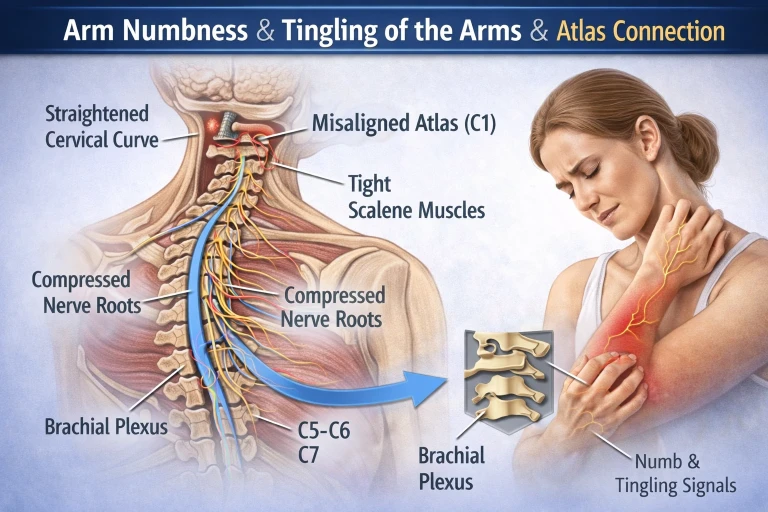
While those conditions can be involved, many cases stem from compression of the brachial plexus.
What Is the Brachial Plexus?
The brachial plexus is a network of nerves that originates from the lower cervical spine (C5–T1).
These nerves travel between the anterior and middle scalene muscles in the neck before moving into the shoulder and arm.
They control:
• Arm strength
• Hand sensation
• Shoulder stability
• Grip function
If these nerves are compressed or irritated anywhere along their path, symptoms may develop.
The Role of the Scalene Muscles
The scalene muscles are located on the side of the neck.
They attach from the cervical vertebrae to the first and second ribs.
Their function includes:
• Stabilizing the neck
• Assisting with breathing
• Supporting posture
The brachial plexus passes directly between these muscles.
When the scalenes become tight or spastic, they can compress the nerve bundle.
This can lead to:
• Numbness
• Tingling
• Weakness
• Radiating pain
But why would the scalenes become chronically tight?
The answer often lies in the upper cervical spine.
Atlas Misalignment and Loss of Cervical Curve
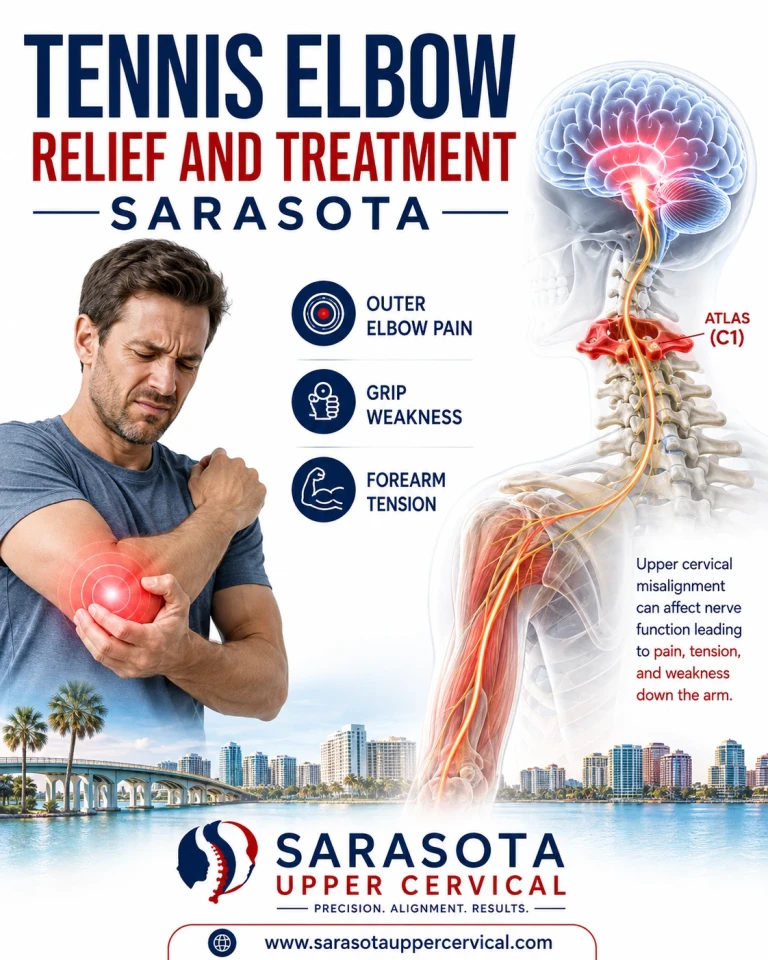
The atlas (C1) is the top bone of the spine and supports the skull.
When the atlas becomes misaligned due to trauma, it can alter the entire alignment of the cervical spine.
Common causes include:
• Car accidents
• Slip and falls
• Sports injuries
• Whiplash
• Poor posture over time
When C1 shifts out of proper alignment, it may lead to:
• Loss of normal cervical lordosis (neck curve)
• Forward head posture
• Uneven muscle tone
• Increased strain on stabilizing muscles
As the cervical curve straightens, the scalenes often become overactive to compensate.
Over time, this chronic contraction narrows the space where the brachial plexus travels.
The nerve becomes irritated.
Symptoms begin.
Muscle Spasm Is a Protective Response
When the atlas joint capsule is injured:
• Inflammation develops
• Motion becomes restricted
• Instability forms
• The nervous system senses imbalance
In response, muscles tighten to protect the unstable joint.
The scalenes are part of this protective system.
But when protection becomes chronic, it turns into compression.
The body is trying to stabilize the neck — but the side effect is nerve entrapment.
Why Treating the Arm Alone Often Fails
Many patients try:
• Wrist braces
• Massage therapy
• Physical therapy
• Steroid injections
• Anti-inflammatory medications

While these may temporarily reduce symptoms, they often do not address the structural misalignment at the top of the spine.
If the cervical curve remains altered and the scalenes remain tight, brachial plexus compression can continue.
True arm pain relief requires restoring structural balance.
The Brainstem and Neurological Influence
The upper cervical spine sits directly beneath the brainstem.
The brainstem regulates:
• Muscle tone
• Sensory processing
• Autonomic balance
• Pain modulation
When atlas misalignment creates mechanical stress near this region, it may increase abnormal muscle firing patterns.
The scalenes may remain in a heightened state of tension due to altered neurological signaling.
Correcting the atlas can reduce this neurological stress.
Precision Upper Cervical Correction
Upper cervical chiropractic focuses specifically on restoring alignment at C1 and C2.
When alignment improves:
• The cervical curve may normalize
• Muscle tone may balance
• Scalene tension may reduce
• Nerve compression may decrease
• Circulation improves
The goal is not repeated manipulation.
The goal is restoring proper joint motion and allowing the body to stabilize naturally.
The Importance of 3D CBCT Imaging
Every person’s anatomy is unique.
No two atlas misalignments are identical.
That is why advanced 3D Cone Beam CT (CBCT) imaging is critical.
CBCT allows us to measure:
• Exact rotational displacement
• Lateral deviation
• Angular misalignment
• Skull-to-atlas relationship
• Structural asymmetry
Without imaging, adjustments are generalized.
With CBCT imaging, the correction is tailored precisely to your misalignment pattern.
Precision reduces risk and improves stability.
Related article

Upper Cervical Chiropractor Sarasota, Bradenton, Venice and Tampa Bay Area
Nov 15, 2021
No Twisting, Popping, or Pulling
Many patients hesitate because they fear aggressive neck manipulation.
Upper cervical care is gentle and specific.
There is:
• No forceful twisting
• No aggressive cracking
• No yanking or pulling
Adjustments are:
• Low-force
• Measured
• Based on imaging data
This is especially important when dealing with nerve-related symptoms.
Objective Testing: When to Adjust
We utilize objective measures to determine if misalignment is present.
These include:
Leg Balance Analysis
Neurological imbalance may show up as asymmetry in leg patterns.
Infrared Thermography
Thermal scanning measures heat differences along the spine, indicating nervous system irritation.
Adjustments are only performed when objective findings indicate misalignment.
This protects healing tissues and promotes stability.
Signs Your Arm Symptoms May Be Neck-Related
You may benefit from evaluation if:
• Symptoms began after trauma
• You have chronic neck stiffness
• Tingling worsens with posture
• You feel tightness along the side of your neck
• Symptoms are worse when raising your arm
• You’ve treated the wrist without lasting relief
Your arm symptoms may not originate in your arm.
They may be coming from the neck.
Arm Numbness & Tingling Treatment in Sarasota, Bradenton, and Lakewood Ranch
If you are tired of chasing symptoms and want to investigate the root cause, upper cervical chiropractic may be the missing link.
We focus on:
• Precision 3D CBCT imaging
• Gentle, specific correction
• Objective neurological testing
• No twisting, cracking, or pulling
• Long-term structural healing
👉 Call 941-259-1891 to schedule your FREE consultation
Or click here to book online.
Your brachial plexus should not be compressed.
Let’s evaluate the alignment at the top of your spine and restore the structural balance your nervous system needs to function properly.

Leave a comment