

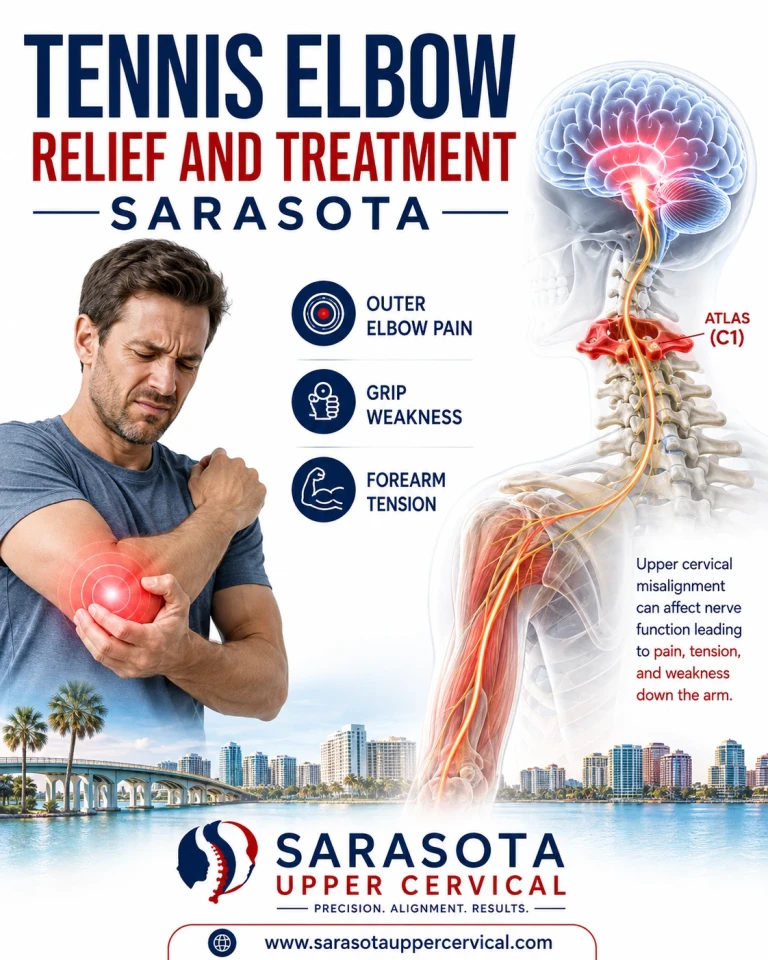
Tennis elbow and golfer's elbow treatment in Sarasota, Bradenton, and Lakewood Ranch is nearly always directed at the elbow, which makes intuitive sense, because that is where it hurts. What is less well known is that of all the upper limb conditions where a cervical contribution has been proposed, lateral elbow pain has the strongest supporting trial evidence — and it comes from physiotherapy research rather than from chiropractic. This article covers what those trials found, what they did not find, and where the honest limits of the claim sit.
What these conditions are
Schedule Your Appointment
Schedule appointment
Tennis elbow, more accurately called lateral epicondylalgia or lateral epicondylitis, involves pain at the outer aspect of the elbow where the common extensor tendon attaches to the lateral epicondyle of the humerus. It is the leading cause of lateral elbow pain in adults, with an estimated incidence of one to three per cent, most commonly presenting between the ages of forty and fifty and usually affecting the dominant arm. The great majority of cases have nothing to do with tennis.
Golfer's elbow, or medial epicondylalgia, is the equivalent problem on the inner aspect of the elbow, involving the common flexor-pronator origin. It is considerably less common and considerably less studied, and most of what is known about its management is extrapolated from the lateral version.
An important correction to the older understanding: despite the "-itis" suffix, histological studies of affected tendon tissue show relatively little inflammation. What they show is disorganised collagen, immature repair tissue, and abnormal blood vessel and nerve ingrowth — a failed healing response rather than an inflammatory one. This is why anti-inflammatory approaches often disappoint and why loading-based rehabilitation has become the mainstay.
The cervical evidence — what was actually tested
Bill Vicenzino and colleagues at the University of Queensland produced the foundational work here, and it deserves to be described precisely.
In a paper published in Pain in 1996, Vicenzino, Collins, and Wright used a randomised, double-blind, placebo-controlled, repeated-measures design in fifteen patients with lateral epicondylalgia. They applied a cervical spine treatment technique — a contralateral lateral glide at the C5-6 motion segment — and compared it against a placebo condition, in which the therapist's hands were placed on the neck without treatment, and a control condition with no contact. Pressure pain threshold, pain-free grip strength, upper limb neurodynamics, pain, and function were measured before and after.
The treatment condition produced significantly greater improvement than either placebo or control in pain-free grip strength and in pressure pain threshold at the lateral epicondyle. That is a genuine result: treating the neck measurably changed pain at the elbow, against a credible placebo, in a blinded design.
A follow-up study by Vicenzino, Collins, Benson, and Wright in the Journal of Manipulative and Physiological Therapeutics in 1998 examined twenty-four subjects with chronic lateral epicondylalgia and explored the relationship between the hypoalgesic effect and sympathetic nervous system activation, finding that the cervical technique produced both simultaneously. The technique also increased the flexibility of the upper limb neural tissues compared with placebo and control conditions.
This work has held up in systematic review. Basson and colleagues, in a 2017 systematic review and meta-analysis in the Journal of Orthopaedic & Sports Physical Therapy, examined neural mobilisation across neuromusculoskeletal conditions and identified three studies of lateral epicondylalgia. Of these, the one judged to have a low risk of bias was the cervical lateral glide study, which showed significant improvements in pressure pain threshold, pain-free grip strength, neurodynamic test range of motion, and pain scores against placebo and control. The reviewers concluded that cervical lateral glides can be considered in the treatment of tennis elbow. The other two studies carried a high risk of bias.
Related article
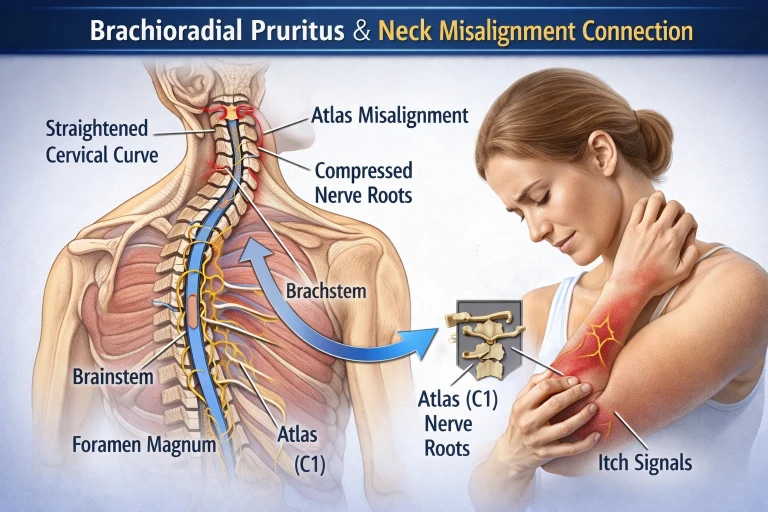
Brachioradial Pruritus Relief in Sarasota and Bradenton | Why Is My Arm Itching?
Mar 04, 2026Related work by Fernández-Carnero and colleagues in the same journal in 2008 examined the immediate hypoalgesic and motor effects of a single cervical spine manipulation in lateral epicondylalgia, and Zunke, Auffarth, Hitzl, and Moursy published a randomised placebo-controlled patient-blinded trial in BMC Musculoskeletal Disorders in 2020 examining thoracic spine manual therapy in lateral epicondylalgia with measures of pain-free grip, skin conductance, and peripheral skin temperature.
The limits of that evidence, stated plainly
I think this evidence is real, and I also think it is routinely oversold. Four qualifications matter.
The trials are small. Fifteen patients in the 1996 study, twenty-four in 1998, ten in the single-manipulation study, thirty in the thoracic trial. These are mechanistic studies, not definitive effectiveness trials, and small samples produce unstable estimates.
The outcomes are largely immediate. Most of these designs measured what happened within minutes of a single intervention. Demonstrating that a cervical technique produces immediate hypoalgesia is not the same as demonstrating that a course of care resolves a tendinopathy over months. Bisset and Vicenzino, reviewing the whole physiotherapy literature for lateral epicondylalgia in 2015, found only a small number of studies of spinal manual therapy of sound methodological quality, and where combined local and spinal treatment showed a benefit in pain-free grip strength, there was no corresponding difference in pain or function outcomes.
The intervention studied was a cervical lateral glide mobilisation applied at C5-6 by physiotherapists. It was not an upper cervical chiropractic correction of the atlas or axis. I am not aware of any trial of upper cervical chiropractic for lateral epicondylalgia, and I am not going to present physiotherapy trials of a different technique at a different spinal level as though they were evidence for mine.
And the cervical spine is not the primary pathology. The tendon is. Vicenzino's own group has been consistent that exercise-based loading is central to management, with isometric loading appropriate for irritable presentations and progressive concentric and eccentric loading as symptoms allow. Manual therapy in this literature is an adjunct that improves the window in which loading can be performed, not a replacement for it.
Why the neck would affect the elbow at all
Two mechanisms are proposed, and they are worth distinguishing by how well supported each is.
The first is neural mechanosensitivity, and it is the better established. The radial nerve, which supplies the extensor muscles, arises from the C5 through T1 nerve roots and travels through the region of the lateral elbow. Where a nerve becomes mechanically sensitised anywhere along its course, movements that tension it produce pain. The upper limb neurodynamic test findings in the Vicenzino studies — the cervical technique improved neural tissue flexibility — support this reading directly. A cervical segmental restriction can plausibly contribute to neural mechanosensitivity that presents as lateral elbow pain, and a proportion of patients labelled with tennis elbow may have a neurogenic component that local tendon treatment does not address.
The second is descending pain modulation. The hypoalgesia produced by these cervical techniques was accompanied by sympathetic nervous system excitation, a pattern Vicenzino and colleagues interpreted as activation of a descending inhibitory pathway from the periaqueductal grey in the brainstem. Under this reading, the technique is not correcting a mechanical fault at the elbow at all; it is engaging a central pain-modulating system. I find this interpretation plausible and I want to flag it as an interpretation of a physiological correlation rather than an established causal chain.
Related article

Brachioradial Pruritus: Why Sun Exposure Triggers Itchy Arms | Sarasota Upper Cervical
Jul 27, 2026As for the upper cervical spine specifically, the honest position is that the trials used C5-6, not C1-2. What can be reasoned is that head position over the cervical column influences the mechanics of the segments below it, and that suboccipital proprioceptive input contributes to global postural tone in ways that affect the whole upper quadrant. That is a reasoned hypothesis extending established anatomy, not a tested treatment mechanism, and I would rather label it as such than dress it up.
Who should have their neck examined
Rather than claiming every case of elbow pain is a neck problem, it is more useful to identify who is likely to have a cervical or neural component.
Symptoms extending beyond the point of the epicondyle, particularly down the forearm, are suggestive. So is any numbness or tingling, which a pure tendinopathy does not produce. Pain that changes with neck position, or accompanying neck or upper back symptoms, is relevant. So is elbow pain that began after a whiplash injury or another neck trauma. Bilateral symptoms without a bilateral loading history warrant a look higher up. And an adequate course of well-delivered loading rehabilitation that has not produced the expected improvement is a reason to reconsider the diagnosis rather than to repeat the treatment.
Conversely, a clear history of overload, well-localised tenderness precisely over the epicondyle, pain reproduced by resisted wrist extension, and no neurological features describes a straightforward tendinopathy, and that person's time is better spent on a loading programme than in my office.
How upper cervical correction is performed
Upper cervical correction involves no twisting, popping, cracking, or pulling of the neck. The contact is low-force and image-guided. Cone beam computed tomography is used to determine the three-dimensional position of the atlas and axis, and objective measures including leg length assessment and cervical range of motion are used to determine whether a correction is indicated and whether it is holding. Imaging measures cervical alignment; the diagnosis of lateral or medial epicondylalgia is clinical.
Red flags
Most elbow pain is benign, but some presentations need medical assessment rather than manual care.
Elbow pain following acute trauma requires imaging to exclude fracture or dislocation. A visible deformity, an inability to straighten or bend the elbow, or a sudden pop with immediate loss of function suggests a tendon rupture or a joint injury.
A hot, swollen, red elbow, particularly with fever, may indicate septic arthritis or infected bursitis and requires urgent medical evaluation. Progressive weakness of grip or of finger extension, as opposed to weakness limited by pain, may indicate a nerve lesion — posterior interosseous nerve involvement can mimic tennis elbow and is a recognised and frequently delayed diagnosis. Numbness in a defined nerve territory indicates a neurological rather than tendinous problem. Night pain unrelated to position, or elbow pain in someone with a history of cancer or with unexplained weight loss, warrants investigation.
Medial elbow pain in a throwing athlete, particularly an adolescent, requires specific assessment for ulnar collateral ligament injury and for growth plate involvement, neither of which should be managed as a simple tendinopathy.
Questions and answers
Is there real evidence that treating the neck helps tennis elbow?
Yes, more than for most upper limb conditions. A randomised, double-blind, placebo-controlled study by Vicenzino and colleagues published in Pain in 1996 found that a cervical lateral glide technique produced significantly greater improvement in pain-free grip strength and pressure pain threshold than either placebo or control, and a 2017 systematic review identified that study as the low-risk-of-bias evidence supporting cervical lateral glides for tennis elbow. The important qualifications are that the studies are small, the outcomes were largely immediate rather than long-term, and the technique tested was a physiotherapy mobilisation at C5-6, not an upper cervical chiropractic correction.
Why did my cortisone injection help and then stop helping?
This is a well-documented pattern. Corticosteroid injection produces good short-term relief at six weeks or so but is associated with significantly higher recurrence rates and offers no advantage at twelve months compared with other approaches. Given that the underlying tissue change is degenerative rather than inflammatory, that pattern is not surprising.
What about golfer's elbow?
Medial epicondylalgia is substantially less studied than the lateral version, and the cervical evidence described here is specific to lateral epicondylalgia. The reasoning that applies to it — a shared neural pathway, the possibility of neural mechanosensitivity contributing — is anatomically plausible for the medial side, involving the median and ulnar nerves rather than the radial, but it has not been tested in the same way. I would describe any cervical treatment claim for golfer's elbow as extrapolation.
What should I be doing regardless?
A progressive loading programme for the wrist extensors is the intervention with the strongest support, with the type and dose matched to how irritable the symptoms are — gentle pain-free isometric holds for reactive or irritable presentations, progressing to concentric and eccentric loading as tolerated. Modifying the aggravating load matters too, whether that is a grip size, a work task, or a technique fault.
Getting evaluated in Sarasota
If your elbow pain has not responded to an adequate loading programme, or if your symptoms extend beyond the epicondyle, or if there is any numbness or tingling, or if the pain began after a neck injury, an examination that includes the cervical spine and the neural pathway to the elbow may identify a contributor that local treatment has not addressed. This works alongside appropriate medical and rehabilitation care rather than instead of it. To arrange a consultation call 941 259-1891.
Dr. Drew Hall, Upper Cervical Chiropractor
Serving Sarasota, Bradenton, and Lakewood Ranch, Florida
This article is for general educational purposes only and is not medical advice, a diagnosis, or a treatment recommendation for any individual. Lateral and medial epicondylalgia should be evaluated by a qualified healthcare provider, and other causes of elbow pain excluded. Upper cervical chiropractic is an area of focus within chiropractic; it is not a board-recognized specialty, and no claim of specialization or superiority is made or implied. The cervical trials described here tested physiotherapy mobilisation techniques applied at the mid-cervical spine, not upper cervical chiropractic correction, and no trial evidence exists for upper cervical chiropractic in this condition; the distinction is stated deliberately. Cone beam computed tomography is used as a precision measurement and analysis tool, not as a stand-alone diagnostic device. Progressive loading exercise remains the primary evidence-supported management for lateral epicondylalgia. Individual results vary and no specific outcome is guaranteed. Seek prompt medical attention for elbow pain following trauma, a hot or swollen joint with fever, visible deformity, progressive weakness or numbness, or elbow pain with unexplained weight loss or a history of cancer. Always consult a qualified healthcare provider regarding diagnosis and treatment.


Leave a comment