

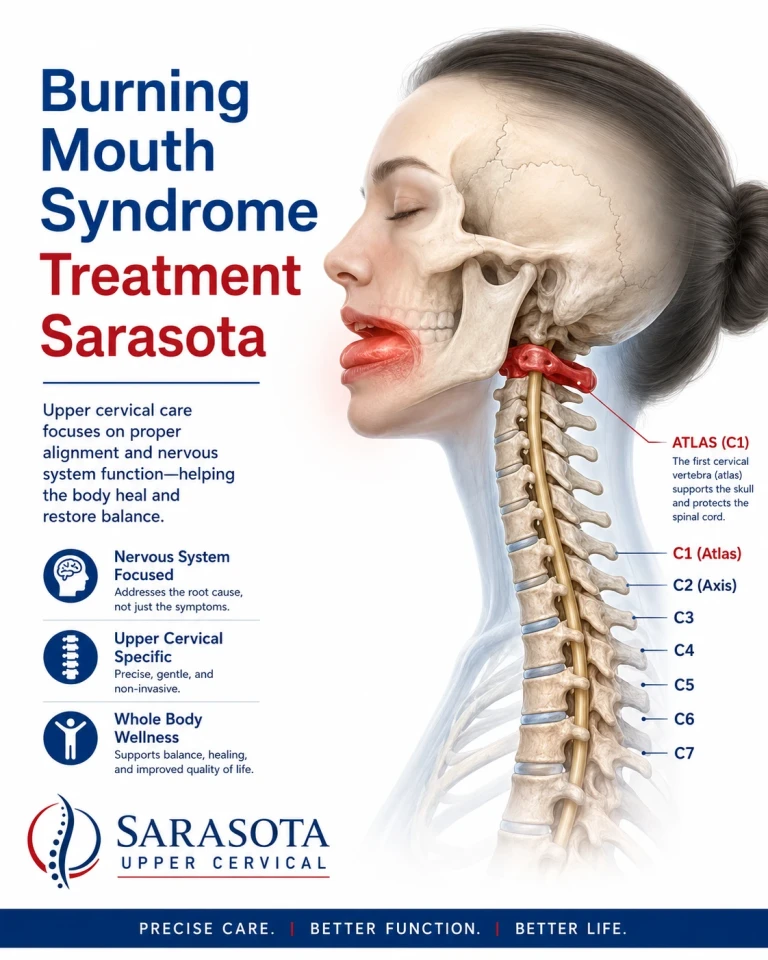
Burning mouth syndrome treatment in Sarasota, Bradenton, and Lakewood Ranch is complicated by a frustrating fact: the mouth usually looks completely normal. Patients describe a scalding, burning, or tingling sensation on the tongue, lips, or palate, often with altered taste or a persistent dry sensation despite normal saliva. Dentists find nothing. Blood work comes back clean. The implication that it must be psychological arrives sooner or later, and it is wrong.
Burning mouth syndrome is a neuropathic pain disorder. The tissue is fine; the nerves reporting on it are not.
Schedule Your Appointment
Schedule appointmentPrimary and secondary — the distinction that matters most
Secondary burning mouth symptoms have an identifiable cause, and finding it is the whole job. The list is long enough that it should be worked through systematically: deficiencies of iron, vitamin B12, folate, or zinc; diabetes and prediabetes; thyroid disease; oral candidiasis, which can be present without obvious white plaques; reduced salivary flow, including from Sjögren's syndrome; contact allergy to dental materials or flavourings; acid reflux reaching the mouth; and medications, particularly ACE inhibitors and some antiretrovirals.
Primary burning mouth syndrome is the diagnosis that remains after those are excluded. It affects postmenopausal women disproportionately, which has driven considerable speculation about hormonal contribution, and it is genuinely idiopathic in the sense that no local cause is found.
If your work-up has not included iron studies with ferritin, B12, folate, glucose or HbA1c, thyroid function, and an assessment for candidiasis and dry mouth, that is where to start. Nothing in this article substitutes for that.
The evidence that this is neuropathic
Research groups working on burning mouth syndrome have consistently found objective neurological abnormalities in patients whose mouths appear normal.
Related article
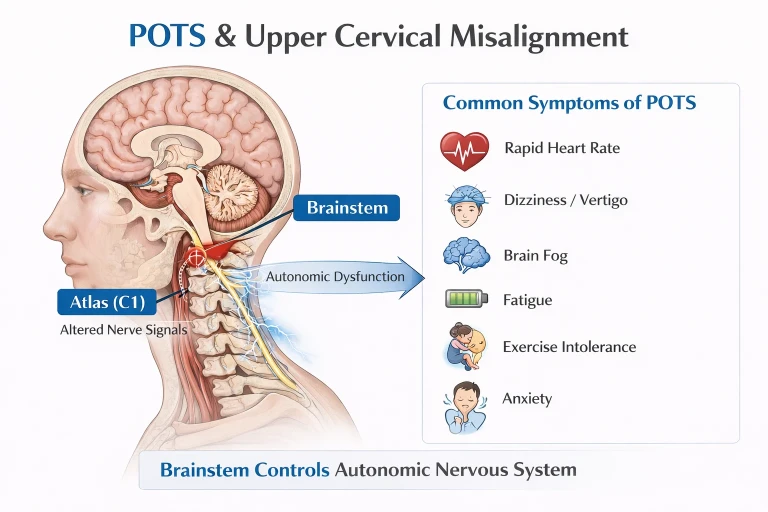
My heart races when I stand up |Postural Orthostatic Tachycardia Syndrome Specialist in Sarasota
Mar 20, 2026Neurophysiological testing, including blink reflex studies, has demonstrated trigeminal system abnormalities in a substantial proportion of patients. Tongue biopsy studies have shown reduced density of epithelial nerve fibres consistent with a small fibre neuropathy of the oral mucosa. Quantitative sensory testing frequently reveals altered thermal and pain thresholds in the affected area.
A separate and elegant line of work concerns the relationship between taste and pain. The chorda tympani branch of the facial nerve carries taste from the front of the tongue, and it normally exerts an inhibitory influence on trigeminal sensory input from the same region. When taste input is damaged, that inhibition is released, and trigeminal sensation from the tongue becomes disproportionately loud. This offers a mechanistic account of why so many people with burning mouth syndrome also report distorted taste or a persistent metallic or bitter flavour — the taste change is not a coincidental symptom, it may be part of the cause.
Where the upper cervical spine enters
The bridge here is anatomical and specific, and it is the same structure that connects the neck to facial pain generally.
Sensation from the tongue and oral mucosa travels in the trigeminal nerve, principally through the lingual branch of the mandibular division. Trigeminal sensory fibres do not terminate in the pons alone. They descend as the spinal trigeminal tract to the trigeminal nucleus caudalis, and that nucleus extends downward into the upper cervical spinal cord, typically to the level of C2 and sometimes C3. There, trigeminal afferents share second-order neurons with afferents arriving from the upper cervical nerve roots. This region is the trigeminocervical complex.
The consequence is convergence. A second-order neuron in the trigeminocervical complex can receive input from both the face and the upper neck, which is why neck problems can be felt as facial or head pain, and why upper cervical input can influence the excitability of neurons processing sensation from the mouth.
Stated at its honest strength, the proposition is this: nociceptive input from the upper cervical spine converges on the same neuronal pool that processes oral trigeminal sensation, and sustained input to that pool can raise its excitability. In a condition already characterised by a hyperexcitable trigeminal system, reducing an additional source of input into the same circuit is a coherent aim.
What I am not going to claim is that atlas misalignment causes burning mouth syndrome, or that correcting it resolves the condition. There is no clinical trial of upper cervical chiropractic in burning mouth syndrome. The trigeminocervical convergence is established neuroanatomy; its clinical relevance to this particular disorder is a reasoned extension, not a demonstrated one.
Where a cervical evaluation is most reasonable
Rather than suggesting everyone with a burning tongue needs their neck examined, it is more useful to identify who plausibly might.
Symptoms that began after a head or neck injury are the clearest case. So is burning mouth occurring alongside other trigeminal territory symptoms — facial pain, jaw pain, ear pain, or headache — which suggests a system-level problem rather than a purely local one. Coexisting upper neck pain, suboccipital tightness, or restricted cervical rotation is relevant. So is a history of jaw or dental work that involved prolonged mouth opening, which loads both the temporomandibular joint and the upper cervical spine.
Conversely, if secondary causes have not been excluded, or if the burning is confined to an area of visible tissue change, the neck is not the place to look.
What medical management involves
Because this is neuropathic pain, the medical approaches used are those used for neuropathic pain generally. Topical clonazepam, applied and held in the mouth, has reasonable supporting evidence. Alpha-lipoic acid has been studied with mixed results. Low-dose tricyclics, gabapentinoids, and cognitive behavioural approaches all appear in the treatment literature. Saliva substitutes help where dryness is a component.
Several things reliably make it worse and are worth eliminating: alcohol-containing mouthwashes, strongly flavoured or mint toothpastes containing sodium lauryl sulphate, acidic foods and drinks, and tobacco. Many patients find symptoms are lowest in the morning and build through the day, and that eating or drinking temporarily relieves rather than aggravates the burning — a pattern that is itself diagnostically useful, since it is the opposite of what a mucosal lesion produces.
How upper cervical correction is performed
Upper cervical correction involves no twisting, no popping, no cracking, and no pulling of the neck. Cone beam computed tomography measures the three-dimensional position of the atlas and axis against your own anatomy so that any correction is calculated rather than estimated. Objective measures — leg length assessment, cervical range of motion, postural and balance measurement, and thermographic pattern tracking — determine whether a correction is indicated and whether it is holding. When the measures show it is holding, no adjustment is given. Cone beam imaging measures cervical alignment; it does not diagnose burning mouth syndrome, which is a clinical diagnosis of exclusion.
Red flags
A visible ulcer, white or red patch, lump, or area of tissue change that does not heal within two weeks requires dental or medical evaluation for oral pathology, including malignancy. Burning accompanied by numbness of the lip or chin is a specific warning sign that requires imaging. Progressive difficulty swallowing, unexplained weight loss, a neck lump, or hoarseness lasting more than a few weeks need medical work-up. New facial weakness, double vision, or numbness in a defined trigeminal division requires neurological assessment rather than management as burning mouth syndrome.
An evaluation in Sarasota
If secondary causes have been excluded, your mouth looks normal, and the burning persists — particularly if it started after a neck injury or comes with other facial or head pain — an upper cervical evaluation can determine whether cervical input is contributing to a trigeminal system that is already sensitised. This works alongside your dentist, physician, and any neurological care rather than in place of it. To arrange a consultation call 941 259-1891.
Dr. Drew Hall, Upper Cervical Chiropractor
Serving Sarasota, Bradenton, and Lakewood Ranch, Florida
This article is for general educational purposes only and is not medical advice, a diagnosis, or a treatment recommendation for any individual. Burning mouth syndrome is a diagnosis of exclusion and requires evaluation by a qualified dental or medical provider, including screening for nutritional deficiencies, diabetes, thyroid disease, candidiasis, dry mouth, allergy, and medication effects. Upper cervical chiropractic is an area of focus within chiropractic; it is not a board-recognized specialty, and no claim of specialization or superiority is made or implied. No clinical trial evidence exists for upper cervical chiropractic care in burning mouth syndrome, and none is claimed here; the trigeminocervical convergence described is established neuroanatomy presented as a reasoned rationale, not a demonstrated treatment mechanism. Cone beam computed tomography is used as a precision measurement and analysis tool, not as a stand-alone diagnostic device. Individual results vary and no specific outcome is guaranteed. Seek prompt evaluation for any oral ulcer, patch, or lump that does not heal within two weeks, or for numbness of the lip or chin. Always consult a qualified healthcare provider regarding diagnosis and treatment.

Leave a comment