

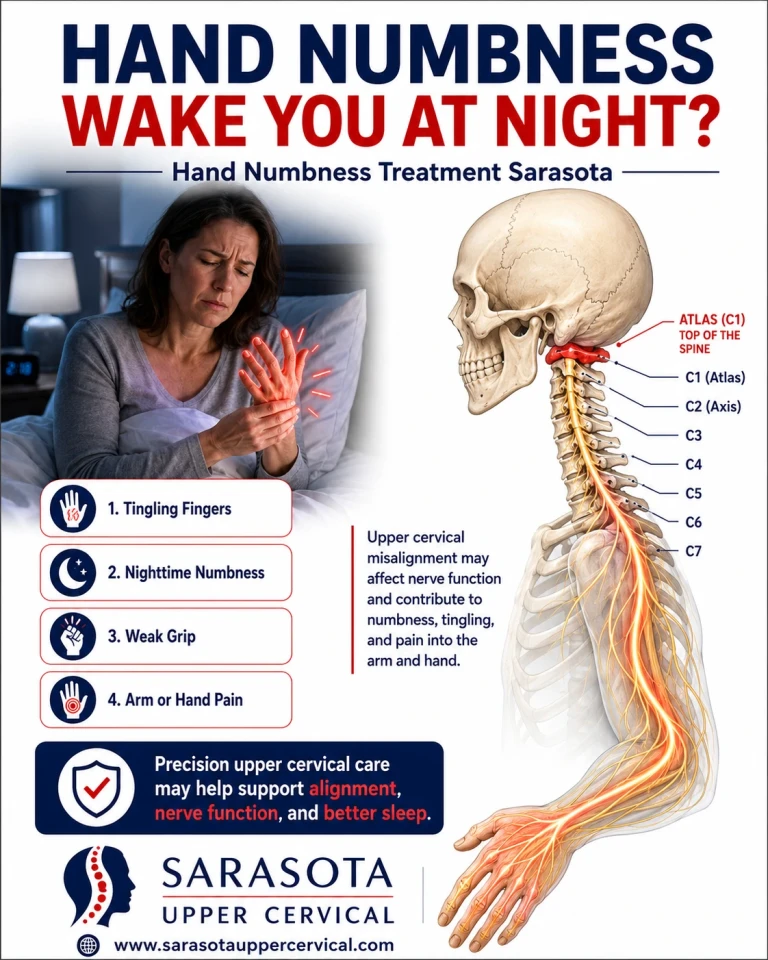
Hand numbness that wakes you at night is one of the most common symptoms I see in Sarasota, Bradenton, and Lakewood Ranch, and it is also one of the most diagnostically useful, because the fact that it happens at night narrows the possibilities considerably. A hand that goes numb while you sleep and forces you awake to shake it out is telling you something specific about mechanism. This article explains what the night-time pattern means, how to work out which nerve is involved from the distribution of the numbness, and when the cause is not in the arm at all.
Why night is different
Schedule Your Appointment
Schedule appointment
There are three reasons symptoms concentrate during sleep, and they compound each other.
The first is joint position. Most people do not sleep in neutral. The wrist curls into flexion or extension, and the elbow bends. Both of those positions reduce the space available to a nerve. Pressure inside the carpal tunnel rises substantially with the wrist held in either full flexion or full extension, and the cubital tunnel at the elbow physically narrows as the elbow flexes while the ulnar nerve is stretched across the joint at the same time. During the day you shift position constantly without noticing. Asleep, you hold a position for hours.
The second is fluid distribution. When you lie flat, fluid that has pooled in the limbs during the day redistributes. In an enclosed compartment like the carpal tunnel, that modest increase in volume translates into a measurable increase in pressure, because there is nowhere for it to go.
The third is the loss of the muscle pump. Moving muscles assist venous and lymphatic return. Lying still for hours removes that assistance, allowing venous congestion within the nerve itself. Nerves are metabolically demanding tissue with a rich but easily compromised blood supply, and impaired venous drainage produces exactly the tingling and numbness that wakes people.
The characteristic response — hanging the hand over the edge of the bed and shaking it until sensation returns — is common enough to have a clinical name. It is called the flick sign, and it is one of the more useful pieces of history in this whole area.
Reading the pattern: which fingers
The distribution of numbness is the single most informative thing you can observe, and it is worth paying deliberate attention to it rather than describing the whole hand as numb.
Numbness involving the thumb, index finger, middle finger, and the thumb side of the ring finger points to the median nerve and therefore to carpal tunnel syndrome as the leading candidate. A useful additional detail: the median nerve gives off a palmar cutaneous branch above the wrist, so in true carpal tunnel syndrome the base of the palm often retains normal sensation while the fingers do not.
Numbness involving the little finger and the little-finger side of the ring finger points to the ulnar nerve, most often compressed at the elbow in the cubital tunnel. If the back of the hand on the little finger side is also numb, the problem is at or above the elbow rather than at the wrist, because the branch supplying that skin leaves the main nerve above the wrist.
Related article

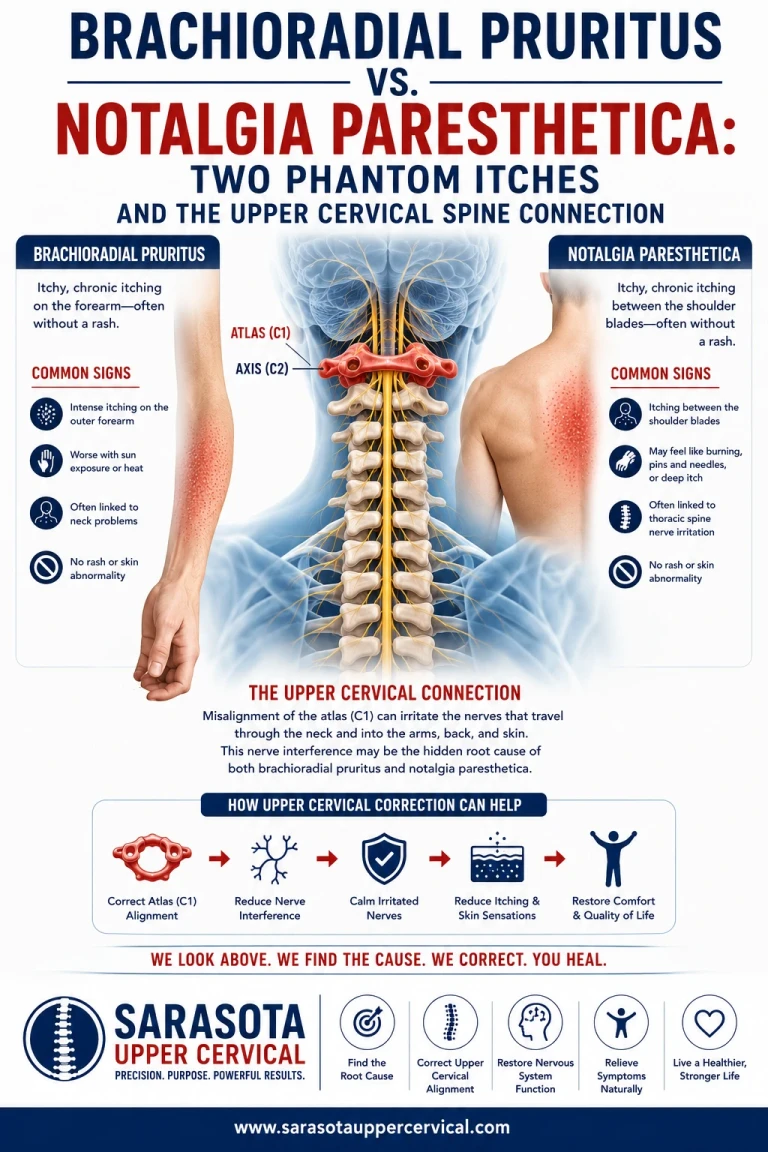
Brachioradial Pruritus: Why Sun Exposure Triggers Itchy Arms | Sarasota Upper Cervical
Jul 27, 2026Numbness of the whole hand, or numbness that does not respect either of those territories, is a different signal. It may indicate involvement higher up — the brachial plexus, the thoracic outlet, or a cervical nerve root — or it may indicate a systemic peripheral neuropathy, particularly if the feet are involved too.
Numbness over the inner forearm is worth singling out, because it is frequently misread. That skin is supplied by the medial antebrachial cutaneous nerve, which branches from the medial cord of the brachial plexus and is not part of the ulnar nerve. If the inner forearm is numb, the problem is not at the elbow or the wrist. It is higher, and the work-up needs to change accordingly.
When the neck is involved
Cervical radiculopathy can produce night symptoms, and there are features that raise its likelihood.
Symptoms that follow a stripe down the arm rather than settling in a defined hand territory suggest a nerve root. Symptoms that change when you move your neck — better with the arm raised over the head, worse with the neck extended or side-bent toward the symptomatic side — point strongly toward the cervical spine. Accompanying neck pain, particularly if it preceded the hand symptoms, is relevant. Weakness in a specific muscle group rather than general clumsiness is a root-level finding. So is symptom onset after a whiplash injury or another neck trauma.
Sleeping position matters here too. A pillow that leaves the head laterally flexed for hours can narrow the intervertebral foramen on one side, and a pillow that pushes the head into sustained forward flexion loads the lower cervical segments. People who wake with neck pain as well as hand numbness are giving a useful piece of history.
I want to be careful about how far to take this. The nerve roots that supply the hand are C6 through T1, in the lower cervical spine. The atlas and axis, which are the specific focus of upper cervical work, are well above that and do not directly compress those roots. What can be argued — and I would label this a reasoned hypothesis rather than a demonstrated mechanism — is that the position of the head over the cervical column influences the mechanics of the segments beneath it, including scalene tension and first rib position, which is the territory the brachial plexus traverses. The value an upper cervical evaluation adds in night-time hand numbness is chiefly in identifying whether a cervical or postural contribution exists that has been missed, and in addressing it where it does. It is not a substitute for identifying a compression at the wrist or elbow when that is what is actually happening.
Causes that are not mechanical at all
A meaningful proportion of night-time hand numbness is not a compression problem, and treating it as one wastes time.
Diabetes and prediabetes produce peripheral neuropathy, and also independently raise the risk of carpal tunnel syndrome. Hypothyroidism is associated with both fluid retention and carpal tunnel syndrome. Vitamin B12 deficiency produces a symmetrical neuropathy and can be worsened by long-term metformin or proton pump inhibitor use. Pregnancy commonly produces carpal tunnel symptoms through fluid retention, and these usually resolve after delivery. Rheumatoid arthritis, amyloidosis, and chronic kidney disease all appear in this differential. Alcohol use and certain chemotherapy agents cause neuropathy directly.
The clue that usually distinguishes a systemic cause is symmetry and distribution: numbness in both hands and both feet, in a stocking-and-glove pattern, is a systemic neuropathy until proven otherwise, not a trapped nerve. Anyone with that pattern needs blood work rather than an adjustment.

Red flags requiring medical evaluation
Some presentations should not be managed conservatively.
Sudden onset of numbness or weakness, particularly on one side of the body, or accompanied by facial droop, slurred speech, or visual change, requires emergency evaluation. Numbness accompanied by loss of bladder or bowel control, or by unsteadiness of gait, or by symptoms in both arms and both legs, suggests spinal cord involvement and needs urgent assessment.
Visible muscle wasting in the hand — flattening at the base of the thumb, hollowing between the thumb and index finger, or loss of bulk on the little finger side of the palm — indicates motor axon loss and needs prompt surgical opinion, because that tissue does not recover well once lost.
Numbness that has become constant rather than intermittent represents progression. Fever, unexplained weight loss, or a history of cancer alongside new neurological symptoms requires medical work-up. Numbness following significant trauma needs imaging. A droopy eyelid or altered pupil on the same side as arm symptoms requires immediate medical attention.
What to try first
Before any of this becomes complicated, two low-risk measures address the mechanism directly.
A neutral wrist splint worn at night prevents the sustained wrist flexion and extension that raise carpal tunnel pressure during sleep. It is inexpensive, carries essentially no risk, and is supported by better evidence than most conservative measures for carpal tunnel syndrome. It is a reasonable first step whatever else you do.
Limiting elbow flexion during sleep addresses the ulnar nerve equivalent. A soft elbow splint, or simply a bath towel wrapped around the elbow and loosely secured, prevents the deep flexion that narrows the cubital tunnel. If your little finger is the numb one, this is the first thing to try.
If either of these substantially changes your symptoms within a few weeks, that is diagnostically informative in itself.
Questions and answers
Related article
Why does my hand only go numb at night?
Three mechanisms overlap during sleep. Joints are held in sustained non-neutral positions that reduce the space available to nerves. Fluid redistributes when you lie flat, raising pressure inside enclosed compartments like the carpal tunnel. And the loss of muscle movement removes the pump that assists venous drainage, allowing congestion within the nerve. None of these operates during the day, when you shift position constantly.
Does shaking my hand out mean it is carpal tunnel syndrome?
The flick sign — shaking the hand to restore sensation — is a recognised and reasonably useful feature of carpal tunnel syndrome, but it is not diagnostic on its own. It reflects restoration of blood flow to a congested nerve, which can occur with compression at more than one site. The distribution of the numbness is more informative than the response to shaking.
Could this be coming from my neck?
It can be. The features that raise that possibility are symptoms extending in a stripe down the arm rather than confined to a hand territory, symptoms that change with neck position, accompanying neck pain, weakness in a specific muscle group, or onset after a neck injury. Numbness over the inner forearm effectively rules out a wrist or elbow origin and points higher.
Should I get nerve conduction testing?
Nerve conduction studies and electromyography are the standard for confirming and grading compression neuropathies, and they are particularly valuable when the diagnosis is uncertain, when symptoms are severe, or when surgery is being considered. They are less necessary in a mild, classic, recent-onset presentation that responds to simple measures. That decision belongs with the physician managing your case.
Is it dangerous to ignore?
Mild intermittent symptoms are not an emergency. Progression to constant numbness, weakness, or visible muscle wasting is a different matter, because motor axon loss in the small muscles of the hand is often not fully reversible. The presence of any red flag listed above, and particularly sudden onset or symptoms affecting more than one limb, warrants prompt evaluation rather than watchful waiting.
Getting evaluated in Sarasota
If your hand wakes you at night and simple positioning measures have not helped, or if the pattern of your numbness does not fit a single nerve, an examination of the whole course of the nerve — from the cervical spine through the thoracic outlet to the wrist — can clarify where the problem actually sits. This is intended to complement medical evaluation and any nerve conduction testing rather than replace it. To arrange a consultation, call 941 259-1891
Dr. Drew Hall, Upper Cervical Chiropractor
Serving Sarasota, Bradenton, and Lakewood Ranch, Florida
This article is for general educational purposes only and is not medical advice, a diagnosis, or a treatment recommendation for any individual. Hand numbness has many possible causes, including systemic and metabolic conditions, and should be evaluated by a qualified medical provider. Upper cervical chiropractic is an area of focus within chiropractic; it is not a board-recognized specialty, and no claim of specialization or superiority is made or implied. It addresses mechanical and postural contributors as a complement to appropriate medical care rather than a replacement for it. Cone beam computed tomography is used as a precision measurement and analysis tool, not as a stand-alone diagnostic device. Individual results vary and no specific outcome is guaranteed. Seek emergency medical attention for sudden numbness or weakness, facial droop, slurred speech, visual change, loss of bladder or bowel control, unsteady gait, or symptoms affecting more than one limb. Seek prompt medical evaluation for visible muscle wasting in the hand, constant rather than intermittent numbness, or numbness following significant trauma. Always consult a qualified healthcare provider regarding diagnosis and treatment.


Leave a comment