

A Different Way to Look at Health Starts at the Top of Your Neck
If you’ve been searching for an “atlas chiropractor near me” or an upper cervical specialist in Sarasota, chances are you’re dealing with more than just simple neck discomfort. Many people come in with migraines, vertigo, tinnitus, jaw tension, or even symptoms that seem completely unrelated to the spine—like brain fog or dizziness.
Schedule Your Appointment
Schedule appointmentWhat most don’t realize is that the root of many of these issues may lie at the very top of the neck, in an area called the upper cervical spine.
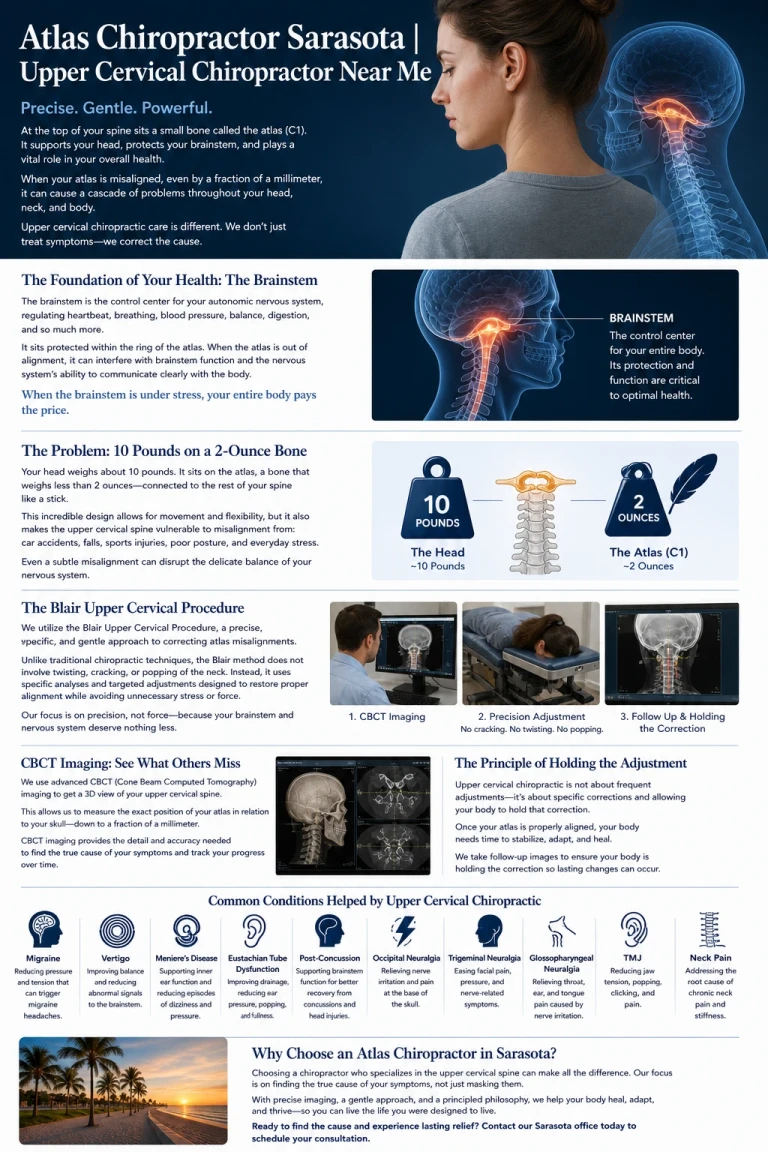
This region is home to the atlas (C1), the most important vertebra in your spine when it comes to neurological function. It supports your head, protects your brainstem, and plays a critical role in how your entire body functions.
The Atlas: A Small Bone With a Massive Responsibility
Why the Atlas Matters So Much
Your head weighs about 10–12 pounds. It sits on a bone that weighs roughly 2 ounces—the atlas. This delicate structure is responsible for supporting your entire head while allowing for movement and balance.
Think about that for a moment. A heavy structure resting on a small, mobile foundation. It’s not hard to see how even a slight shift in alignment could create problems.
When the atlas is properly aligned, the head sits balanced and the nervous system functions smoothly. When it is misaligned, the entire system can become strained.
The Brainstem Connection
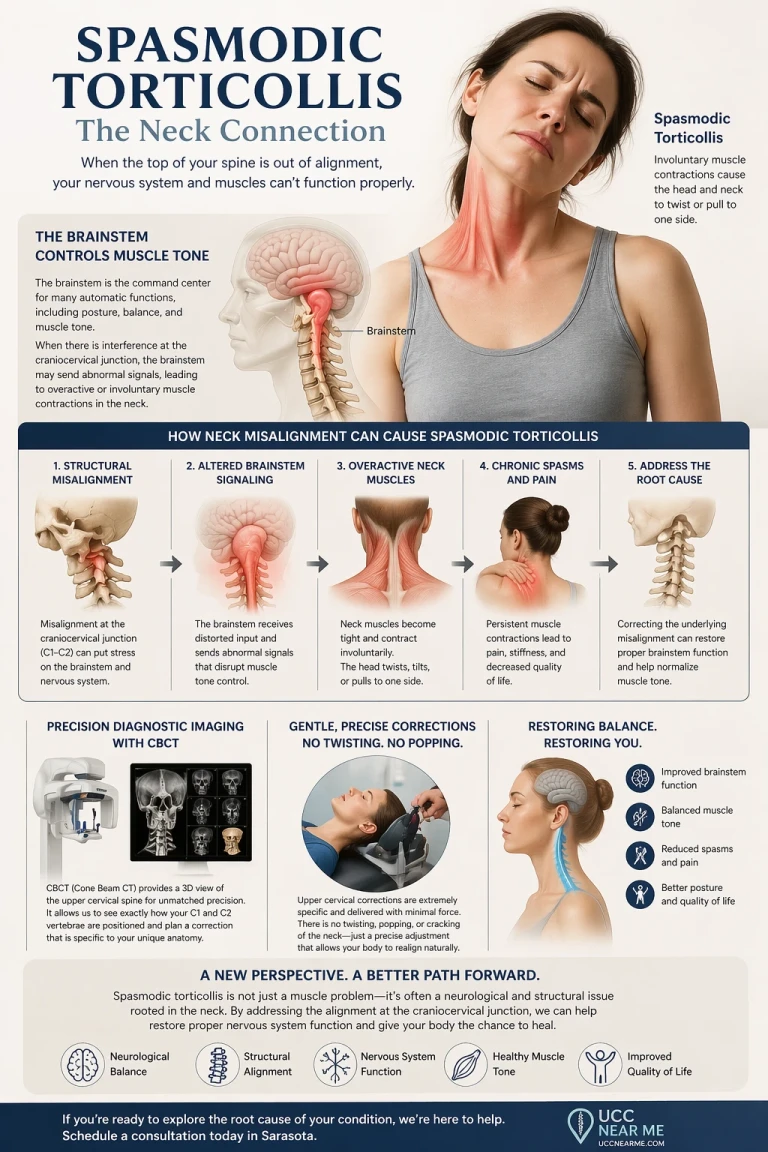
Just above the atlas sits the brainstem, one of the most vital control centers in the body. It regulates automatic functions like breathing, heart rate, blood pressure, balance, and coordination.
Because of how closely the atlas surrounds the brainstem, any misalignment in this area can influence how the brain communicates with the body.
This is why upper cervical chiropractic care focuses so heavily on precision. Small changes in this area can have large effects.
What Is the Blair Upper Cervical Technique?
A Precision-Based Approach
The Blair Upper Cervical Technique is a highly specific chiropractic method focused exclusively on correcting misalignments of the atlas and axis (C1 and C2).
Unlike general chiropractic care, which may involve adjusting multiple areas of the spine, the Blair technique is centered on one goal: restoring proper alignment at the top of the neck to improve nervous system function.
Individualized Corrections
No two people have the exact same anatomy or misalignment pattern. That’s why the Blair technique uses detailed analysis to determine the precise direction and angle of correction for each patient.
This is not guesswork. It is measured, calculated, and customized.
The Role of CBCT Imaging in Upper Cervical Care
Seeing the Problem Clearly
One of the most important tools in modern upper cervical chiropractic is CBCT (Cone Beam Computed Tomography) imaging.
This advanced 3D imaging allows us to visualize the exact position of the atlas and axis in relation to the skull. It provides a level of detail that traditional X-rays simply cannot.
Why Precision Matters
In the upper cervical spine, millimeters matter. A slight misalignment can alter how the head sits, how muscles function, and how the brainstem processes information.
CBCT imaging ensures that corrections are based on objective data, allowing for highly precise and effective care.
Adjusting Without Twisting, Cracking, or Popping
A Gentle Approach
One of the biggest concerns patients have is whether their neck will be twisted or forcefully manipulated. With upper cervical care, especially the Blair technique—the answer is no.
There is no cracking, popping, or aggressive twisting.
Instead, adjustments are:
Gentle
Controlled
Specific to your alignment
The goal is not to force movement, but to guide the atlas back into a more natural position.
Why This Matters
Because the upper cervical spine is so neurologically important, excessive force is not only unnecessary—it can be counterproductive.
Precision allows for effective correction with minimal stress on the body.
The Principle of Holding the Adjustment
Less Is More
Related article

Menstrual migraines and the neck connection | Sarasota Menstrual migraine treatment
Sep 05, 2026
One of the core principles of upper cervical chiropractic is the idea of “holding” the adjustment.
Rather than adjusting the spine repeatedly, the goal is to make a precise correction and allow the body to stabilize and heal.
When the atlas is properly aligned, the nervous system can begin to function more efficiently. Over time, the body adapts to this improved alignment.
Letting the Body Do the Work
Your body is designed to heal. Once interference is removed, it often doesn’t need constant intervention.
This is why visits may become less frequent over time, as the correction holds and the body maintains balance on its own.
Common Conditions Associated With Upper Cervical Misalignment
Migraines and Headaches
Many patients suffering from chronic migraines find relief when upper cervical misalignment is corrected. This is often related to improved blood flow, reduced muscle tension, and better brainstem regulation.
Vertigo and Balance Disorders
The upper neck plays a key role in balance through its connection to the brainstem and vestibular system. Misalignment can create conflicting signals, leading to dizziness and vertigo.
Meniere’s Disease
Patients with Meniere’s disease often experience episodes of vertigo, hearing changes, and ear pressure. Upper cervical care aims to improve neurological communication and fluid regulation within the inner ear.
Eustachian Tube Dysfunction
As discussed earlier, the muscles controlling the Eustachian tube are regulated by the brainstem. Misalignment in the upper neck can contribute to chronic dysfunction, leading to pressure, crackling, and discomfort.
Post-Concussion Symptoms
After a head injury, the alignment of the upper cervical spine is often affected. This can contribute to lingering symptoms like headaches, dizziness, and cognitive issues.
Neuralgias: Occipital, Trigeminal, and Glossopharyngeal
These conditions involve irritation of cranial nerves and can cause intense facial or head pain. Because these nerves originate near the brainstem, upper cervical alignment can play a role in symptom patterns.
TMJ and Jaw Pain
The jaw and upper neck are closely connected both structurally and neurologically. Misalignment can lead to muscle imbalances and joint dysfunction in the TMJ.
Tinnitus and Ear Symptoms
Ringing, buzzing, or pressure in the ears can be linked to how the brainstem processes auditory information and regulates pressure in the middle ear.
Neck Pain and Muscle Tension
Of course, the most direct symptom is often neck pain itself. When the atlas is misaligned, surrounding muscles can become tight and overactive in an attempt to stabilize the area.
Why the Upper Neck Is So Vulnerable
A Design That Requires Balance
The structure of the upper cervical spine is unique. A heavy head sits on a small, mobile base. This design allows for incredible movement, but it also requires precise balance.
Even small shifts can create disproportionate effects.

Everyday Stress Adds Up
Poor posture, repetitive strain, and minor injuries can all contribute to misalignment over time. You don’t need a major accident for the system to become disrupted.
The body often compensates for a while, but eventually those compensations can lead to symptoms.
The Brainstem: The Key to Whole-Body Health
The Control Center of the Body
The brainstem is responsible for regulating many of the functions that keep you alive and functioning. It coordinates communication between the brain and body, ensuring everything works together smoothly.
When this system is clear and unobstructed, the body operates efficiently.
What Happens When It’s Not
If there is interference at the level of the brainstem, the effects can be widespread. Symptoms may appear in different areas of the body, often without a clear connection.
This is why addressing the upper cervical spine can have such a broad impact on health.
Finding an Atlas Chiropractor Near You
What to Look For
If you’re searching for an upper cervical chiropractor, it’s important to find someone trained in precision-based techniques like Blair.
Look for a provider who uses advanced imaging, focuses on specific corrections, and emphasizes long-term stability rather than frequent adjustments.
A Different Approach to Healing
Upper cervical care is not about chasing symptoms. It’s about addressing the underlying cause and allowing the body to restore balance.
Final Thoughts: A Small Correction With a Big Impact
The idea that a small bone at the top of your neck could influence so many aspects of your health may seem surprising—but when you understand the relationship between the atlas, the brainstem, and the nervous system, it begins to make sense.
Your head sits on a delicate structure that must remain balanced for everything to function properly. When that balance is restored, the body often responds in powerful ways.
If you’ve been dealing with chronic symptoms and haven’t found answers, looking at the upper cervical spine may provide the missing piece.
Because sometimes, the biggest changes start at the very top.


Leave a comment