

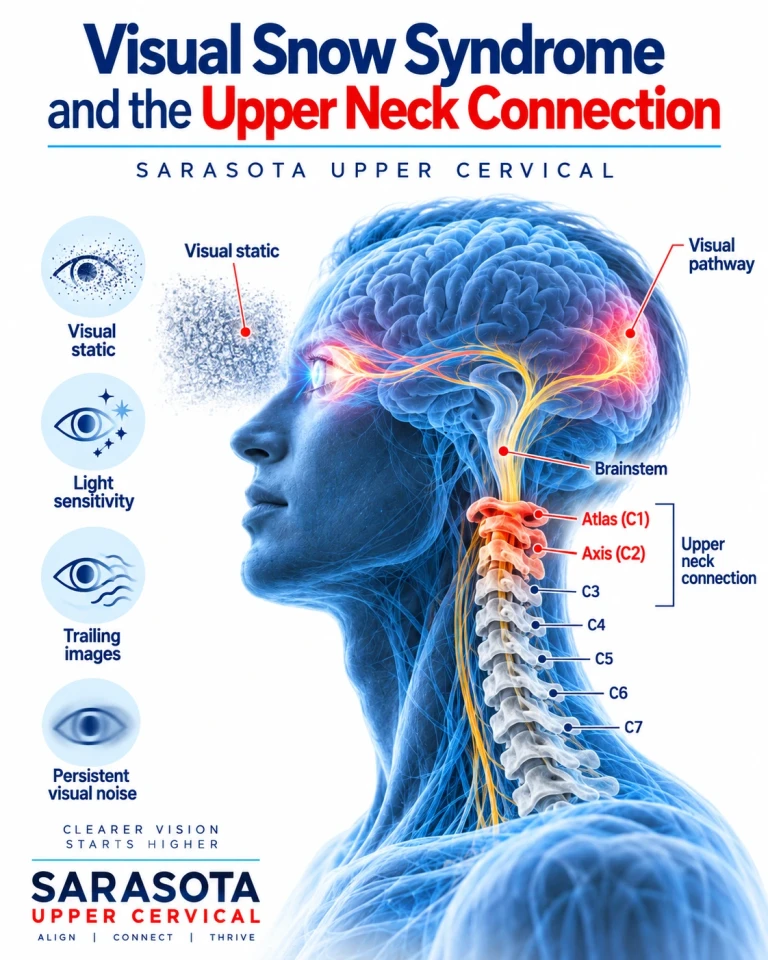
Visual snow syndrome is a condition most people in Sarasota, Bradenton, and Lakewood Ranch discover the name of themselves, usually online, after years of being told their eyes are fine. The description is consistent: countless tiny flickering dots across the entire visual field, present constantly, in every lighting condition, with eyes open and often with eyes closed. Patients compare it to television static, or falling snow, or heavy grain over everything they see.
Eye examinations are normal, because the eyes are normal. Visual snow is not an eye disease.
Schedule Your Appointment
Schedule appointmentWhat defines it visual snow syndrome?
Proposed diagnostic criteria, developed by Christoph Schankin and colleagues and published in Brain, require dynamic continuous tiny dots across the whole visual field persisting for at least three months, plus at least two of four additional visual features, with the picture not better explained by another disorder and not consistent with typical migraine visual aura.
Those four additional features are worth naming, because patients often do not realise they belong to the same condition. Palinopsia is the persistence of images after the stimulus has gone — trailing behind moving objects, or afterimages that linger. Enhanced entoptic phenomena means unusual awareness of things arising within one's own eye: floaters, the tiny moving dots of blue field entoptic phenomenon, self-light of the eye seen in darkness, and the spontaneous photopsia of brief flashes. Photophobia is light sensitivity. Nyctalopia is impaired night vision.
Beyond the visual criteria, the great majority of patients also report tinnitus, and many report brain fog, fatigue, tremor, and difficulty concentrating. That symptom cluster is part of the syndrome rather than a coincidence.
Why is visual snow happening?

The evidence points to altered central visual processing rather than anything in the eye.
Functional imaging has identified hypermetabolism in the lingual gyrus, part of the visual association cortex, in patients with visual snow. Studies have also reported altered processing in other visual areas and abnormalities in how the visual system habituates to repeated stimuli. The prevailing interpretation is that this is a disorder of cortical hyperexcitability and failed inhibition — the visual system generating and failing to suppress its own background noise.
Migraine comorbidity is high, and patients with both migraine and visual snow tend to report more severe additional symptoms. The relationship is not simple, though: visual snow is distinct from migraine aura, which builds over minutes, moves across the field, and resolves. Visual snow does not do any of that. It is continuous.
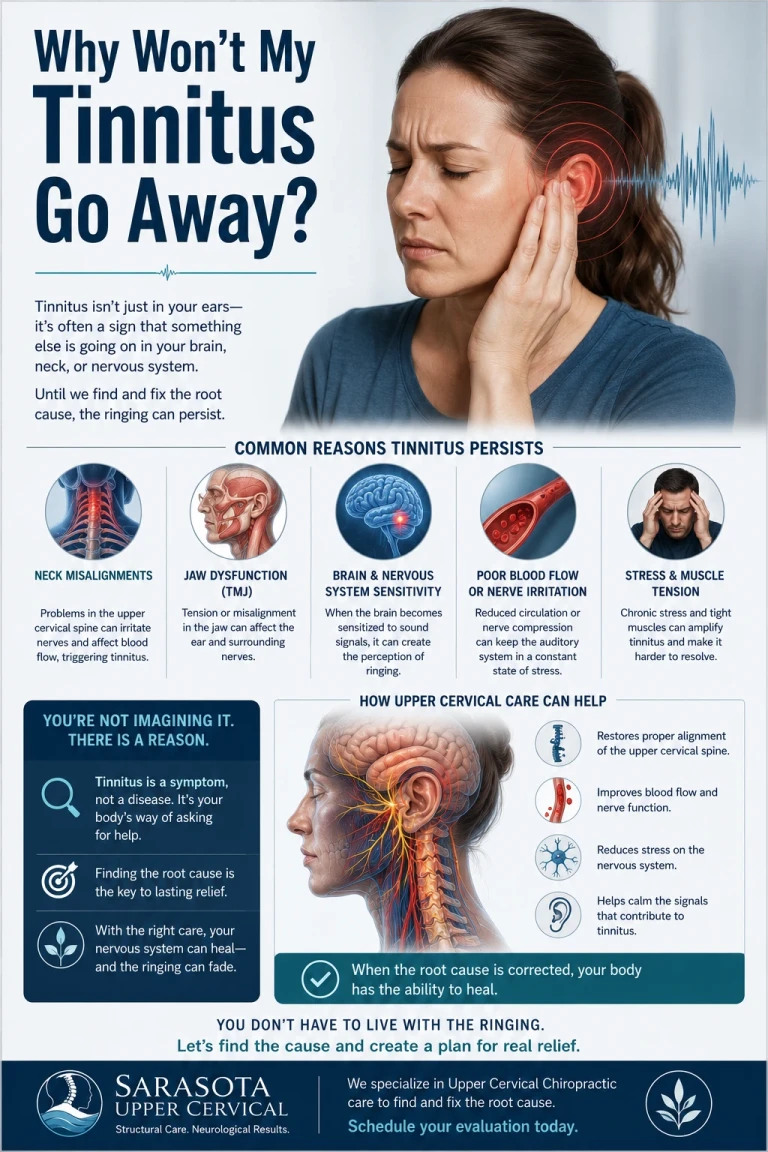
The tinnitus association is worth pausing on. Tinnitus is likewise increasingly understood as a disorder of central sensory processing — the auditory system generating perception in the absence of input, with a strong element of failed inhibition. That the two occur together so frequently suggests a shared tendency toward sensory cortical hyperexcitability rather than two unrelated problems in one person.
Where the upper cervical spine fits — and my honest answer
I am going to give you a straighter answer here than you will find on most chiropractic pages discussing this condition.
There is no evidence that upper cervical misalignment causes visual snow syndrome, and no evidence that upper cervical care treats it. The pathology identified so far is in visual cortical processing, and no adjustment alters cortical excitability in the lingual gyrus. If you find a practice claiming to resolve visual snow, ask what evidence supports the claim, because I am not aware of any.
What can be said is limited and I will not stretch it. Visual snow occupies the same conceptual territory as other disorders of sensory gain — tinnitus, photophobia, central sensitization in pain. In each, the problem is failure of inhibition rather than excess input. Where a patient has an additional persistent input source contributing to overall sensory load, addressing it is a reasonable general aim, and the upper cervical spine is a common source, particularly after head or neck trauma.
That is a statement about terrain, not a treatment claim, and I would want any patient to hear it as such before deciding whether an evaluation here is worth their time.
Where I think an upper cervical evaluation is more defensible is in the accompanying symptoms rather than the visual snow itself. Many of these patients also have headache, neck pain, dizziness, and photophobia — and for photophobia and headache, the trigeminocervical convergence pathway is established anatomy with a genuine cervical contribution. Improving those does not remove the static. It may improve the overall picture, and I would rather promise that accurately than promise more.
What to do about it
Honest management starts with what does not work. There is no established treatment. Various medications have been tried, including lamotrigine, with inconsistent results, and none has strong supporting evidence. Tinted lenses help some patients with the associated photophobia without altering the static.
What does help is a real diagnosis. A very large proportion of people with visual snow spend years being told nothing is wrong, and being given a name and an explanation measurably reduces the distress. The condition is not degenerative, is not a sign of impending blindness, and does not progress to vision loss — and being told that by someone who understands it matters.
Practical measures include avoiding sustained dark adaptation, which worsens visual sensitivity over time, managing coexisting migraine properly, addressing sleep, and reducing the anxiety loop that attending closely to the static reliably produces. Patient advocacy organisations exist and are a better source of ongoing support than any single clinician.
What needs excluding first
Related article
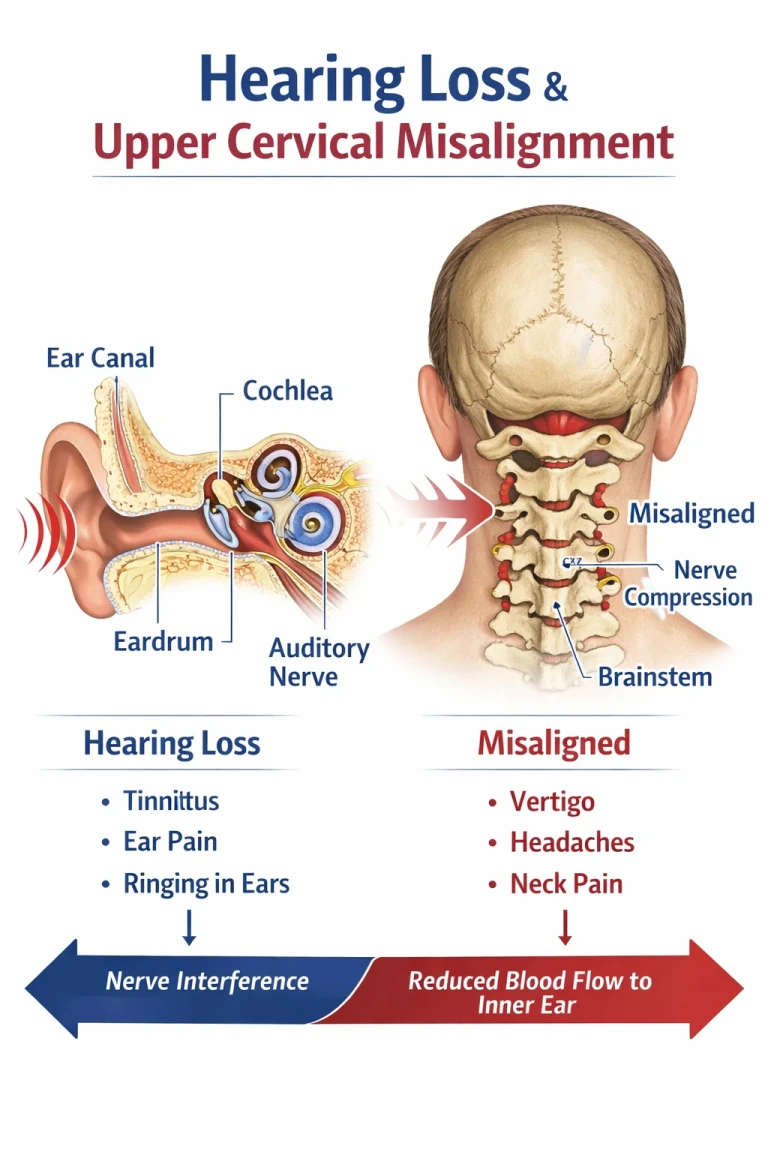
Hearing Loss Treatment in Sarasota | Understanding Eustachian Tube Dysfunction
Mar 23, 2026
Visual snow syndrome is a clinical diagnosis made after other causes are ruled out, and that ruling out is not optional. Retinal disease, optic neuropathy, and posterior vitreous detachment need ophthalmological examination. Hallucinogen persisting perception disorder produces a similar picture with a relevant history. Some medications produce visual disturbance. Occipital lobe pathology, idiopathic intracranial hypertension, and rarely autoimmune or infectious causes appear on the differential.
Anyone with these symptoms needs a dilated eye examination and, in most cases, neurological assessment before the diagnosis is accepted.
Precision and knowing when not to adjust
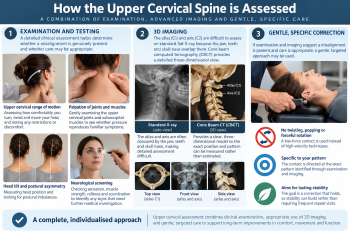
Where an upper cervical evaluation is undertaken, correction involves no twisting, no popping, no cracking, and no pulling of the neck. Cone beam computed tomography measures the three-dimensional position of the atlas and axis against your own anatomy so a correction is calculated rather than estimated. Objective measures — leg length assessment, cervical range of motion, postural and balance measurement, and thermographic pattern tracking — determine whether a correction is indicated and whether it is holding. When it is holding, no adjustment is given.
In a condition characterised by sensory hyperexcitability, restraint is particularly warranted, and so is honesty about what is being treated. If your visual snow does not change, that is the expected outcome, and I would tell you so before starting rather than after.
An evaluation in Sarasota
If you have visual snow and also carry headache, neck pain, dizziness, or light sensitivity — particularly if these began after a head or neck injury — an upper cervical evaluation may be worth considering for those accompanying symptoms. It is not a treatment for visual snow syndrome, and I would not want you to arrive expecting otherwise. To discuss whether an evaluation makes sense in your situation call 941 259-1891.
Dr. Drew Hall, Upper Cervical Chiropractor
Serving Sarasota, Bradenton, and Lakewood Ranch, Florida
This article is for general educational purposes only and is not medical advice, a diagnosis, or a treatment recommendation for any individual. Visual snow syndrome is a clinical diagnosis of exclusion requiring dilated eye examination and, in most cases, neurological assessment to exclude retinal, optic nerve, and central causes. Upper cervical chiropractic is an area of focus within chiropractic; it is not a board-recognized specialty, and no claim of specialization or superiority is made or implied. There is no evidence that upper cervical misalignment causes visual snow syndrome and no evidence that upper cervical care treats it; no such claim is made here, and any potential role is limited to accompanying symptoms such as headache or neck pain. There is currently no established treatment for visual snow syndrome. Cone beam computed tomography is used as a precision measurement and analysis tool, not as a stand-alone diagnostic device, and does not assess visual function. Individual results vary and no specific outcome is guaranteed. Seek emergency care for sudden visual change, a curtain across the visual field, flashes with new floaters, loss of visual acuity or field, or visual symptoms with headache, weakness, numbness, or confusion. Always consult a qualified healthcare provider regarding diagnosis and treatment.

Leave a comment