

Brain fog is a frustrating symptom that many people struggle to explain. Patients often describe it as feeling mentally slow, unable to concentrate, forgetful, or like their thinking is clouded. Tasks that used to be easy—reading, focusing at work, remembering details, or staying mentally sharp—suddenly become difficult.
While brain fog is often blamed on stress, poor sleep, or aging, many people are surprised to learn that the problem may actually originate in the upper neck.
Schedule Your Appointment
Schedule appointmentThe upper cervical spine, located at the junction where the head meets the neck, plays a critical role in brain function. This region is responsible for protecting the brainstem and supporting the delicate circulation systems that supply and drain the brain.
When a misalignment occurs in this area—particularly involving the atlas vertebra (C1)—it can disrupt several important physiological processes that the brain depends on to function properly.
Schedule a Free Brain Fog Consultation book here.
The Head-Neck Junction: A Critical Gateway for Brain Function
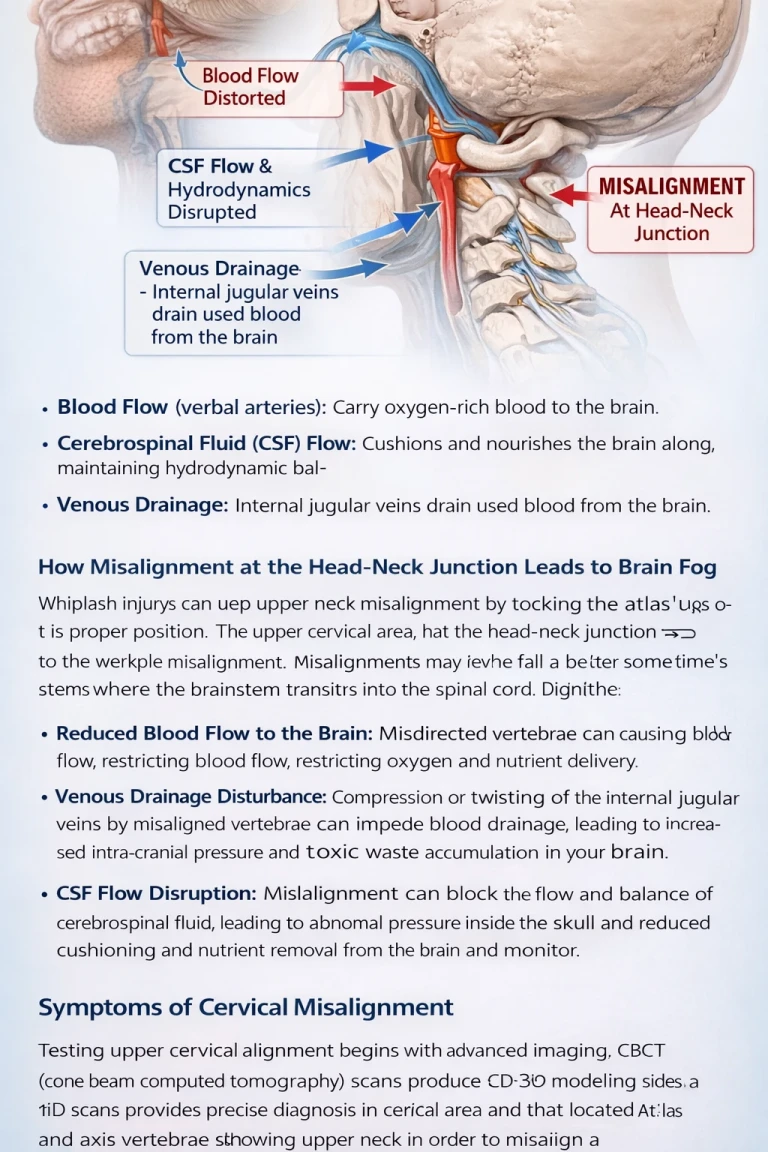
The upper cervical spine acts as an important choke point for several critical systems that support the brain, including:
Blood flow into the brain
Venous drainage out of the brain
Cerebrospinal fluid (CSF) circulation and pressure regulation
Because these structures pass through a relatively tight anatomical area at the base of the skull, small structural misalignments can potentially influence how these systems function.
When this area is functioning normally, the brain receives a steady supply of oxygen-rich blood, waste products are efficiently removed, and cerebrospinal fluid maintains healthy pressure balance within the skull.
When this balance is disrupted, however, brain performance can suffer.
Blood Flow to the Brain
Two important arteries called the vertebral arteries travel through the cervical spine and enter the skull at the base of the head. These arteries supply blood to critical regions of the brain including the brainstem, cerebellum, and portions of the cerebral cortex.
These areas are heavily involved in:
Cognitive processing
Focus and concentration
Balance and coordination
Autonomic nervous system regulation
Because the vertebral arteries travel through the upper cervical spine, alignment of the atlas and axis vertebrae can influence the mechanical environment surrounding these vessels.
If the upper neck becomes misaligned due to trauma or chronic postural stress, it may create abnormal tension or structural stress in this region. When blood delivery to the brain is compromised—even slightly—it may contribute to symptoms such as:
Brain fog
Fatigue
Difficulty concentrating
Lightheadedness
Mental sluggishness
The brain consumes a tremendous amount of oxygen and nutrients. Even subtle disruptions in circulation can affect cognitive performance.
Schedule a Free Brain Fog Consultation book here.
Venous Drainage From the Brain
Just as important as blood flowing into the brain is the ability for blood to drain out of the brain efficiently.
The primary pathways responsible for removing used blood and metabolic waste are the internal jugular veins, which pass directly through the upper neck region.
These veins allow the brain to eliminate carbon dioxide, metabolic byproducts, and other waste materials.
If venous drainage becomes restricted or inefficient, pressure within the cranial vault can increase. This can lead to a buildup of metabolic waste in the brain and altered pressure dynamics.
When this occurs, individuals may experience symptoms such as:
Brain fog
Head pressure
Fatigue
Difficulty focusing
Cognitive slowing
Structural alignment of the head and neck plays an important role in maintaining optimal venous outflow pathways.
Cerebrospinal Fluid and Brain Hydrodynamics
Another critical system influenced by the upper cervical spine is cerebrospinal fluid (CSF) circulation.
Cerebrospinal fluid surrounds and cushions the brain and spinal cord. It performs several essential functions, including:
Protecting the brain from mechanical stress
Delivering nutrients to neural tissue
Removing waste products
Maintaining pressure balance within the skull
CSF flows rhythmically through the brain and spinal cord in response to cardiac pulsation and respiration. This delicate hydrodynamic balance is extremely sensitive to structural relationships at the craniocervical junction, where the skull meets the spine.
If the atlas vertebra becomes misaligned, it may alter the mechanics of this region and potentially affect the way CSF circulates between the brain and spinal canal.
When CSF flow or pressure balance becomes disrupted, patients may experience symptoms such as:
Brain fog
Head pressure
Cognitive difficulty
Fatigue
Visual disturbances
Dizziness
Related article

Craniocervical Instability Symptoms: How Do You Know If You Have It? | Sarasota
Jul 29, 2026
This is why structural integrity of the upper cervical spine is so important for neurological health.
Whiplash Injuries: A Common Cause of Upper Neck Misalignment
One of the most common triggers for upper cervical misalignment is whiplash trauma.
Whiplash injuries frequently occur during:
Car accidents
Sports collisions
Falls
Sudden impacts
During a whiplash event, the head can rapidly accelerate forward and backward, placing significant stress on the delicate joints that connect the skull to the atlas and axis vertebrae.
Even mild accidents that do not appear serious at the time can cause subtle misalignments in this region.
Unfortunately, symptoms such as brain fog, dizziness, headaches, and cognitive difficulties may develop weeks or months after the injury, making the connection difficult to recognize.
Many patients struggling with chronic brain fog trace the beginning of their symptoms back to a previous neck injury or whiplash event.
Testing to Determine if the Upper Neck Is Misaligned
At our office, the goal is to determine whether the upper cervical spine is functioning normally or whether a structural misalignment may be contributing to neurological stress.
This evaluation includes several steps:
Detailed Health History
We begin by reviewing your symptom history, including when brain fog started and whether previous injuries such as whiplash may have occurred.
Postural and Neurological Assessment
Careful measurements are performed to evaluate head position, muscle tone, and neurological function related to the cervical spine.
Advanced 3D CBCT Imaging
If a misalignment is suspected, Cone Beam CT (CBCT) imaging is used to analyze the precise orientation of the atlas and axis vertebrae.
This technology produces a three-dimensional view of the upper cervical spine, allowing the doctor to measure the exact direction and degree of misalignment.
This level of precision is essential because every patient's anatomy is different.
A Custom Tailored Correction
Related article

Whiplash and Neck Pain After a Car Accident: What Sarasota Drivers Should Know
Jul 19, 2026
Once the misalignment is precisely identified, a custom correction is designed specifically for the patient's anatomy.
Upper cervical adjustments are very different from traditional spinal manipulation.
There is no twisting, popping, or pulling of the neck.
Instead, a gentle and highly precise correction is delivered in a controlled manner using measurements derived from the CBCT imaging.
The goal is not to treat symptoms directly, but to restore proper structural alignment at the head-neck junction.
When the structure is corrected, the nervous system and circulation systems can begin to function more normally.
Restoring Structure to Restore Function
The body has an incredible ability to heal and regulate itself when interference is removed.
By restoring normal alignment in the upper cervical spine, many patients experience improvements in neurological function, circulation, and pressure dynamics within the brain.
Over time, this may lead to improvements in symptoms such as:
Brain fog
Difficulty concentrating
Fatigue
Dizziness
Cognitive slowing
Every case is different, but addressing structural issues in the upper neck can often uncover an important missing piece in the puzzle of chronic brain fog.
Schedule a Free Brain Fog Consultation book here.
If you are struggling with brain fog, difficulty concentrating, or cognitive fatigue, the upper cervical spine may be an overlooked factor.
A detailed evaluation can help determine whether a structural misalignment in the neck may be contributing to your symptoms.
📞 Call 941-259-1891 to schedule a free consultation
or click here to schedule your visit online.
Identifying and correcting the root cause may help restore clarity, focus, and optimal brain function.
We serve Sarasota, Bradenton, Lakewood Ranch, Arcadia, Venice, Punta Gorda, Englewood, Osprey, Northport, and Parish.


Leave a comment