

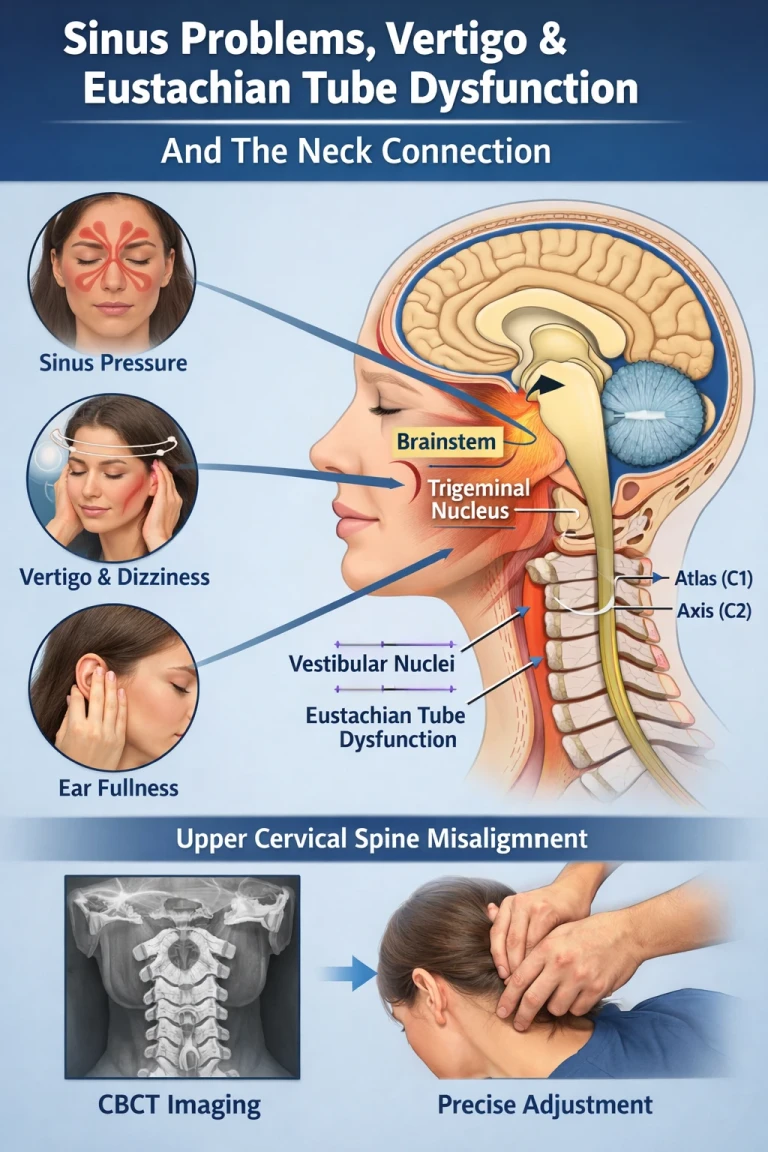
Sinus pressure that won’t clear. Ears that feel clogged or constantly need to “pop.” Episodes of dizziness or vertigo that seem to come out of nowhere. For many people, these symptoms are treated as completely separate conditions—managed with medications, nasal sprays, or vestibular therapy.
But what if these seemingly unrelated issues actually share a common root cause?
Schedule Your Appointment
Schedule appointmentMore and more patients are discovering that chronic sinus problems, eustachian tube dysfunction, and vertigo can all be linked to one central factor: misalignment of the upper cervical spine—specifically the atlas (C1) and axis (C2) vertebrae at the top of the neck.
In this article, we’ll break down how these symptoms are connected, the critical role of the brainstem, and how precise upper cervical chiropractic care using CBCT imaging can help address the root cause—not just the symptoms.
Click here to schedule a FREE consultation.
The Overlooked Link: The Upper Cervical Spine
The upper cervical spine is one of the most neurologically significant regions in the body. The atlas (C1) sits directly beneath the skull and surrounds the lower portion of the brainstem. The axis (C2) allows for rotation of the head and also plays a key structural role.
This area is not just about movement—it’s about communication.
The brainstem, which passes through this region, is responsible for regulating many automatic functions in the body, including:
Balance and coordination
Muscle tone
Blood flow regulation
Cranial nerve function
Sensory integration from the inner ear, eyes, and joints
When the atlas or axis becomes misaligned—even slightly—it can create mechanical stress and neurological interference at the brainstem level.
And that’s where the connection begins.
The Brainstem: The Control Center Behind Your Symptoms
The brainstem acts like a central relay station. It connects the brain to the body and coordinates information from multiple systems.
Three major systems tied to your symptoms converge here:
1. The Vestibular System (Balance & Vertigo)
The vestibular nuclei, located in the brainstem, integrate information from:
The inner ear (semicircular canals)
The eyes (visual input)
The upper cervical joints (proprioception)
When the upper cervical spine is misaligned, it can send abnormal joint signals to the brainstem. This disrupts how the vestibular system processes balance, leading to:
Vertigo
Dizziness
Disequilibrium
Motion sensitivity
Related article
The Complete Guide to TMJ/TMD and Its Connection to the Neck | TMJ treatment and relief Sarasota
Jun 14, 2026
This is why many patients who fail treatments like the Epley maneuver (used for BPPV) often have a cervicogenic source of vertigo instead.
2. The Trigeminal and Sinus Connection
The trigeminal nerve is one of the largest cranial nerves and is heavily involved in:
Facial sensation
Sinus perception
Pain signaling
Its nucleus extends down into the upper cervical spine (to about C2–C3). This creates what’s known as the trigeminocervical complex.
When there is irritation or misalignment in the upper cervical spine, it can influence this system and lead to:
Sinus pressure
Facial pain
Headaches
A feeling of congestion without infection
This explains why some patients experience chronic “sinus problems” despite normal imaging or lack of infection.
3. Eustachian Tube Dysfunction and Ear Pressure
The eustachian tube helps equalize pressure in the middle ear. It is influenced by surrounding muscles and neurological control—much of which is coordinated through the brainstem.
Upper cervical misalignment can affect:
Muscle tone around the jaw and throat
Nerve signaling to the eustachian tube
Pressure regulation in the middle ear
This can result in:
Ear fullness or pressure
Clicking or popping sensations
Muffled hearing
Recurrent ear issues
Many patients are told to “just live with it” or repeatedly use decongestants—but the real issue may be neurological, not structural within the ear itself.
Click here to schedule a FREE consultation.
One Root Cause, Multiple Symptoms
When you step back, a pattern becomes clear.

All of these symptoms—sinus issues, ear dysfunction, and vertigo—are tied together through:
The brainstem
The upper cervical spine
The nervous system’s ability to process and regulate information
A misalignment in this critical region can create a cascade of dysfunction, leading to symptoms in multiple systems at once.
That’s why treating each symptom individually often leads to frustration. You may get temporary relief—but not lasting resolution.
Why Traditional Approaches Often Fall Short
Most conventional treatments are symptom-focused:
Sinus problems → antihistamines, steroids, antibiotics
Eustachian tube dysfunction → decongestants, nasal sprays
Vertigo → vestibular therapy, repositioning maneuvers
While these approaches can be helpful in certain cases, they often don’t address the underlying neurological cause when the issue originates from the upper cervical spine.
If the brainstem is being irritated or receiving distorted input, the body cannot regulate these systems properly—no matter how many medications are used.
The Upper Cervical Solution: Precision Matters
Upper cervical chiropractic care is fundamentally different from general chiropractic approaches.
It focuses specifically on correcting misalignments of the atlas and axis with extreme precision.
Advanced 3D Imaging with CBCT
One of the most important tools in this process is Cone Beam Computed Tomography (CBCT).
This advanced imaging provides a three-dimensional view of your unique anatomy, allowing doctors to:
Identify the exact direction and degree of misalignment
Analyze asymmetries in the skull and upper neck
Measure angles and rotations with precision
Develop a correction tailored specifically to you
No two patients are the same. That’s why cookie-cutter adjustments don’t work in the upper cervical spine.
Customized, Gentle Corrections
Using the data from CBCT imaging, upper cervical chiropractors deliver a correction that is:
Highly specific
Gentle and controlled
Free of twisting, popping, or cracking
In fact, many patients are surprised at how subtle the adjustment feels.
The goal is not to force movement—but to restore proper alignment, allowing the body to:
Related article
Does the room feel like its moving while you are walking? | Oscillopsia treatment Sarasota
Sep 17, 2026Reduce brainstem irritation
Normalize nerve signaling
Re-establish balance and coordination
Improve fluid dynamics (including blood and cerebrospinal fluid flow)
The Importance of Holding the Correction
Another key principle in upper cervical care is this:
Healing happens when the correction holds.
Once alignment is restored, the body begins to stabilize and heal. Repeated, unnecessary adjustments can actually disrupt this process.
That’s why upper cervical doctors use objective testing—such as:
Thermography (to assess nervous system patterns)
Postural analysis
Leg length checks
These tools help determine when an adjustment is needed—and when it’s not.
Real-World Impact: What Patients Experience
When the upper cervical spine is properly aligned and the brainstem is no longer under stress, patients often report improvements such as:
Reduced sinus pressure and congestion
Improved ear pressure and less popping
Resolution or reduction of vertigo
Better balance and coordination
Clearer thinking and less brain fog
The key difference?
These changes are not just temporary—they’re often sustainable, because the underlying cause has been addressed.
Is Your Neck the Missing Piece?
If you’ve been struggling with:
Chronic sinus issues without clear infection
Persistent ear pressure or eustachian tube dysfunction
Vertigo that hasn’t responded to traditional care
…it may be time to consider the role of your upper cervical spine.
Especially if:
Your symptoms started after a head or neck injury
Looking up or certain neck movements trigger dizziness
You’ve tried multiple treatments without lasting success
Final Thoughts
The human body is incredibly interconnected. What happens in one area—especially a region as critical as the upper cervical spine—can have far-reaching effects.
Sinus problems, eustachian tube dysfunction, and vertigo may seem unrelated on the surface. But when you understand the role of the brainstem and nervous system, a unifying cause begins to emerge.
By focusing on precise correction of upper cervical misalignment, it’s possible to restore proper neurological function and allow the body to heal naturally.
If you’re searching for answers beyond symptom management, this approach may provide the missing link you’ve been looking for.



Leave a comment