

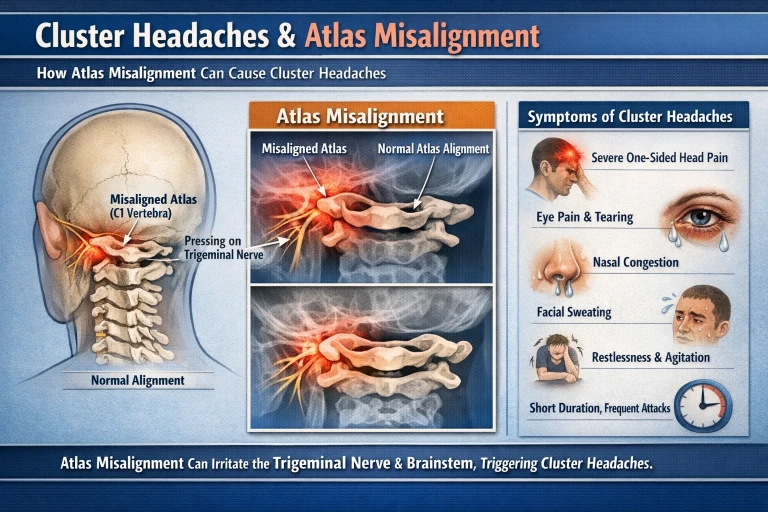
Cluster headaches are often described as one of the most painful conditions a person can experience.
Sharp, piercing pain behind one eye.
Tearing.
Nasal congestion.
Restlessness.
Episodes that strike at the same time every day.
Schedule Your Appointment
Schedule appointmentIf you are suffering from cluster headaches in Sarasota or Bradenton, you may feel desperate for relief.
Most patients are told cluster headaches are purely neurological or vascular in origin. Oxygen therapy, triptans, and medications are often prescribed to suppress attacks.
But what if the root cause is structural?
What if an atlas misalignment at the top of your spine is contributing to the cycle?
👉 Call 941-259-1891 to schedule your FREE consultation
Or click here to book online.
What Makes Cluster Headaches Different?
Cluster headaches differ from migraines or tension headaches.
They typically involve:
• Severe, stabbing pain on one side of the head
• Pain centered behind the eye
• Drooping eyelid on one side
• Nasal congestion or runny nose
• Red, watery eye
• Episodes lasting 15 minutes to 3 hours
• Clusters of attacks occurring for weeks or months
They are often called “suicide headaches” because of the intensity of pain.
But even though they are intense, the body is not attacking itself randomly.
There is a pattern.
And patterns point to underlying dysfunction.
The Atlas (C1) and the Brainstem
The atlas (C1) is the top bone in your spine. It supports the skull and sits directly beneath the brainstem.
The brainstem regulates:
• Pain processing
• Blood vessel dilation and constriction
• Autonomic nervous system balance
• Cranial nerve function
Cluster headaches are strongly associated with trigeminal nerve activation and vascular changes in the head.
The trigeminal nucleus extends into the upper cervical region of the brainstem.
If the atlas becomes misaligned due to trauma, it may:
• Create mechanical stress on the brainstem
• Irritate upper cervical nerves
• Alter vascular tone regulation
• Distort sensory input
• Increase trigeminal nerve sensitivity
Related article

POTS vs. Anxiety: How to Tell the Difference — and the Autonomic Connection Behind Both
Jul 04, 2026Even small misalignments can amplify neurological irritation in this region.
How Trauma Leads to Atlas Misalignment
Most atlas misalignments begin with trauma, including:
• Car accidents (even low speed)
• Slip and falls
• Sports injuries
• Concussions
• Whiplash
• Repetitive strain
When trauma injures the joint capsule surrounding C1:
• Inflammation develops
• Motion becomes restricted
• Instability forms
• Muscles tighten protectively
Over time, this creates chronic tension at the base of the skull and mechanical stress beneath the brainstem.
The body compensates.
The nervous system adapts.
But in some individuals, that adaptation becomes cluster headache patterns.
Why Cluster Headaches Often Return in Cycles
Cluster headaches tend to occur in cycles. Many patients notice attacks at the same time of day.
The brainstem plays a major role in circadian rhythm regulation and autonomic balance.
If mechanical irritation exists near this region, it may disrupt:
• Vascular tone
• Pain threshold
• Autonomic signaling
• Sleep-wake cycles
Correcting structural imbalance at the top of the spine may reduce neurological stress that contributes to these cycles.
Upper Cervical Chiropractic: A Precision Approach
Upper cervical chiropractic focuses specifically on correcting misalignment at C1 and C2.
Unlike traditional chiropractic, this is not full-spine manipulation.
The focus is precision.
When atlas alignment is restored:
• Brainstem stress may decrease
• Trigeminal irritation may calm
• Muscle guarding reduces
• Vascular regulation stabilizes
• Pain cycles may lessen
The goal is not to treat the headache directly.
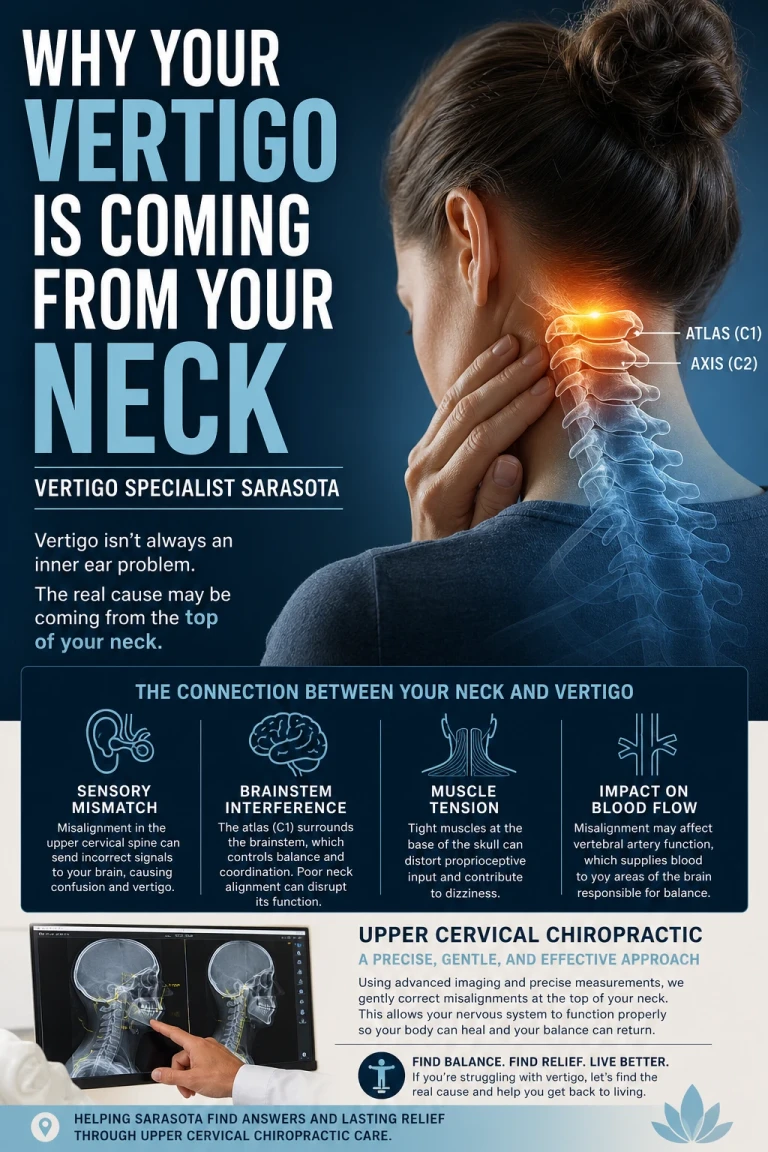
The goal is to remove structural interference so the nervous system can regulate itself more effectively.
The Importance of 3D CBCT Imaging
Every person’s anatomy is unique.
No two atlas misalignments are identical.
That is why we utilize advanced 3D Cone Beam CT (CBCT) imaging.
CBCT allows us to measure:
• Exact rotational displacement
• Lateral deviation
• Angular misalignment
• Skull-to-atlas relationship
• Structural asymmetry
Without imaging, adjustments are generalized.
With CBCT imaging, we determine the exact pattern of misalignment and tailor the correction specifically to you.
Precision matters — especially when working near the brainstem.
No Twisting, Cracking, or Pulling
Many patients hesitate because they fear aggressive neck manipulation.
Upper cervical care is different.
There is:
• No forceful twisting
• No aggressive cracking
• No yanking or pulling
Adjustments are:
• Gentle
• Specific
• Low-force
• Based entirely on measured data
Especially for patients suffering severe neurological headaches, minimal force with maximum precision is critical.
Objective Testing: When to Adjust
We do not adjust on every visit.
We use objective testing to determine necessity.
This includes:
Leg Length Analysis
Neurological imbalance may create subtle asymmetry in leg patterns.
Related article
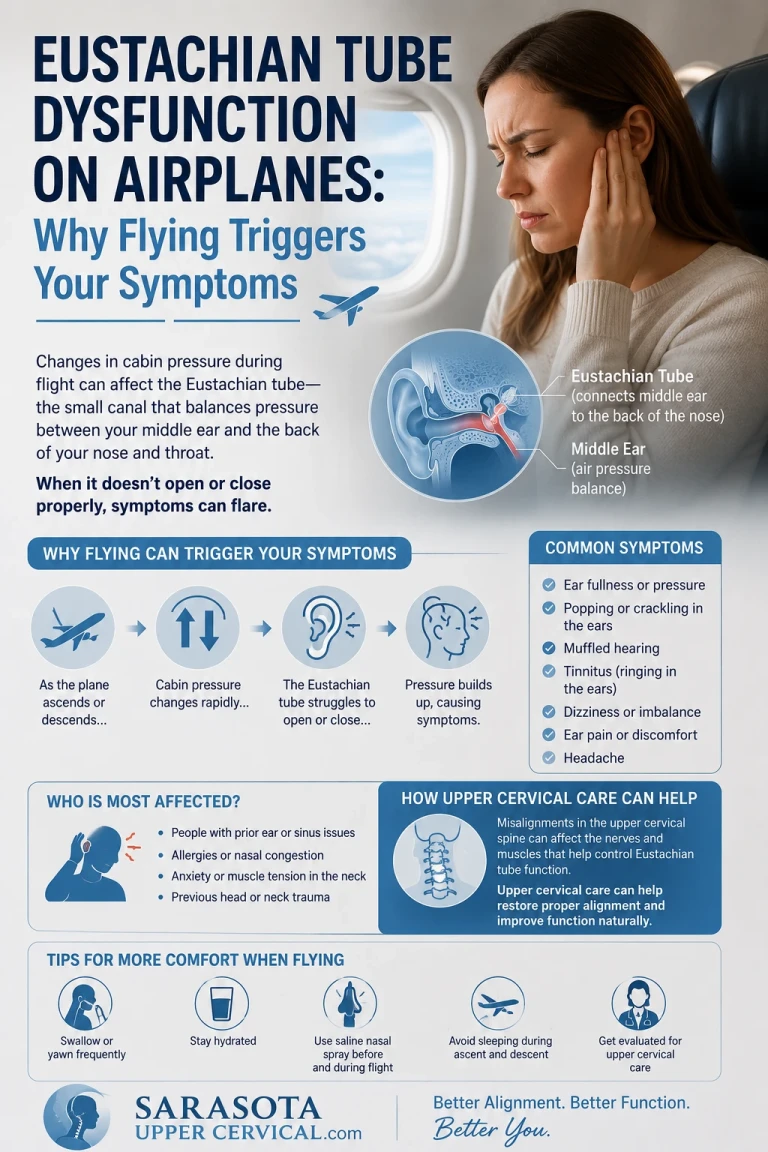
Eustachian Tube Dysfunction on Airplanes: Why Flying Triggers Your Symptoms
Jun 08, 2026Infrared Thermography
Thermal scanning detects heat differences along the spine, indicating nervous system irritation.
These tools help determine:
• If misalignment is present
• If correction is holding
• If adjustment is needed
• When stability has been restored
Adjustments are data-driven — not routine.
True Healing vs Symptom Suppression
Traditional cluster headache treatment often focuses on:
• Oxygen therapy
• Injections
• Medications
• Pain suppression
While these may reduce attack severity, they do not address potential structural causes.
Upper cervical chiropractic focuses on:
• Restoring joint motion
• Reducing mechanical stress
• Stabilizing the nervous system
• Supporting long-term healing
When the nervous system functions properly, pain cycles may decrease in frequency and intensity.
Signs You May Need an Upper Cervical Evaluation
You may benefit from evaluation if:
• Cluster headaches began after trauma
• You have chronic neck stiffness
• You feel pressure at the base of your skull
• Attacks occur in predictable cycles
• You have tried medications without lasting relief
Your head and neck function as a unit.
If the foundation beneath your brainstem is unstable, symptoms may persist.
Cluster Headache Treatment in Sarasota & Bradenton
If you are suffering from cluster headaches and are ready to explore a root cause approach, upper cervical chiropractic may be the missing link.
We focus on:
• Precision 3D CBCT imaging
• Gentle, specific correction
• Objective neurological testing
• No twisting, cracking, or pulling
• Long-term structural healing
👉 Call 941-259-1891 to schedule your FREE consultation
Or click here to book online.
Cluster headaches are not random.
Let’s evaluate the alignment at the top of your spine and determine whether atlas misalignment may be contributing to your pain.
Relief may begin with restoring balance where your head meets your spine.

Leave a comment