

That constant feeling like your ear won’t pop.
Pressure.
Fullness.
Muffled hearing.
Ringing.
Dizziness.
Schedule Your Appointment
Schedule appointmentIf you are searching for ear pressure relief in Sarasota, you may have been told you have Eustachian Tube Dysfunction (ETD). You may have tried antihistamines, nasal sprays, decongestants, steroids, or even ear tubes.
But what if the issue isn’t just inside your ear?
What if the real problem is structural — and coming from the top of your neck?
Many people suffering with chronic ear pressure also experience:
• Tinnitus (ringing in the ears)
• Vertigo or dizziness
• TMJ pain or jaw clicking
• Hearing changes
• Head pressure
• Neck stiffness
These symptoms are often connected. And one commonly overlooked cause is atlas (C1) misalignment.
👉 Call 941-259-1891 to schedule your FREE consultation
Or click here to book online.
What Is Eustachian Tube Dysfunction?
The Eustachian tube connects the middle ear to the back of the throat. Its job is to:
• Equalize pressure in the middle ear
• Drain fluid
• Protect the ear from infection
When it functions properly, pressure remains balanced and hearing feels clear.
When it malfunctions, you may experience:
• Ear fullness
• Popping or crackling
• Pressure that won’t equalize
• Muffled hearing
• Dizziness
Most explanations focus on allergies, sinus congestion, or inflammation.
While these can contribute, many chronic cases are not caused by sinus issues alone.
The Hidden Connection: The Upper Neck and the Ear
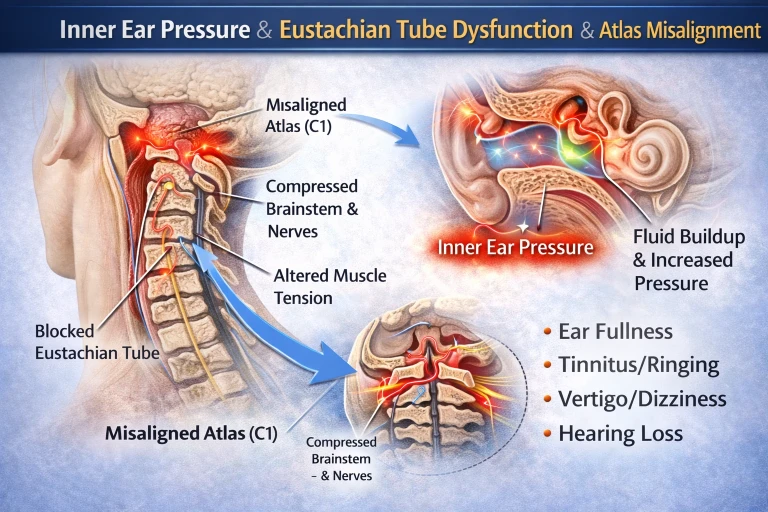
The upper cervical spine — specifically the atlas (C1) — sits directly beneath the skull and in front of the brainstem.
This area is neurologically dense and mechanically delicate.
The brainstem regulates:
• Balance centers
• Cranial nerve function
• Muscle tone
• Autonomic nervous system activity
• Sensory processing
The Eustachian tube is influenced by muscles that help it open and close — including muscles connected to the jaw and upper neck.
When the atlas becomes misaligned due to trauma, it may:
• Alter muscle tone
• Disrupt cranial nerve signaling
• Affect fluid regulation
• Create abnormal tension patterns
This can interfere with proper pressure equalization.
Trauma and Atlas Misalignment
Common causes of atlas misalignment include:
• Car accidents (even minor fender benders)
• Whiplash injuries
• Slip and falls
• Sports impacts
• Concussions
• Chronic forward head posture
When the joint capsule surrounding C1 is injured:
• Inflammation develops
• Motion becomes restricted
• Muscles tighten protectively
• Neurological signaling changes
Even subtle misalignment can disrupt how the body regulates pressure and fluid in the head.
Why Ear Pressure Often Comes With Tinnitus
Many patients with Eustachian Tube Dysfunction also experience tinnitus — ringing, buzzing, or hissing in the ear.
The vestibulocochlear nerve (cranial nerve VIII) originates in the brainstem near the upper cervical spine.
If structural irritation exists in this region, it may influence:
• Auditory signaling
• Inner ear fluid balance
• Sensory processing
Tinnitus is often not just an ear issue. It can be a nervous system issue.
When atlas alignment improves, some patients notice changes in ear fullness and ringing.
The TMJ Connection
The jaw joint (TMJ) sits very close to the ear canal and shares muscular and neurological connections with the upper neck.
When the atlas is misaligned:
• The head may tilt subtly
• Jaw mechanics may shift
• Muscles of mastication may tighten
• Eustachian tube opening may be restricted
Patients with ETD frequently report:
• Jaw clicking
• Teeth grinding
• Facial tension
• Ear pressure that worsens when chewing
The neck and jaw work together.
If one is imbalanced, the other compensates.
Vertigo and Balance Disturbance
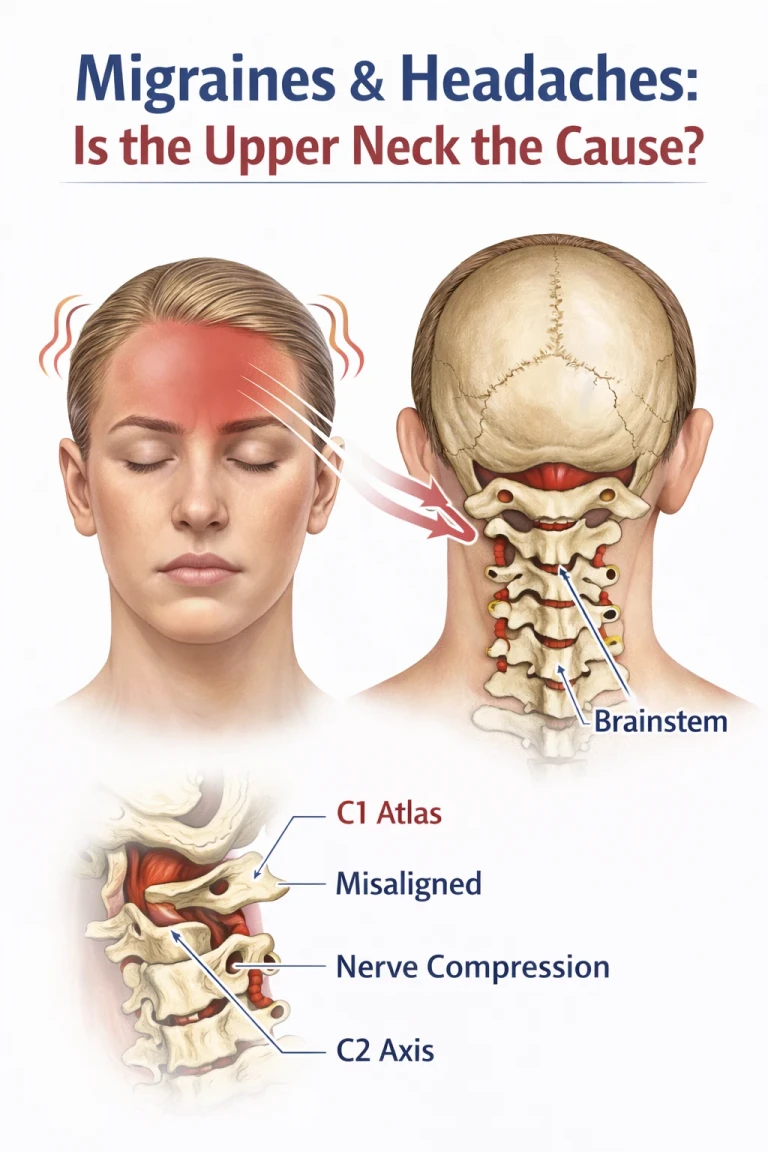
The upper cervical spine plays a critical role in balance.
The joints of C1 and C2 contain dense proprioceptive receptors that send positional information to the brainstem.
If misalignment alters this signaling, it can confuse the vestibular nuclei — the brainstem centers that regulate balance.
The result may include:
• Vertigo
• Rocking sensations
• Floating feelings
• Motion sensitivity
When combined with Eustachian Tube Dysfunction, this can make symptoms feel overwhelming.
Hearing Loss and Fluid Regulation
Chronic ear pressure can sometimes progress to hearing changes.
Fluid buildup in the middle ear may impair vibration of the eardrum.
The brainstem and autonomic nervous system influence:
• Blood flow
• Lymphatic drainage
• Fluid regulation
If mechanical stress affects this regulatory center, pressure and fluid imbalance may persist.
Correcting structural alignment may improve the body’s ability to regulate these systems.
Why Medications Often Provide Temporary Relief
Common treatments include:
• Decongestants
• Antihistamines
• Steroid nasal sprays
• Antibiotics
• Ear tubes
These approaches may reduce inflammation or temporarily improve drainage.
But if structural misalignment remains, abnormal tension and neurological stress may continue.
True healing requires addressing the underlying cause.
Precision Upper Cervical Chiropractic Care
Upper cervical chiropractic focuses specifically on restoring alignment at C1 and C2.
The goal is not aggressive manipulation.
The goal is precision.
When alignment improves:
• Brainstem stress may decrease
• Muscle tension may normalize
• Cranial nerve signaling may stabilize
• Fluid regulation may improve
• Pressure balance may restore
The Importance of 3D CBCT Imaging
Every person’s misalignment pattern is unique.
That is why we use advanced 3D Cone Beam CT (CBCT) imaging.
CBCT allows us to measure:
• Exact rotational displacement
• Lateral deviation
• Angular misalignment
• Skull-to-atlas relationship
• Structural asymmetry
Related article
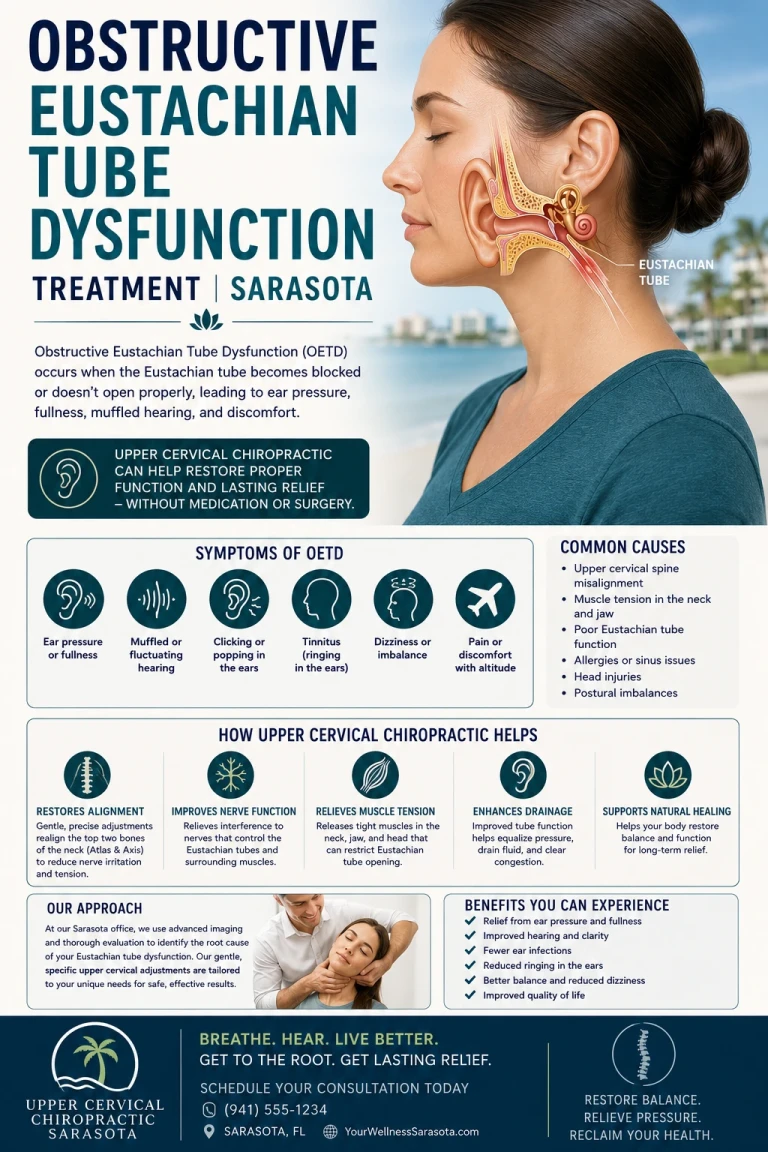
Obstructive Eustachian Tube Dysfunction treatment and the Craniocervical Connection
May 25, 2026Without imaging, adjustments are generalized.
With CBCT imaging, corrections are customized to your specific anatomy.
Precision is critical in cases involving ear pressure and neurological symptoms.
No Twisting, Cracking, or Pulling
Upper cervical care is gentle.
There is:
• No forceful twisting
• No aggressive cracking
• No yanking or pulling
Adjustments are:
• Low-force
• Specific
• Measured
• Based on imaging data
This approach is ideal for patients who are sensitive to movement or already experiencing dizziness.
Objective Testing: When and When Not to Adjust
We use objective tools to determine if misalignment is present.
These include:
Leg Balance Analysis
Neurological imbalance may appear as asymmetry in leg patterns.
Infrared Thermography
Thermal scanning detects heat differences along the spine, indicating nervous system irritation.
Adjustments are performed only when measurable findings indicate misalignment.
This helps promote stability and long-term healing.
Ear Pressure Relief in Sarasota
If you are struggling with:
• Chronic ear fullness
• Tinnitus
• TMJ symptoms
• Vertigo
• Hearing changes
• Neck stiffness
Your ear may not be the true source of the problem.
The issue may lie at the top of your neck.
If you are looking for ear pressure relief in Sarasota and want to explore whether Eustachian Tube Dysfunction may be connected to atlas misalignment, upper cervical care may be the missing link.
👉 Call 941-259-1891 to schedule your FREE consultation
Or click here to book online.
Your ears depend on your nervous system.
Your nervous system depends on proper spinal alignment.
When the foundation beneath your brainstem is stable, your body can regulate pressure, fluid, and balance more effectively.
Relief may begin at the top of your spine.


Leave a comment