

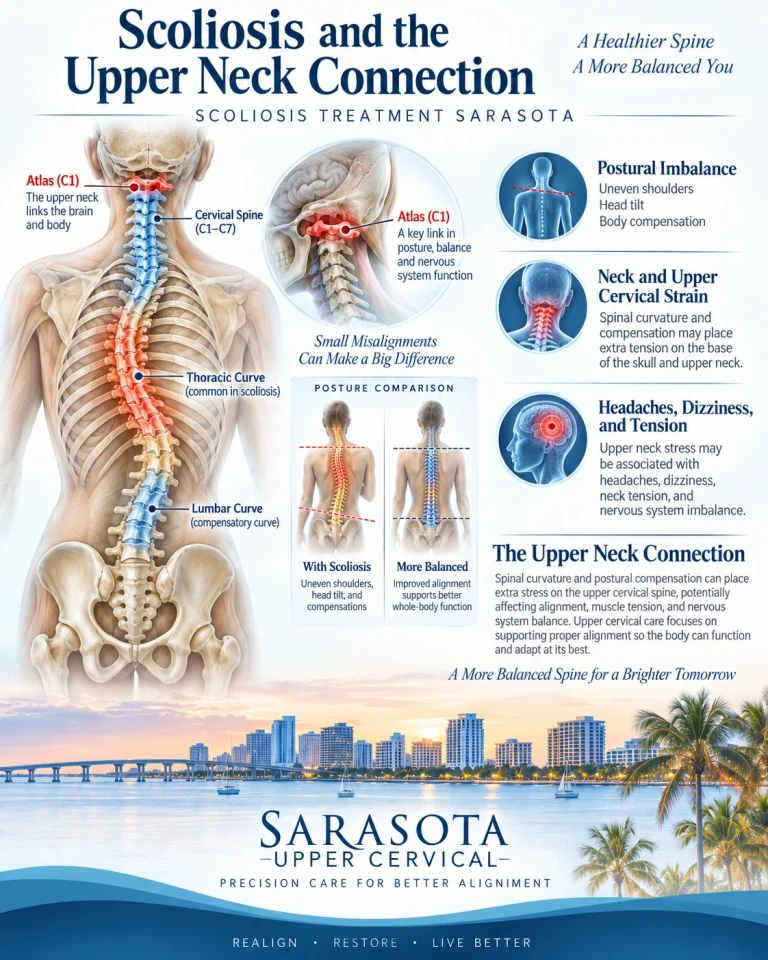
Scoliosis is the condition where I most often have to tell families in Sarasota, Bradenton, and Lakewood Ranch something they were hoping not to hear, and I would rather say it at the top of the article than bury it: chiropractic adjustment does not correct a scoliotic curve, and there is no good evidence that it does.
That is not a comfortable opening for a chiropractic page. It is the accurate one, and for a condition where the treatment window in an adolescent is measured in months of remaining growth, accuracy matters more than usual.
Schedule Your Appointment
Schedule appointmentWhat scoliosis is
Scoliosis is a three-dimensional deformity of the spine — lateral curvature combined with vertebral rotation, which is why it produces a rib hump on forward bending rather than simply a sideways bend. It is defined as a Cobb angle of 10 degrees or more measured on a standing radiograph.
Adolescent idiopathic scoliosis is the most common form, appearing during the growth spurt, with no identifiable cause and a strong tendency to progress while growth continues. It is considerably more likely to progress to a significant curve in girls than boys. Congenital scoliosis results from vertebral malformation. Neuromuscular scoliosis accompanies conditions such as cerebral palsy or muscular dystrophy. Degenerative or de novo scoliosis appears in adults from asymmetric disc and facet degeneration.
Two things determine what happens next in an adolescent: the size of the curve, and how much growth remains. Remaining growth is estimated from skeletal maturity markers including the Risser sign and menarchal status. A 25-degree curve in a child with substantial growth left is a very different clinical problem from the same curve in someone who has finished growing.
What the evidence supports for scoliosis treatment
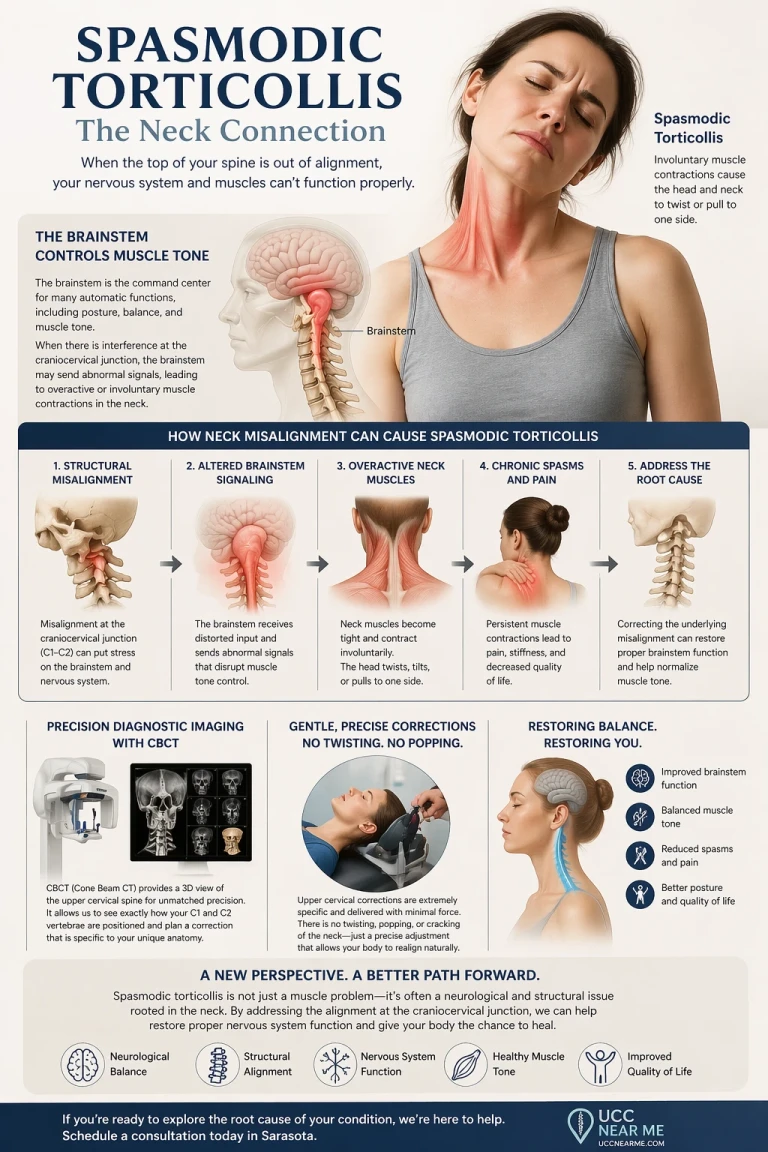
Two interventions have meaningful supporting evidence, and neither is spinal manipulation.
Bracing. The BrAIST trial, published in the New England Journal of Medicine, tested bracing against observation in adolescents with idiopathic scoliosis and was stopped early because the benefit of bracing was clear. Bracing significantly reduced progression to the surgical threshold, and the effect was dose-dependent — more hours of wear produced better outcomes. That trial substantially settled a long-running argument, and bracing is now standard for curves in the moderate range in a growing child.
Physiotherapeutic scoliosis-specific exercises. Approaches such as the Schroth method, which use three-dimensional auto-correction, breathing techniques, and postural training specific to the individual curve pattern, have supporting trial evidence and are recommended in international guidance from the Society on Scoliosis Orthopaedic and Rehabilitation Treatment.
Surgery is considered for curves progressing beyond roughly 45 to 50 degrees, and for smaller curves in specific circumstances.
What is not on that list is generic exercise, generic manual therapy, or spinal manipulation. Systematic reviews examining chiropractic and manipulative treatment for scoliosis have consistently found the evidence insufficient to support a claim of curve reduction. Where improvements have been reported, they have come from uncontrolled case series without the design needed to distinguish treatment effect from natural variation or measurement error.
Cobb angle measurement itself has a known measurement error of roughly five degrees between observers, which means any claimed improvement of a few degrees is within the noise. Anyone showing you before-and-after films with a small difference should be asked about that.
Why the timing point is a safety point
Related article
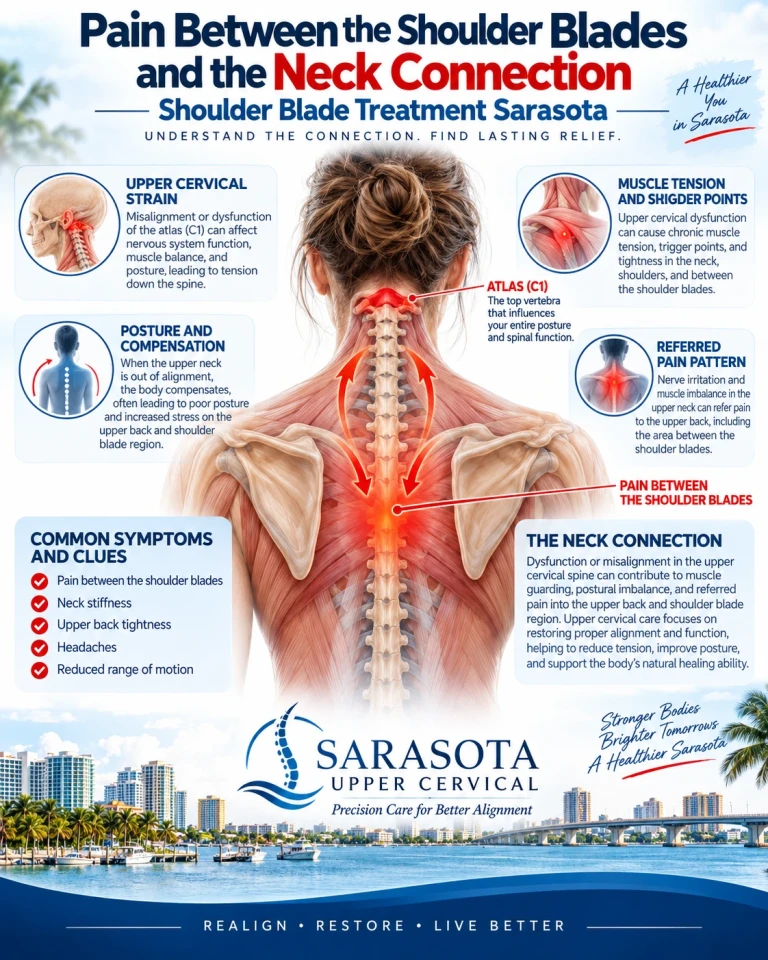
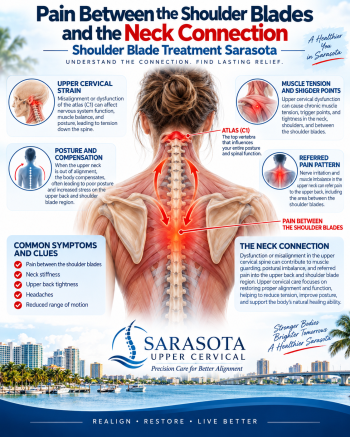
Pain between the shoulder blades and the neck connection | Shoulder blade treatment Sarasota
Sep 19, 2026
This is the reason I write about scoliosis with more urgency than most conditions.
The window in which bracing works closes when growth stops. A curve that progresses during a period of treatment that could not have changed it is a curve that may have needed bracing and did not get it. Time spent on an ineffective approach during active growth is not neutral — it is the one resource that cannot be recovered.
If you have an adolescent with a curve, the appropriate care pathway is orthopaedic or scoliosis-specialist assessment with serial radiographic monitoring, bracing where indicated by curve size and remaining growth, and scoliosis-specific exercise therapy. That should not be delayed for anything offered here.
What upper cervical care can and cannot honestly offer
Addressing symptoms and compensations. This is where a legitimate and much narrower role sits, and it applies mainly to adults.
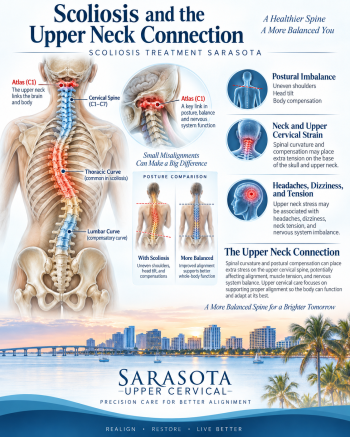
People with scoliosis frequently develop neck pain and headache, and there is a mechanical reason. A curve in the thoracic or lumbar spine displaces the shoulders and trunk, and the body compensates above it to keep the eyes level and the head balanced — because the visual and vestibular systems demand a level head, and the upper cervical spine is where that final correction is made. The result is a sustained asymmetric load on the atlanto-occipital and atlanto-axial joints and the suboccipital musculature.
Addressing that compensation can relieve neck pain, headache, and suboccipital tension. It does not touch the curve. In adults with degenerative scoliosis who are past any question of progression management, symptomatic care of the compensations is a reasonable thing to pursue.
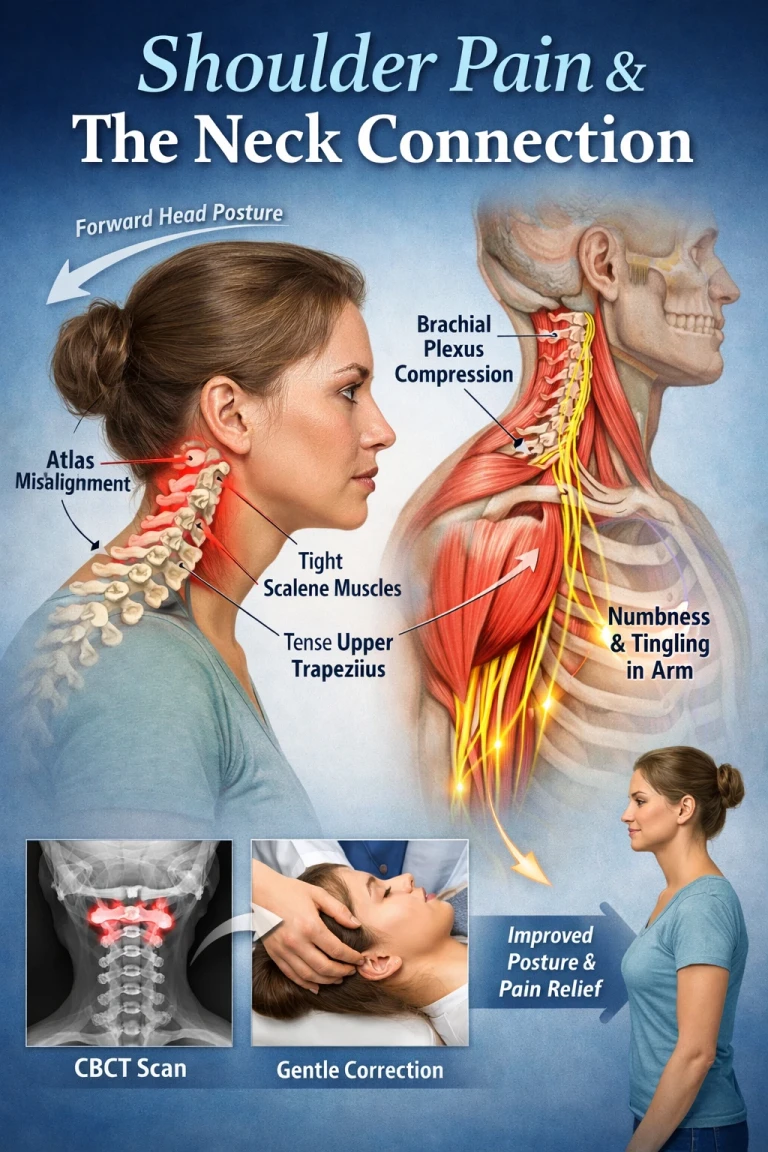
There is also a screening role. Scoliosis is frequently first noticed by someone examining a spine for another reason — uneven shoulders, an asymmetric waist, a rib hump on forward bending. Adam's forward bend test takes seconds, and identifying a curve in a growing adolescent and referring promptly is genuinely valuable.
Precision and knowing when not to adjust
Upper cervical correction involves no twisting, no popping, no cracking, and no pulling of the neck. Cone beam computed tomography measures the three-dimensional position of the atlas and axis against your own anatomy so a correction is calculated rather than estimated. Objective measures — leg length assessment, cervical range of motion, postural and balance measurement, and thermographic pattern tracking — determine whether a correction is indicated and whether it is holding. When it is holding, no adjustment is given.
Two cautions. Radiation exposure matters in adolescents undergoing serial imaging over years, and any additional imaging should be justified rather than routine. And in adults with degenerative scoliosis, osteoporosis is common and forceful spinal technique is inappropriate where bone density is reduced or unknown.
An evaluation in Sarasota
If your child has a curve, the appointment that matters is with an orthopaedic or scoliosis specialist, and it should be soon. If you are an adult with scoliosis carrying neck pain or headache from the compensations above your curve, an upper cervical evaluation may help with those symptoms specifically — and I would be clear with you at the outset that it is not treating the scoliosis. To discuss whether that makes sense in your situation, call 941 259-1891.
Dr. Drew Hall, Upper Cervical Chiropractor
Serving Sarasota, Bradenton, and Lakewood Ranch, Florida
This article is for general educational purposes only and is not medical advice, a diagnosis, or a treatment recommendation for any individual. Scoliosis requires diagnosis and management by qualified medical providers, and adolescents with curves require orthopaedic assessment with serial monitoring while growth continues. Bracing and physiotherapeutic scoliosis-specific exercises are the conservative interventions with supporting evidence, and treatment should not be delayed or replaced by chiropractic care during the growth period, when the window for effective intervention is limited. Upper cervical chiropractic is an area of focus within chiropractic; it is not a board-recognized specialty, and no claim of specialization or superiority is made or implied. There is no evidence that chiropractic adjustment corrects a scoliotic curve or prevents its progression, and no such claim is made here; any role described is limited to symptomatic management of compensations, principally in adults. Cobb angle measurement carries an inter-observer error of approximately five degrees. Forceful spinal technique is inappropriate where osteoporosis is present or bone density is unknown. Cone beam computed tomography is used as a precision measurement and analysis tool, not as a stand-alone diagnostic device. Individual results vary and no specific outcome is guaranteed. Seek prompt evaluation for a curve in a growing child, rapid progression, an atypical or painful curve, or any leg weakness, numbness, or change in bladder or bowel control. Always consult a qualified healthcare provider regarding diagnosis and treatment.
Leave a comment